


Last week, while I was covering interesting news at a conference in Denver, Kaseya was making interesting news at a conference in Sydney.
The news, about three new MCP servers, was interesting to me, certainly. It was probably interesting as well to Channelholic readers aware of how much attention I’ve dedicated to MCP this year, not to mention Kaseya partners with an interest in MCP, like this guy. And it should be of interest to Kaseya’s competitors too, as well as anyone else who makes software for MSPs.
I’ll explain why momentarily. First, some basics:
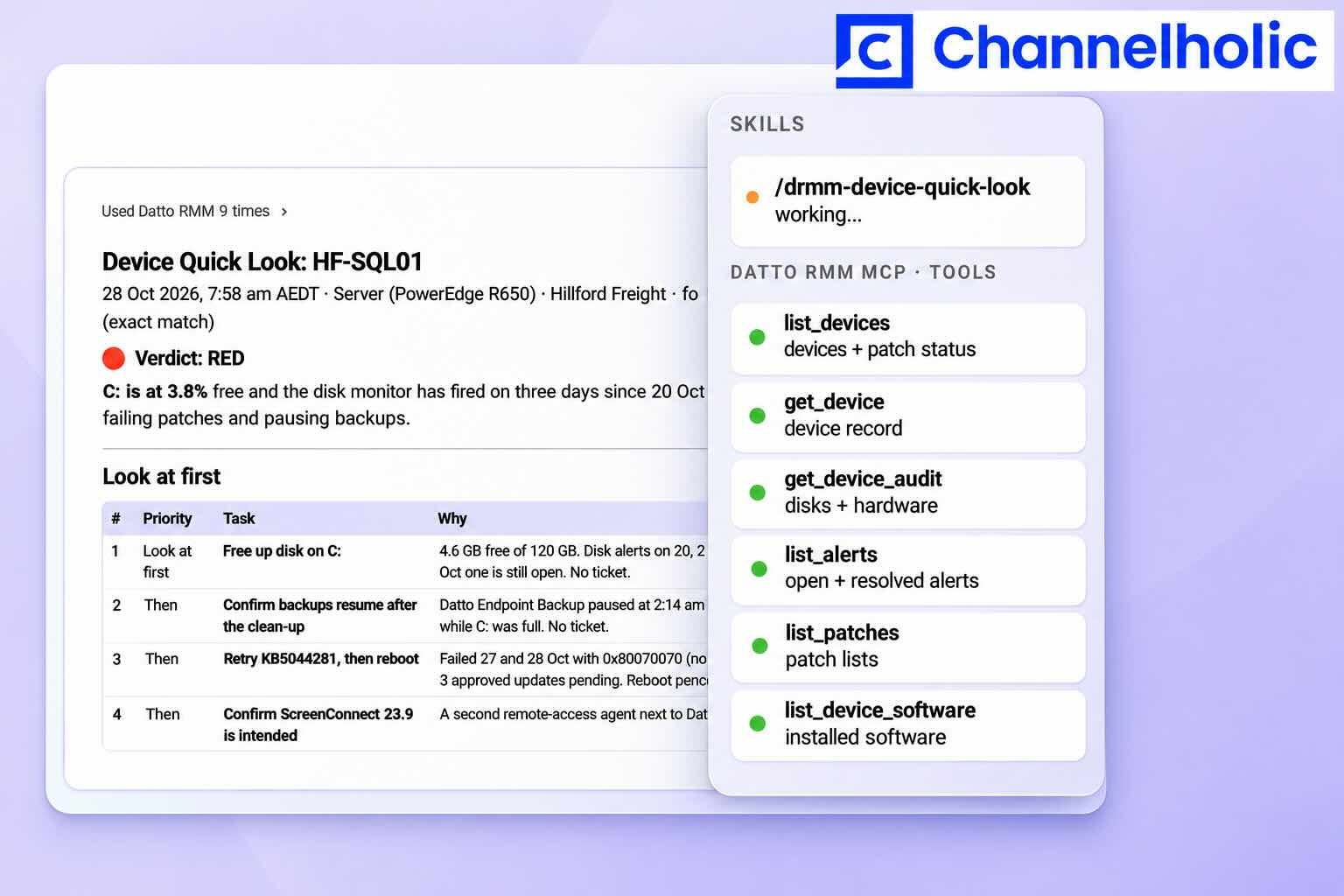
The MCP servers, Kaseya’s first, connect MSPs to Autotask, Datto RMM, and IT Glue via Claude, ChatGPT, and other AI chatbots.
They’re accompanied by 17 pre-built skills for tasks like checking the patch status of supported endpoints, researching newly opened tickets, and documenting newly closed tickets. “They’re effectively recipes for things we believe that a lot of our customers are trying to do that aren’t supported extremely well in the products, especially when we look cross-product,” says Johnny Ghibril, Kaseya’s general manager for RMM.
Introduced as alpha releases earlier this year, they’re now in broader early access and scheduled to go GA at some point in Q1.
They’re available on GitHub, along with the skills, free of charge but won’t necessarily be free forever. According to Ghibril (pictured), Kaseya plans to use them down the road itself to power new “AI-native experiences” (more on that in a bit), at which point it might start billing for token consumption.

But then you knew most of that just by reading Kaseya’s press release. The interesting part of the news from where I sit is what it adds to a story that’s been building since at least April when N-able shipped an MCP server and invited people to use it as a headless conduit to its products, much as Slide did last year. Over the months that followed, Syncro and NinjaOne have shipped MCP servers too, and ConnectWise has one coming.
Meanwhile, per earlier posts here, Rewst and TD SYNNEX have both been floored in recent months by how much usage their MCP servers are getting, usage impressive enough for Rewst to shift development resources from its web interface to its MCP interface and for me to wonder how long it’ll be before most of what MSPs do with tools like Rewst’s, N-able’s, and NinjaOne’s happens agentically, invisibly, and far from the most strategic work those MSPs spend their day thinking about.
I got a chance to explore the matter with Ghibril (who was recovering from a brutal cold, btw, but gamely agreed to speak with me anyway) a few days before Kaseya’s Sydney conference. His thoughts added clarity to Kaseya’s take on four questions about MCP and the future of managed services:
Question 1. Is MCP as surprisingly popular as I’ve been suggesting? Yes, though not to the same degree everywhere.
“Demand is almost universal, but the real practical use cases and the [partners] that consider it core are what we consider the strategic or larger MSPs,” Ghibril says.
That’s consistent with what Kaseya CEO Rania Succar told me over a year ago when she noted that companies like New Charter, Integris, and Evergreen with the money and resources to build heavily customized tool stacks are both enthusiastic MCP early adopters and increasingly unlikely to buy solutions without MCP support.
“It’s a strategic imperative,” says Ghibril, “versus in the smaller MSPs, where they see it as a benefit, but it doesn’t define how I select my toolset.”
Question 2. Do traditional UXs still matter? Less and less as far as the largest MSPs are concerned, according to Ghibril, based in part on what a few of them told him over dinner not long ago.
“Literally, their vision going forward is that your UX is irrelevant to me. I’ll build my own experiences, but I need the tools to be able to build those experiences myself,” he says.
Question 3. Do integrated MSP software suites still matter? Again, not for the big boys. “Especially in the larger space where they have a lot of collected tools, they pick best in class,” Ghibril says. “They’re not always integrated ecosystems, and they build a lot of those integrations themselves.”
Question 4. OK, but what about the long huge tail of MSPs that are neither mega nor mega mega in size? Yes, Ghibril says, integrated software suites like Kaseya’s do and will continue to matter to all but the most sophisticated providers. MSPs can in theory use MCP to integrate best-of-breed suites like their largest peers, but Kaseya thinks most of them shouldn’t and ultimately won’t.
“It’s one thing to be able to have a conversational interface in which you can solve problems for your customers, but can you really have a conversational experience that you build and house and maintain that is highly scalable?” Ghibril asks. “Building a good, reliable experience isn’t easy.”
And there’s that word “experience” again. It’s roughly synonymous with workflow and comes up a lot with Ghibril, because he believes it’s experiences, rather than interfaces, that will soon separate winners from losers in managed services software.
“We’re all going to use the Claudes. We’re all going to use the ChatGPTs. We’re all going to use the Copilots and Muses, or whatever,” says Ghibril, underscoring that he’s expressing an opinion versus speaking for Kaseya. “The issue I think that pertains to us now is in the absence of your ability to innovate and create a moat using the interface that you build, the experience becomes really the big differentiator.”
The experiences Ghibril’s team is building, he adds, will orchestrate workflows like onboarding new users across Kaseya’s RMM, PSA, documentation, and other tools seamlessly, scalably, and reliably, not to mention invisibly most of the time.
And sure, MSPs can build experiences like that themselves, as the biggest ones already do, Ghibril concedes. “They’ll still need a highly reliable patching engine. They’ll still need highly reliable monitoring. They’ll still need agents,” he says, and they’ll need all that to be secure and tightly integrated.
“That’s why we’re looking at the platform as a set of functions that come together to complete the jobs to be done that the MSP wants to do,” Ghibril says, versus a suite of products that technicians sit in all day.
Those functions will remain critical, moreover, even if MSPs encounter them indirectly through APIs most of the time, he adds. “There’s still an immense amount of value in the tools that we’re exposing.”
Want more about Kaseya’s take on MCP?
It awaits you here on the latest episode of MSP Chat, the podcast I co-host, along with a timely, AI-oriented interview with Proofpoint cyber expert Andy Syrewicze. And when you’re done listening to that, head on over here for more similarly insightful conversations with industry thought leaders.

Longwave’s “department of sometimes” approach to AI governance
Some things have gotten worse in AI this year, others have gotten much worse, and others still have gotten terrifyingly worse.
Want to know what’s gotten better in AI? Governance.
Or, rather, the fact that MSPs are finally taking governance seriously. When I wrote my first story of the year on the topic back in March and then ranted about it on MSP Chat a few days later, the striking thing about AI governance was that for something pretty important to anyone with IP to protect or privacy regulations to comply with, it sure didn’t seem to interest managed service providers all that much.
That was Longwave’s experience too in June when it spoke with potential partners at Pax8’s Beyond event in Salt Lake City, where its AI governance solution officially debuted. And now?
“The world has entirely changed,” says Pete Skurman (pictured), the young company’s CEO. Pretty much every MSP who visits a Longwave expo hall booth these days is shopping for an AI governance solution, he observes. “That’s really different. It’s really exciting.”

It also inevitably leads to a first question: “Why Longwave?” The answer goes straight to what the company considers to be its primary differentiator.
“We don’t want to be seen as the department of no,” says Skurman.
Meaning the people who sternly enforce rigidly written policies that ban people from using AI tools they like, anywhere and anytime, a strategy that sounds smart but can be self-defeating for reasons Denisia Pereira, of Longwave investor Top Down Ventures, has explained.
“When guardrails are blunt, binary, on or off, with no visibility into why a request got blocked, legitimate professionals don’t stop doing the work. They route around the restriction,” she writes. Meaning the strict guardrail you set up didn’t actually reduce your client’s risk. “It just moved the work somewhere with less oversight.”
Indeed, Skurman observes, good luck using similarly blunt prohibitions against older forms of shadow IT. “It’s pretty difficult, except in a highly confidential federal environment, to block Gmail and to block Amazon,” he says. “Just the same way, it’s kind of difficult to block ChatGPT and Claude.”
So Longwave doesn’t.
“We don’t force you to block ChatGPT or Claude at the network layer,” Skurman says, noting that Longwave’s software doesn’t even operate at the network level. Instead, using a desktop agent and browser integrations, the system monitors AI activity at the edge of the network and acts only when it sees someone using an unsanctioned tool for something dangerous.
“I don’t need you to stop using Claude. I don’t need you to stop using ChatGPT,” Skurman says. “If you’d like to use them to plan a vacation, if you’d like to use them to do general business research, that’s fine.” If you’d like to use them to build a spreadsheet full of customer data or refine a new product design, on the other hand, Longwave takes action.
But judicious, nuanced action. Say you or your client thinks DeepSeek is just too risky a model for use at the office.
“If I visit DeepSeek, a block pops up and says, ‘This tool is out of policy. Review your policy. You can’t go any further,’” Skurman explains.
Now say your next move is to ChatGPT even though you work at a Copilot shop. Longwave won’t stop you so much as prod you in the right direction by emphasizing that you’re accountable for whatever happens next.
“The nudge that people see on the screen says, ‘This tool is unapproved. You’re responsible for what you do here. You shouldn’t be doing work in this tool,’” Skurman says. And if you insist on doing work with it anyway, he notes, you must read and acknowledge your company’s AI use policy before proceeding.
Still want to use ChatGPT? Longwave will let you right up until you do something involving PII, credit card numbers, file uploads, or something else similarly sensitive. “That information never gets to OpenAI servers,” Skurman says.
Or Longwave’s servers, for that matter. “We remove all of it at the edge,” Skurman notes. Before you know it, he adds, using the tool you were supposed to be using in the first place has become the path of least resistance.
MSPs appear to appreciate that strategy, along with the fact that Longwave’s software is multi-tenant, white label, and sold exclusively through the channel.
“This has really been a year of hypergrowth for us,” Skurman says, noting that the tool comes with functionality MSPs can use to help newcomers to the system inventory AI use at their company and define safe, nuanced access policies. Many partners, he adds, find delivering that service a great entry point for building an AI practice.
“I’m oftentimes the first dollar of AI revenue that an MSP ever generates,” Skurman says.
Over on Business of Tech
Host Dave Sobel is readying his best, toughest questions for the next guest on the weekly live episode he does every Wednesday.
That guest is me. Join us both December 2nd at 3pm ET to hear what we get into, which is sure to focus heavily on some of the many topics I’ve been writing about since my last appearance on the show.
Tune in on LinkedIn here or YouTube here.
Let’s talk
When not writing this newsletter, I’m chief analyst at Channel Mastered, a consultancy that helps vendors build, grow, and optimize thriving MSP channels. Wrestling with a channel challenge? Hit me up here: rich@channelmastered.com.

Also worth noting
Nothing much going on this week other than a little pre-holiday this and that. Hope you all had a great Thanksgiving.
Cisco and OpenAI have launched Shirudo (“shield” in Japanese), an open source project designed to defend vulnerable systems without reboots while permanent patches are developed and implemented.
According to research from IDC sponsored by Microsoft, SMB partners generate $7.33 for every dollar of Microsoft AI revenue, a touch below the $7.44 multiplier for all partners. Lots more data here.
ThreatLocker has received FedRAMP Class C (Moderate) certification for its dedicated government cloud deployment.