


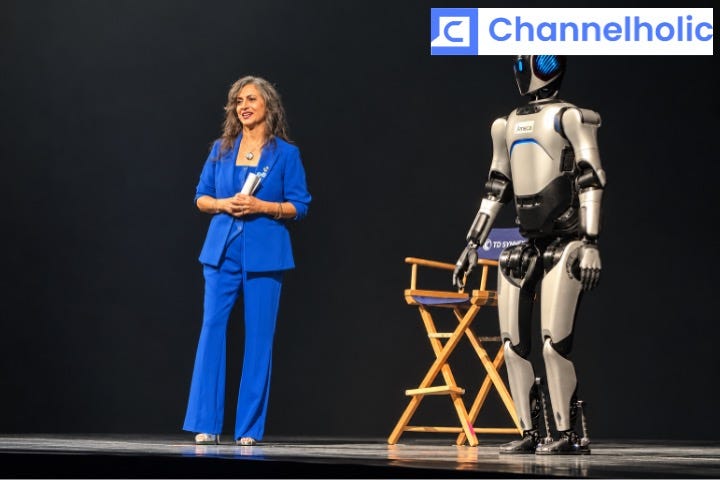
That Reyna Thompson, TD SYNNEX’s North America president, was joined onstage by a co-speaker for part of her keynote presentation at the distributor’s recent Inspire event isn’t unusual. That the co-speaker in question was a 152-lb., 5’ 7” robot named Nylo was.
It was also entirely apt in the context of Thompson’s effort during her 12 minutes of speaking time to define a new identity for the business she helps lead, one that bridges the gap between the functions the company performed in the past on its way to becoming an $80 billion a year industry giant and the function it must perform in the future to grow even larger.
Those earlier functions are familiar to everyone in the channel. Broadline distis like Tech Data and SYNNEX (which merged to form TD SYNNEX in 2021) started out, famously, as “a warehouse and a bank,” meaning a place for resellers to buy lots of products from lots of vendors and get the financing needed to make those purchases.
“Distribution helped build this channel through reach, buying power and logistics, and relationships developed over decades,” Thompson said in her keynote.
In more recent times, the broadlines grew broader still by adding SaaS apps, cloud infrastructure, and a wide range of services. Circa 2018, in fact, Tech Data regularly insisted in interviews with me that it was no longer a distributor at all so much as a “solutions aggregator” capable of providing everything partners needed to turn a collection of products into an integrated, value-producing system.
The role TD SYNNEX seeks to fill now, however, goes beyond mere aggregation in ways that reflect both growing technological complexity and shifting end user expectations.
“The next evolution of distribution is orchestration,” Thompson declared during her keynote.
It’s an overused word, she then rightly observed, before providing TD SYNNEX’s definition. “An orchestrator does three things,” Thompson said. “Looks ahead, removes friction, delivers outcomes.”
And in that order. Orchestration, unlike aggregation, has a beginning, middle, and end. The beginning part involves identifying future opportunities. Sometimes, Thompson explained, that involves sifting through masses of vendor data, transaction records, consumption figures, and renewal dates for hidden end user demand signals, as Ingram Micro does as well to great effect (its Intelligent Digital Assistant, discussed here most recently, generated roughly $1 billion of incremental revenue for the company in its latest quarter).
Other times, however, looking ahead involves forging a path for partners into an emerging technology segment. Like robotics, for example, a market soon to be worth over $40 billion globally, according to IDC, and promising enough to merit that cameo appearance by Nylo. A robotics solution, Thompson noted, is more than just a robot.
“It’s the compute and the sensors and networking, security, integration, services, financing,” she said. Delivering all that—at the right time, in the right sequence, and in pre-validated combinations—is how TD SYNNEX “removes friction” for its partners.
“The robot is what we see,” Thompson said. “The value comes from understanding the work, choosing the right technology, and bringing the ecosystem together around the outcome.”
Which brings us to orchestration’s last and most critical step. Products, in TD SYNNEX’s view, are worth little individually, and solutions are worth only marginally more if they don’t accomplish something useful. Outcomes, as in measurable returns versus potential ones, are what end users will pay for and keep paying for over time.
“Competitive advantage is moving away from whoever can sell the technology and towards whoever can turn it into a recurring business outcome for the customer,” said Robert Abramitis, TD SYNNEX’s North America CFO, during a keynote presentation. “The technology is where it starts, the outcome is where the money is, and the route to that revenue already runs through you.”
Widening that route, TD SYNNEX believes, requires an orchestrator.
People plus platforms
AI, whether physical or generative, is undeniably impressive. To a point anyway, noted Thompson in her keynote.
“It can’t build trust. It can’t develop and invest in relationships. It isn’t curious, and it isn’t creative,” she said. Applied properly, Thompson continued, AI should enhance those attributes in users rather than erase them.
“We have an awesome opportunity right now to redefine how the channel works in this next era,” Thompson said. “And as we do, we have a responsibility to preserve the humanity of this business, to protect the judgment, the trust, the creativity, and relationships that make this channel work.”
Meeting that responsibility while simultaneously sating the channel’s appetite for on-demand, AI-powered assistance from distributors is a balancing act we explored after last year’s Inspire that came up a lot this year too.
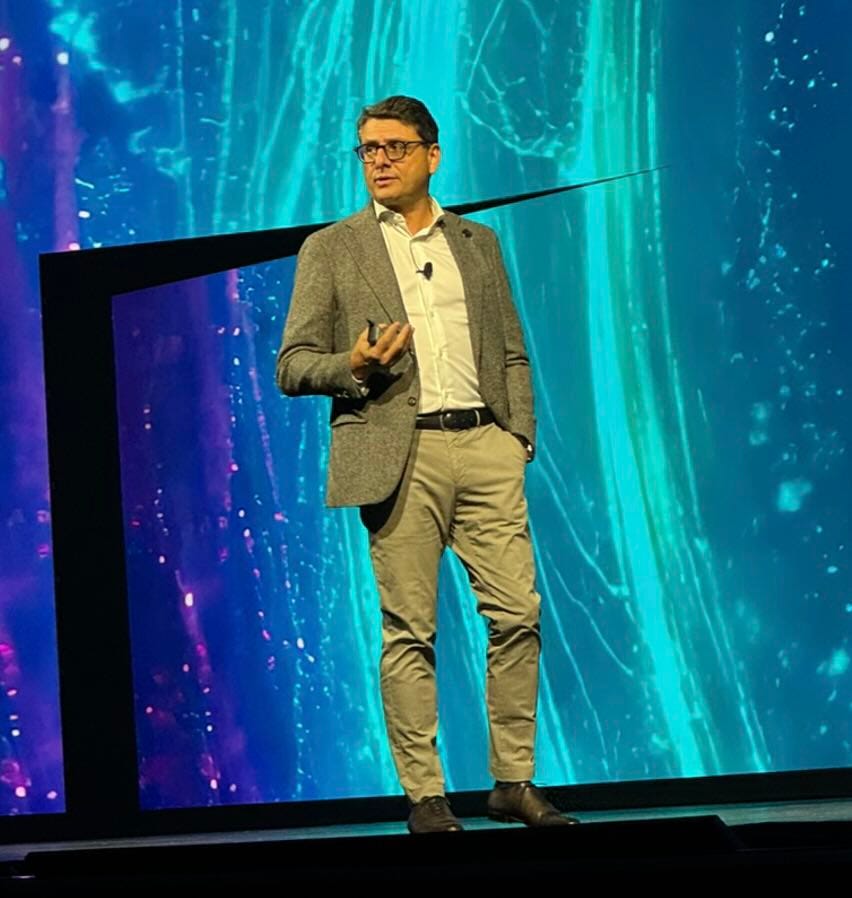
“We live in the digital world, so we need to have the right platforms to deliver 24x7 self-service support,” said CEO Patrick Zammit (pictured) during a keynote appearance, “but people will continue to be critical for the success of our business”. TD SYNNEX invests both in people and in platforms as a result, he added.
The latest investments on the digital side, announced during Inspire, add an array of capabilities to PartnerFirst, the core element in the company’s “omnichannel” partner engagement strategy.
“It’s a way for TD SYNNEX to meet you where you work,” said Thompson of PartnerFirst, which debuted at last year’s Inspire. “It provides one front door, multiple routes in.”
Those include an online portal, a mobile app, API connectors, and now an MCP server that lets partners access PartnerFirst data via Claude, ChatGPT, and other AI chatbots. Nate Herz (pictured), TD SYNNEX’s regional CIO for North America, has been a little startled by how much usage that new option has gotten.
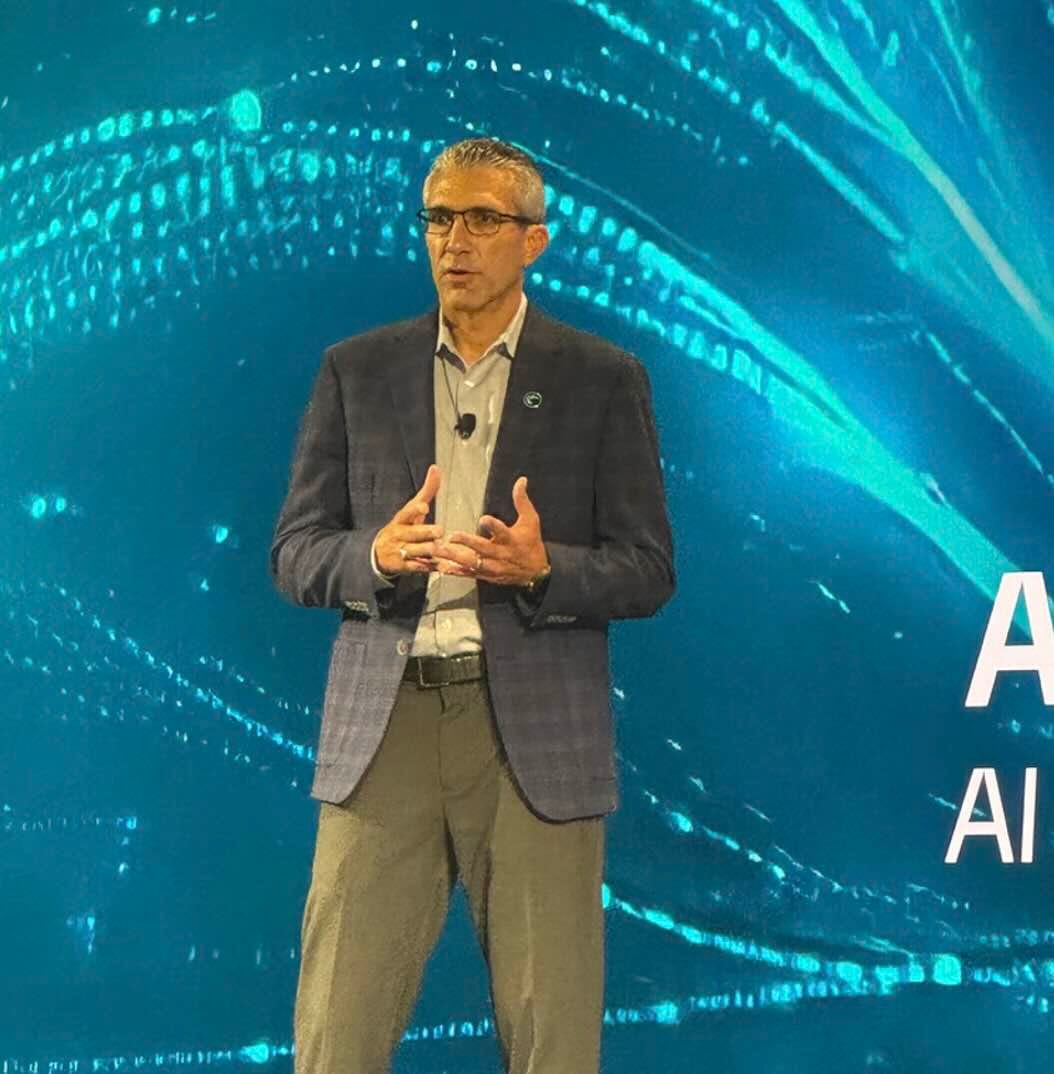
“I was a little bit worried that we were too far in front of the market,” he says. “What we’re seeing though is that’s not the case. There’s a lot of demand for MCP, much more than I had expected.”
Agent Bridge, a PartnerFirst enhancement that also went GA during Inspire, is designed to let less sophisticated partners design and deploy custom agents for tasks like quote management and order tracking.
“It’s not like a one, two, three, click, and you’re done, but it’s definitely a very guided process and would allow a non-technical user to set up an agentic workflow,” says Herz, adding that here too users have been more ambitious than TD SYNNEX anticipated.
“One of the things that was a little bit surprising is we saw people start to use the capabilities to do much more deep product discovery and almost solution engineering than we had expected,” he explains. “Things like, ‘my environment is this and I’m outfitting for an operation of 200 people, suggest a server infrastructure.’”
Partners more comfortable engaging with PartnerFirst via its old-school online portal picked up 40 new agentic features ranging across product search, pricing, availability, and beyond during Inspire as well. More such updates are coming too, as Herz expects PartnerFirst’s web-based front end to be the primary way plenty of users access the platform for a long time.
Though maybe not forever. “I do see the headless experience becoming much more prominent and perhaps the most prominent way in the future,” he says.
Businesses have a FinOps problem. AI’s making it bigger.
Businesses are pretty excited about AI. So much so that their AI spending has doubled in the last year, according to Boston Consulting Group.
And it’s not just big businesses. Small and midsize ones appear to be excited about AI too, enough so that 71% of them worldwide are using AI at present, according to Pax8’s latest SMB AI Report.
Indeed, pretty much everyone in the business world is excited about AI, as they always are initially for new technologies, observes Francisco Criado (pictured), TD SYNNEX’s SVP of security, cloud, and AI.
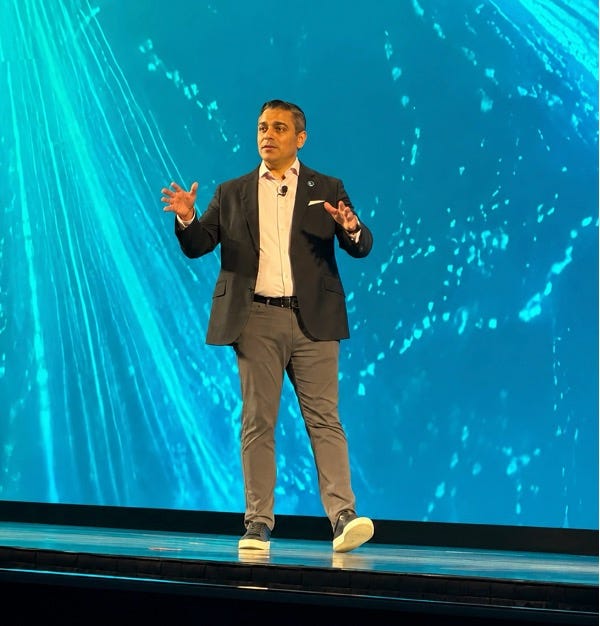
“Then they start getting the bills,” he says.
Which can be painful. Fully 57% of the U.S.-based SMBs Pax8 surveyed, in fact, have received an unexpectedly high AI bill in the past year, and 25% have received more than one. It’s a familiar problem, and not just to regular Channelholic readers. Veterans of the cloud explosion that preceded the current AI explosion know this nightmare all too well.
“AI has become the new unmanaged cloud spend, and I think we’ve all seen that movie before,” said Criado during an Inspire keynote. “Costs sprawled, nobody owned the bill, and we had to invent a whole new discipline to bring it under control. AI is doing that again, only faster.”
And in two separate places: the off-prem data centers that host frontier lab LLMs and the on-prem servers and even laptops that businesses increasingly use to host closed and open-source models locally. Businesses, it seems, no longer have a cloud FinOps problem or an AI FinOps problem. They have a FinOps problem, period, and need an answer to it everywhere they encounter usage-based pricing.
It’s a realization Criado and his team came to in May during partner meetings at TD SYNNEX’s High-Growth Conference that led just five months later during Inspire to the release of FinOps Fusion, a new service offering centralized visibility into cloud, AI, and local consumption spending.
“You get one view, one console where you get that entire estate,” Criado says.
Even if you bought the components of that estate from someone other than TD SYNNEX. “We can go into any environment and we can look at wherever that sits on premise or in the cloud,” Criado says. “There are no limits to it.”
At present, Fusion identifies rather than remediates overspending, but users get detailed recommendations on cost-cutting next steps like downsizing over-provisioned infrastructures, leveraging reserved instances, and replacing always-on environments with usage-based architectures.
Partners that neither can nor wish to manage that for clients themselves, moreover, can outsource the job to TD SYNNEX. According to Criado, they’ll reap customer retention and satisfaction rewards either way. AI spending is largely tied to token usage, he noted during his keynote.
“Whoever helps customers see, understand, and govern that usage helps them save money, unlock value, and scale AI responsibly. That opportunity belongs to you.”
It’s a revenue as well as stickiness opportunity, moreover. Users of TD SYNNEX’s pre-Fusion cloud FinOps service typically cut spending 15-30%, and Criado expects AI FinOps savings to be even higher. Converting some of that bounty into FinOps-as-a-service fees, he notes, is a good deal for everyone involved.
“That’s usually a pretty easy value proposition and most customers are going to say yes, because they’re going to save money regardless,” Criado says, adding that it can drive AI solution sales too.
“If you’re a line of business owner and you’re trying to convince your CFO and everybody to do an AI project, knowing that you have visibility and you’re not going to get surprises gives you a much better probability of getting your projects approved,” Criado says. It also helps you quantify what your customers are getting for all those tokens they’re consuming, he adds, which is the question everyone in IT needs to have answers for.
“Everybody likes the shiny new object and everybody gets really excited, but eventually we’re going to have to be able to show, as an industry, the ROI.”
Over on Business of Tech
Host Dave Sobel notes that laptop fleets are growing older thanks to rising PC costs, and service desk automation software is papering over many of the reliability issues associated with that fact.
Put those together. The aging machine generates friction. The person using it works around most of that friction. What they do report gets triaged, often resolved by software, and sometimes marked closed when it isn’t fixed. Each step is reasonable on its own. Together, they move the cost of an old fleet out of the one place the customer reliably looks, which is the ticket report.
So the cost is real, and it grows. It’s just paid in lost minutes and quiet workarounds, not in anything the client sees.
MSP ARC Comes (Partly) Into View
My last TD SYNNEX story, about the company’s recently established MSP sales group, ended with a tease. There’s a new MSP partner program on the way, I wrote, before adding that I couldn’t tell you much about it.
Not because I’d been sworn to secrecy, mind you, but because Augie Staab (pictured), who runs that new MSP unit, wasn’t ready to share details yet.

That changed a little at Inspire. There’s still a lot I don’t know about the forthcoming program, but I do now know that:
It will be called MSP ARC
ARC is short for “assess, review, cultivate”
TD SYNNEX is excited enough about MSP ARC’s potential to have given Jessica McDowell, its SVP of North America marketing and digital customer success, several precious minutes of general session time at Inspire to talk about it
The biggest clue we got about the new offering is in that “assess, review, cultivate” bit. Among other things, Staab says, MSP ARC will help members assess the state of their business, review how they’re engaging with TD SYNNEX at present, and cultivate more ways to grow together.
Staab shared a few more details about what partners can expect during an appearance at Inspire on MSP Chat, the podcast I co-host. “They’re going to have peer-led cohorts, they’re going to have in-person sessions, and then they’re going to actually have a way to formulate goals of what they’re trying to accomplish to grow their business,” she said.
The best way to learn more about the partner program and everything else Staab’s team is working on right now is to listen to the whole conversation for yourself right here.
Speaking of MSP Chat…
Could it be true that an MSP exiting his business left $1 million on the table by intentionally accepting the second highest bid? And that he was very wise to do so?
Yes and yes, according to the also very wise Amy Babinchak and Rayanne Buchianico of M&A consultancy B2 MSP Advisors during an interview on the latest MSP Chat episode. Listen to that show here and then browse our many other equally compelling episodes here.

Let’s talk
When not writing this newsletter, I’m chief analyst at Channel Mastered, a consultancy that helps vendors build, grow, and optimize thriving MSP channels. Wrestling with a channel challenge? Hit me up here: rich@channelmastered.com.

Also worth noting
NinjaOne has introduced an agentic AI technician that analyzes RMM data to recommend troubleshooting and remediation actions, along with an MCP server.
Slide co-founder and chairman Austin McChord is now interim CEO as well.
Former WatchGuard CEO Prakash Panjwani is now CEO of Acronis.
Varonis has agreed to be purchased by Proofpoint for $6.3 billion.
Proofpoint has also added capabilities to its MSP platform designed to help users protect Microsoft 365 customers against AI-related security and data risks.
AI Defense, from Sophos, is designed to discover unauthorized AI usage and provide real-time protection against risks associated with it.
Over 75% of security decision makers and practitioners surveyed by N-able still don’t fully trust AI-powered remediation without human review.
Arctic Wolf’s new AI-powered Aurora Adaptive Threat Protection uses intent-based detection to identify and disrupt ransomware, credential theft, and other attacks early.
Also from Arctic Wolf: The company has added shadow AI discovery, third-party security integrations, and a new generative AI assistant to its Aurora Superintelligence Platform.
Also also from Arctic Wolf: The company’s forthcoming SwarmView capability will let customers examine how AI agents and human analysts collaborate to investigate threats, validate findings, and make security decisions.
OK, one more: Arctic Wolf and Veeam have partnered to integrate BDR telemetry from Veeam Data Platform into Arctic Wolf’s Aurora Superintelligence Platform.
Speaking of Veeam, its new Intelligent ResOps for Microsoft 365 solution helps users monitor AI agents, reduce storage costs, improve compliance, and more. Editions for Veeam Data Platform and Okta are in private preview.
IRONSCALES and Todyl are partnering to embed the former’s AI-powered email security technology within the latter’s security platform for MSPs.
Torq, covered here earlier in the year, has introduced a channel partner program designed to help security service providers compete with traditional SOC vendors.
Blacksmith InfoSec is the latest vendor to achieve preferred vendor partner status in MSP OneShare, which I profiled here several weeks ago.
Keeper Security and Tenable have announced an integration designed to streamline cloud risk identification, vulnerability assessment, and remediation.
Ingram Micro has received a U.S. patent for its Vendor and Customer Agnostic Framework, a component of its Xvantage platform.
Alexander Thomson is the new CEO and Patricia Tantow is the new CMO at CloudBolt.
New capabilities in LogicMonitor’s Envision and Edwin AI platforms combine infrastructure monitoring, digital experience insights, governed remediation, and more.
Blancco’s new agentic AI platform is designed to automate IT asset lifecycle management and secure data erasure workflows.