


MIT, you may recall, published a study last summer reporting that 95% of generative AI pilot projects ended in failure. A cascade of headlines declared it evidence that AI is a bottomless money pit. I declared it bullshit.
Not because a statistic cited as authoritative seemingly everywhere was based on a mere 52 qualitative interviews so much as because the authors defined success for AI projects as a “marked and sustained productivity and/or P&L impact” within six months.
We’re talking pilot projects at large, complex businesses. Anyone expecting to see marked and sustained financial returns in six months was 95% sure to be disappointed for reasons the late Paul A. David explained way back in 1990, when the two hot tech letters were “PC” rather than “AI.”
People anticipating overnight productivity gains after plugging in the first PCs, he wrote, were committing the same foolish error made decades earlier by factory operators expecting overnight productivity gains after plugging in the first electric dynamos. Transformative technologies don’t deliver transformative results after you plug them in. They deliver transformative results after you’ve completely reimagined everything you do around their transformative capabilities, which takes time and more than a little courage.
Just ask Ingram Micro.
“We took a 47-year-old company and we broke it,” said Bill Brandel, Ingram’s EVP and president for North America, during a conversation at the distribution giant’s ONE conference in Denver last week.
Largely, he continued, because the meteoric rise of hyperscaler marketplaces left it no choice. “We said, ‘we’re going to rebuild to be relevant in the future, because if we keep doing what we’re doing right now, we will not be here in another handful of years.’”
Paul Bay saw that danger looming when he became Ingram’s CEO just shy of five years ago, and he entrusted Sanjib Sahoo, president of the company’s global platform group, CTO Dham Pathervellai, and chief data officer Mukund Gopalan, to avoid it. Their plan for doing so entailed turning a $57 billion company close to half a century old into an AI-native startup with automated workflows, tooling capable of anticipating end-user needs before they materialize, and account managers with the bandwidth to discuss growth with partners instead of order status.
Pretty much everyone thought it was nuts.
“Our frontline associates were like, ‘Are you kidding me?’ Our partners were like, ‘Are you kidding me?’ Our vendors were like, ‘What are you doing?’” recalls Brandel (pictured), who may have harbored a few private doubts of his own.
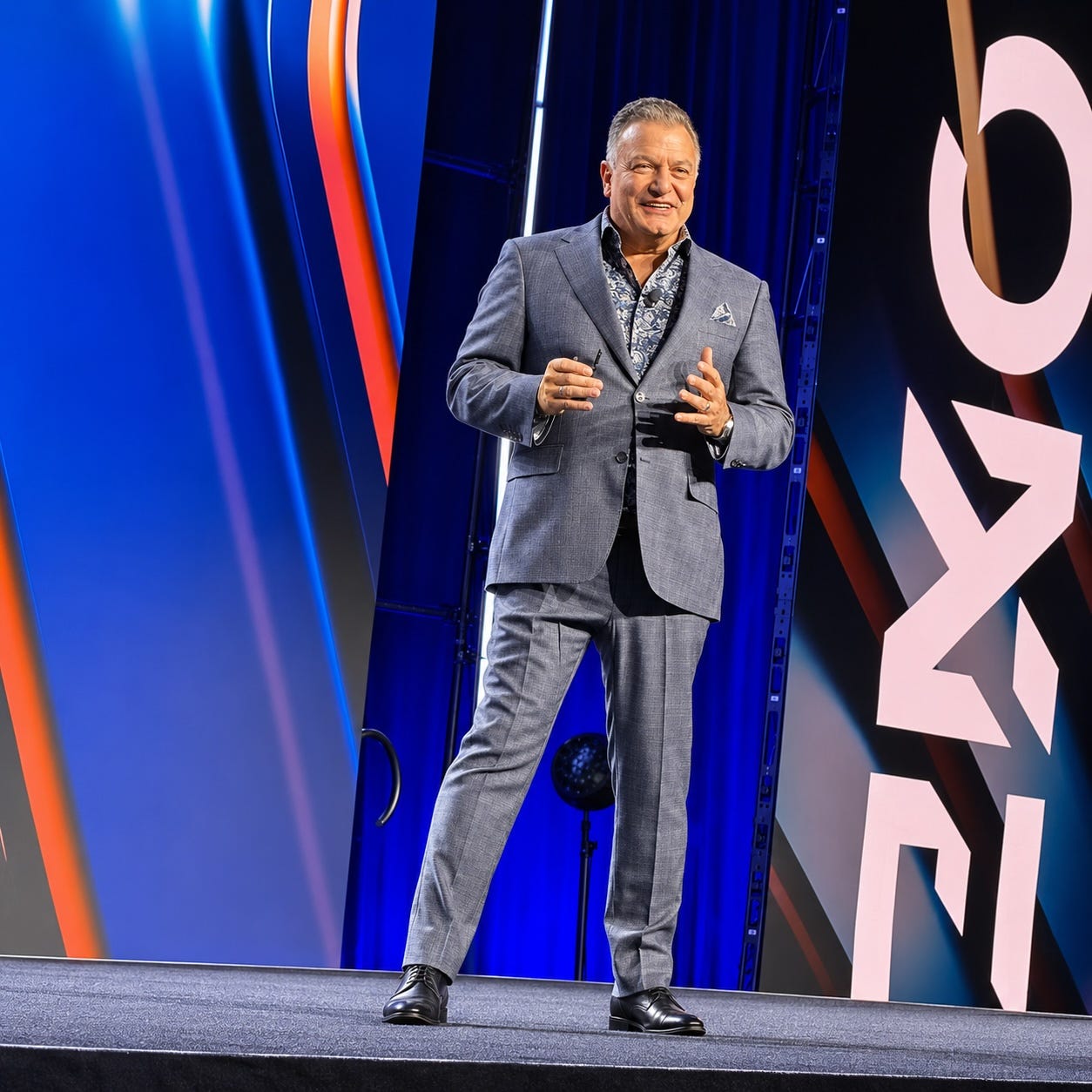
“Put yourself in my shoes,” he says. “I’ve been here for 29 years.”
By the final day of last week’s conference, though, Brandel was far enough past any doubts he’d once had to wrap Pathervellai in a giant, onstage bear hug minutes after watching a demo in which Ingram’s new MCP server swiftly assembled a complex, multi-vendor quote in response to a natural language request.
“Do you have any idea the amount of time that would’ve taken when I was a sales rep back in ’97?” Brandel asks. “He did it with a prompt and it was done in seconds. It was the coolest thing I’ve ever seen.”
It’s taken a lot of work to get there, though. Four-plus years, in fact, spent aggregating 4 petabytes of data, building a platform (called Xvantage) around it, erecting an AI factory that’s pumped out over 400 customized models to date, and retraining its account managers to lead deep, strategic partner conversations.
It didn’t all go smoothly. “There were some challenges,” Bay acknowledged drily during a Tuesday main stage appearance. Because of course there were, Brandel notes.
“When you do a change like this, you disrupt relationships,” he says.
The end results speak for themselves, though. Net sales for Ingram North America soared 31.5% in the company’s latest quarter with little to no accompanying increase in operating expenses. And yes, AI infrastructure spending accounted for a lot of that success, but not all of it. In ways I’ll explain shortly, the “intelligent operating system” Bay and his leadership team bet big on half a decade and untold millions ago played a part as well.
“That’s why I get so pumped up,” Brandel says. “This is really happening. I can see it. It’s right in front of my face. I love it.”
Intelligence junkies
MIT would almost certainly have regarded Xvantage as yet another failed AI pilot six months after its launch. Designed to suggest accessories during hardware orders, for example, the system was smart enough to know that a display was a good add-on for a laptop purchase but not smart enough to suggest one small enough to fit on someone’s desk.
“It was kind of comical,” Brandel says.
No one’s laughing now. Xvantage made poor recommendations initially because it had data but not context, something it’s been accumulating in growing volumes ever since. Today, the platform uses the 250 million signals it ingests each day to fuel what Sahoo calls an “intelligence flywheel” that alerts partners to revenue opportunities like an aging server rack or approaching renewal date and turns the ensuing outcome into new context for additional, increasingly precise, sales suggestions.
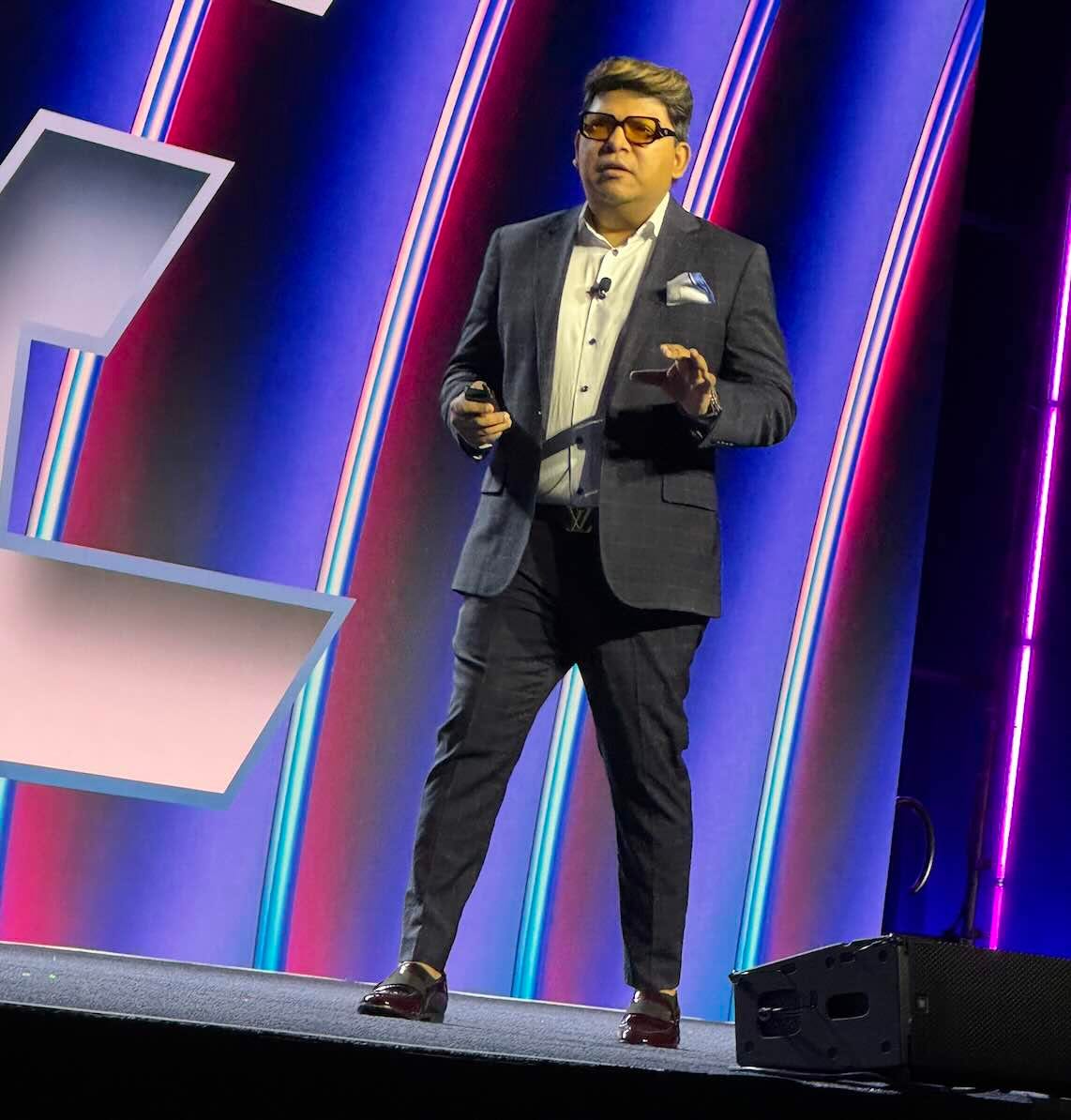
“Every action from you makes us understand better and makes the next transaction better because we are learning with you,” said Sahoo (pictured) during a keynote appearance.
You can see that dynamic pay off just by looking at the numbers associated with IDA, the “intelligent digital assistant” Ingram uses to uncover otherwise hidden sales openings. IDA was producing “hundreds of millions” in revenue a quarter, according to Bay during a press conference at last year’s ONE. By Q2 of this year, that figure had risen to more like $1 billion and by Q3 it had reached something on the order of $1.5 billion, or about 10% of global sales.
And that’s just IDA. A younger initiative named IONA, as in “Intelligent OS for North America,” is slowly exerting a similar impact. Proposed by Sahoo as an experiment in July, IONA is basically a daily 15-minute call in which subject matter experts from across Brandel’s organization meet with members of the platform group to dream up new applications of Ingram’s growing intelligence trove.
Like optimizing inventory management, for example. “Inventory is one of our biggest assets. We have a lot of it. And managing inventory accurately has always been a challenge,” Brandel says. “We buy what we think we’re going to sell, the market dictates whether or not that’s going to happen, and then inevitably we end up with inventory that starts to age.” Eventually, Ingram has to either sell that inventory for pennies on the dollar or dump it.
“The vendors don’t want it back and customers aren’t going to buy it,” Brandel notes, “so we have to just take that as a cost of doing business.”
But what if we didn’t, someone asked during an IONA call. What if we could spot inventory on track to grow old before it’s actually gotten old, identify partners who have sold that inventory in the past, and offer them a “really smoking deal,” in Brandel’s words, to sell more? It took Ingram a few weeks to find out.
“We were able, within one month, to eliminate all of our inventory aged at 120 days,” Brandel says. “We’ve never been able to do that before.”
Wins like that have turned Ingram’s North America leadership team into IONA junkies. “Everybody looks forward to that call,” says Brandel, adding that people are continually sending him fresh what-ifs between calls too.
“My phone goes off all hours of the day.”
Now it’s your turn
Sahoo thinks Ingram can get even better returns on intelligence by augmenting the mostly reactive insights it currently gives partners in response to ordering activity with proactive insights as well.
“So using intelligence with our vendors, we figure out where are the big opportunities we see, where are the attach opportunities, refresh opportunities, and then prioritize those,” he said during an interview recorded at ONE for MSP Chat, the podcast I co-host.
Experiments with that approach are yielding promising results already, according to Brandel, citing a beta test in which Ingram notified a targeted list of partners—agentically—about new ways to boost sales of an unnamed OEM’s products.
“We were able to get a far greater click-through rate on the programs that we sent,” he says, “and the conversion-to-order ratio was the highest we’ve ever seen.”
Ingram’s pretty sure there are more such stories to come, sure enough in fact to have shared some pretty rosy projections about the future with Wall Street analysts in September:
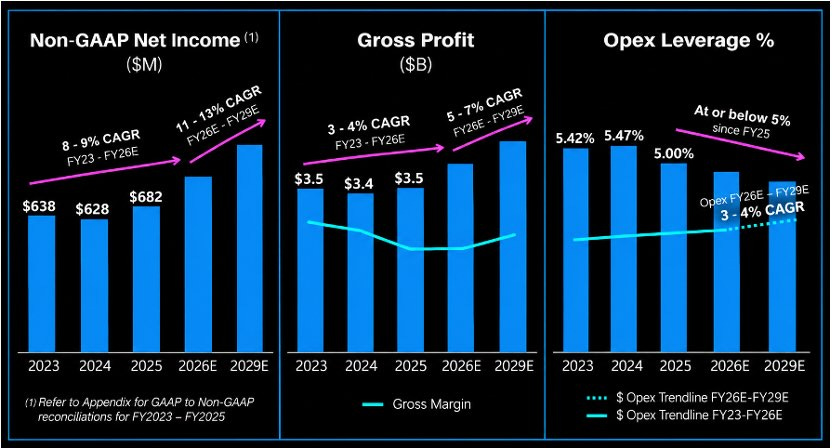
Yet as Brandel and others are quick to concede, Ingram can’t realize those projections on its own. “The only way we’ll do it is if the partners that come to this event and the ones that weren’t able to make it continue to grow,” Brandel says. Which in turn will only happen, he continues, if they take advantage of Ingram’s new tech, accumulating intelligence, and retrained associates.
Which only a minority do at present. Getting more to follow their example is a top goal for 2027, and a big part of why Brandel spent much of his ONE keynote outlining the hard, sometimes painful work involved in rebuilding his organization around AI.
“I was kind of telling people, ‘here’s our journey and here’s why we did what we did to remain relevant’ without coming right out and saying, ‘you all have to do this too,’” he notes.
But they do have to change the way Ingram has, Brandel contends. “You keep doing it the same old way and this industry’s going to pass you by.”
MCP is all about C
Pathervellai ran the MCP demo that so delighted Brandel for a reason, the same one that explains why Bay and Sahoo among others touted MCP from the stage and why an MCP connections hub occupied a prominent hunk of floor space in the ONE expo hall: partners integrating with Xvantage via Ingram’s recently introduced MCP server are growing their business with the company nearly 4x faster than those who aren’t.
According to Sahoo, moreover, smaller partners are benefitting even more than big ones. “A small MSP who does not really have the budget to invest in big AI within their company now, very easily, can get access to market intelligence,” he said during his MSP Chat podcast appearance.
That intelligence, Ingram believes, is what differentiates its MCP server from the many others like it. “Anybody can do MCP,” Sahoo says. Only Ingram’s version, he argues, combines the generic “M” and “P” parts of the acronym with “C” available nowhere else.
“AI can be rented,” Sahoo explained during his keynote. “Context cannot be.”
Context will also play a critical role in Xvantage’s forthcoming agentic commerce functionality, which when fully rolled out will allow a vendor’s agents and Ingram’s agents to send collaboratively designed sales campaigns to a partner’s agents for delivery to an end user’s procurement agents. If everything works as intended, the upshot will be a future in which Xvantage makes money for partners largely behind the scenes. ConnectWise, per a recent post, is a bit uncomfortable with that kind of automated, headless interaction. Sahoo is racing toward it.
“Xvantage has become, and I want it to be more and more, an invisible operating system,” he says. “Our actual customers will come for events, but the agents will do the real work in their company.”
Sahoo can imagine that vision becoming reality to at least some degree by next year’s ONE. Brandel is a little more circumspect.
“That’s the north star. That’s where we’re headed,” he notes. “I can see it and I believe everything that man says, because so far, he has never steered me wrong.” And yet, given that a lot of partners are still adopting today’s Xvantage, it could be a while before they’re ready for tomorrow’s.
“Realistically, there’s still a fair amount of work that has to happen,” Brandel says.
Sahoo in his own words
I’ve alluded twice now to an interview recorded with Sanjib Sahoo during ONE for the MSP Chat podcast. Why not tune in at this point and hear the whole thing for yourself, along with a second interview with John Bak, Ingram’s VP of credit solutions for North America, about funding the AI solutions end users increasingly crave? It’s all here in the latest episode, and joined here by a slew of earlier conversations with movers and shakers in IT.

An FDE by any other name
Last week’s post noted the billions of dollars industry giants like Anthropic, AWS, and Microsoft are spending on forward deployed engineers. Ingram, according to Bay, plans to join them.
“We’re in the process of co-investing with the hyperscalers around this to help put those resources, those technical resources, on your behalf closer to your end users,” he said during his stage time at ONE. “It’s not inexpensive,” he added.
It’s also not entirely new. “We’ve had a very similar motion with our sales and services engineers for some time now,” notes Patrick O’Dell (pictured), Ingram’s executive director of cloud services and sales. It pays off too, he adds, especially for Ingram’s Microsoft partners.
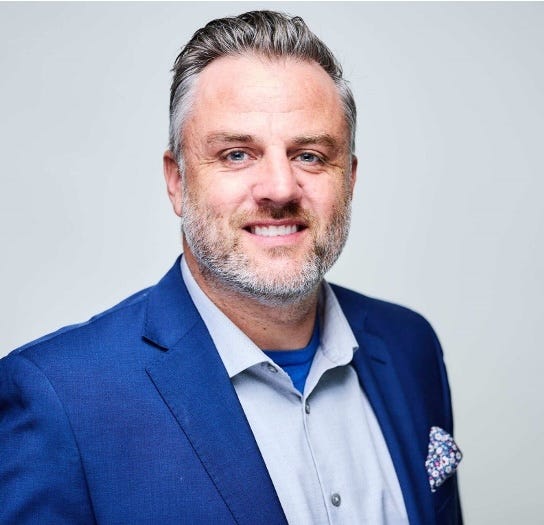
“Microsoft partners that leverage our sales engineers and the professional services engine that we’ve built are growing five times faster this year than the ones that aren’t,” O’Dell says, perhaps because they’re not shouldering the expensive burdens of hiring full-time FDEs.
“They’re hard to find and they’re hard to keep,” O’Dell notes.
Like everything else at Ingram these days, he adds, the sales engineer role has become both more proactive and more strategic in the last year. The original idea was to make experts available to partners in need of technical help while closing a deal.
“Now they’re available to build a true partnership at a decision-maker level with a partner to help them drive the right outcomes and results through consistent enablement and internal readiness,” O’Dell says.
Which, AI or no AI, is what partners continue to want.
“It’s really weird if you think about it, because we’ve always thought automation is going to kind of strangulate how often and how frequently we need to interact with the customer,” O’Dell says. But it hasn’t.
“People still want to have that more strategic conversation,” O’Dell observes. “This gives them that opportunity.”
Over on Business of Tech
My coverage of this year’s Black Hat event included a warning from Jon France of ISC2 that the vulnerability-finding genius of the latest LLMs heralded a forthcoming “patch storm.” What it didn’t include, but should have, was a parallel warning that lots of patches means lots of breakdowns in systems and services people depend on every day. That’s not exactly what Business of Tech host Dave Sobel is speaking about here, but it’s close:
“A patch changes code, and only code. It closes the hole it was written for. It does nothing about whoever already came through that hole, and it can carry a new failure of its own. That used to be manageable, because attackers needed time to work out what a patch fixed, and defenders used that time to install it. AI is taking that time away, and what’s left exposed is everything a patch was never built to cover.”
Also worth noting
Lots of news from Microsoft Ignite last week. Highlight 1/4: Microsoft’s new Microsoft IQ is designed to give AI agents access to organizational data, knowledge, and context.
Highlight 2/4: Microsoft Perception is designed to help organizations protect AI agents, automate cyber defenses, and manage security risks.
Highlight 3/4: The newest Copilot capabilities include Office in Copilot, Copilot Managed Runtime, and an early access edition of Microsoft’s Dots/Duet/Grok Bot competitor, Autopilot.
Highlight 4/4: Microsoft’s new MAI Cyber 2 Flash model is designed to deliver advanced security reasoning and agentic defense capabilities at lower costs. MAI Code 2 and MAI Code 2 Flash aim to bring the same affordability to coding.
Now it’s AWS’s turn. Highlight 1/3: AWS Marketplace now supports AI agent purchasing, conversational software discovery and checkout, automated deployment, and more.
Highlight 2/3: Data as a Service helps AWS partners and their agents discover, subscribe to, and purchase third-party datasets and licensed content.
Highlight 3/3: AWS Revenue Measurement now includes deal-level revenue attribution.
Bedrock, from Top Down Ventures, buys and builds essential IT and digital services firms, starting with Dynamics providers, Fabric/Power BI data consultancies, and Azure cloud providers.
Speaking of AI security risks, only 9% of organizations can discover and classify ungoverned AI across their cloud environments automatically, according to Palo Alto.
Also from Palo Alto: open weight AI provider Applied Compute is its latest acquisition.
AgentSense, from Cato Networks, is designed to identify and stop harmful AI agent behavior in real time.
CyberFOX is partnering with ThreatMate to offer MSPs and IT teams automated penetration testing and exposure management capabilities.
Breach Secure Now products are available through Climb Channel Solutions.
Keeper Security’s new global emergency breach response service helps organizations experiencing active cyberattacks secure credentials, contain threats, and regain control of privileged access rapidly.
AI Visibility & Usage Insights, from ControlUp, is designed to give IT teams a unified view of employee adoption and usage of AI applications.
ConnectSecure now has an agentic AI penetration testing service.
See the problem here? According to Dashlane: 89% of IT and security leaders have at least some confidence they’re aware of every agent employees use, yet 98% of organizations have discovered unknown agents after their deployment.
Impartner has joined the legion of wise companies rolling out an MCP server.
Ivanti has a new MCP server too, along with device management support for Apple and Android operating systems, and more.
Watch out, Salesforce: OpenAI’s new ChatGPT for Sales uses over 30 new and expanded partner plugins to help sales pros identify prospects, manage opportunities, and accelerate sales cycles.
Devicie, which you read about here, has expanded its Microsoft Edge for Business security reporting capabilities across platforms.
MSP-aaS, previously covered here, now backs LastPass password and identity management technology with NOCDOC operational support.
Mega mega MSP Thrive has new managed AI governance and security services.
Mega mega MSP Omega Systems has acquired Chicago-area MSP Framework IT.
Zoho’s new Blended Agents for Zoho Desk gives customer service teams combined access to autonomous AI execution and human judgment.
The latest enhancements to Dell’s AI Factory with NVIDIA expand its infrastructure, data management, and security capabilities, and add support for Azure Local.
GoTo’s Connect AI Receptionist now has digital channel support, AI-powered scheduling, live analytics, and new observability capabilities.
Circulate, from Blancco, is an AI-powered device lifecycle solution designed to help organizations maximize the resale and recovery value of used IT assets.