


When I first got word back in June that Chris Day had a book for MSPs coming in the fall, I assumed it was about AI.
Not because Day posts regularly on LinkedIn about the impact AI is having at ScalePad, the managed services software vendor he serves as CEO. Or because Top Down Ventures, which he serves as chairman, is heavily invested in AI-native startups for MSPs, like Lemhi and Lexful, to name two you’ve met here before.
No, the best reason to assume that any book Day took the time to write at this moment would be about AI is that it’s the biggest issue in IT at present, if not ever, not to mention a topic that’s been dominating conversation in the channel all year.
But having gotten hold of the book—called MSP to MVP: Building Unbreakable Partnerships in the Customer Success Era—a couple of weeks ago, I can now report that I was wrong. It’s not about AI, at least directly. And if what Day says in it is correct and you reading this are an MSP, odds are good you’re wrong too, about at least four pretty important things:
1. You’re offering the wrong services. Because they probably lean hard towards the network, device, and cloud management MSPs have been delivering for as long as there have been MSPs, all of which were already commoditized years before people started assuming (wrongly) that Claude can handle all of that for them. This is the warning at the heart of Day’s book:
Right now, many MSPs are standing at the edge of a gap. On one side is the traditional business model, built around technology, tools and internal efficiency. On the other side is what clients increasingly expect: business outcomes, strategic guidance, and a partner who can help them grow. Crossing that gap is the defining challenge for our industry today.
To complete that journey, Day contends, yesterday’s troubleshooters must become today’s business enablers.
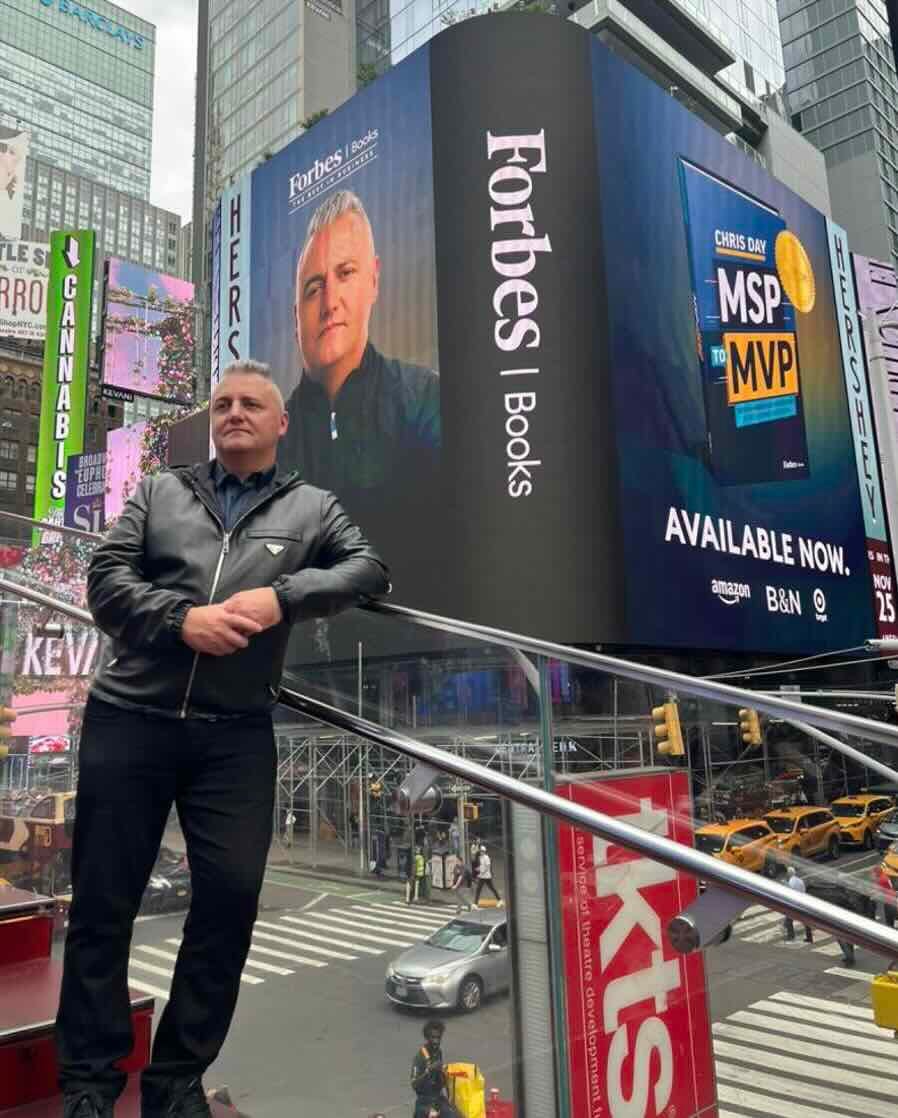
“I don’t think there’s another way forward other than pivoting into advisory,” Day (pictured below) told me during a conversation at a book launch party his publisher held for him in Manhattan recently. If I’m an MSP these days, he said, “I want to replace the commodity with something that’s value added, and I think it’ll end up being a higher margin service.”
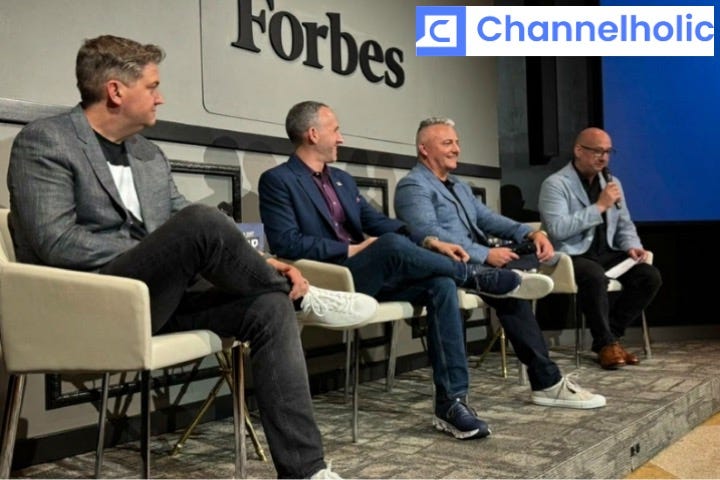
Peter Melby (pictured first from left at the top of this story) agrees. The managed services world’s DNA is all about help desk services. “If that’s the primary DNA that exists in your MSP, you’re kind of screwed for the future,” said Melby, CEO of mega mega MSP New Charter Technologies, during a panel discussion at Day’s book launch. “Customer experience, customer success, the platform, the processes—that’s the center of the ecosystem now.”
2. You’re hiring the wrong people. If winning in managed services is more about driving customer success than managing technology, then MSPs need to hire for a different set of skills than they have before.
“We need people who understand how to go deep with customers,” Melby says.
And are fanatical about keeping customers happy, says Steven Freidkin (pictured second from left at the top of this story), CEO of managed services heavyweight Ntiva. You can find such people in unexpected places too, he adds.
“One of my best hires was maybe 20 years ago, and I met this person at a bar while she was hammered,” Freidkin says. But she was fun and witty and skilled, even while deep in her cups, at retaining information.
“I asked what she did, and she told me that she ran a daycare,” recalls Freidkin. He hired her on the spot, figuring she’d be a natural at managing help desk technicians.
“Where she nailed it was in client success,” he says. “Anything a customer needed, she would own and then she would go and wake up engineers, punch them in the face, whatever had to happen to get them to help that client in that moment.”
Employees that obsessed with customer satisfaction will be at least as valuable to MSPs going forward as AI developers, Freidkin believes, and more valuable than help desk technicians too.
3. You’re making the wrong investments. You are if they’re mostly about making your service desk more efficient, anyway. “I can spend all that time and modernize the help desk only for it to be outdated the moment that I get there,” Melby says. Better to invest in technologies that drive closer client relationships.
Like, for example, the Ntiva Artificial Thought and Language Intelligence Engine (aka NATALIE), a home-grown business intelligence solution filled with customer knowledge from across Freidkin’s company.
“With the data that we now have access to, we can start to get intelligent about what is actually driving challenges for the customer,” he says. “It’s not what you typically think.” When Ntiva asked the system what most stresses customers out, for example, the answer turned out to have nothing to do with network and email outages.
“NATALIE said our customers are most stressed out when they have to terminate an employee,” Freidkin says. Which, upon reflection, makes sense.
“They’re worried,” Freidkin says. “Is this going to happen on time? Is there a security risk? Am I going to replace this person? This is change in the organization.”
Based on that unexpected insight, Ntiva now reaches out to customers immediately after offboarding employees. “We make sure they know proactively that it’s been done correctly and on time,” Freidkin says. They call back the next day too just to say they understand how hard it is to let someone go.
“One or two of those calls and you earn trust,” Freidkin says. “That capital builds up. And with that capital, you get invited in to really be part of that organization.”
4. You’ve got the wrong outlook on the future. Some of you do anyway, according to Day, based on the many gloomy comments he provoked on Reddit after proclaiming on LinkedIn that “there is no better time to be alive as an MSP.” Freidkin found those responses unsurprising.
“The beauty of what technology has done is it’s automated so much process and so much execution that it took away the technical pieces, but now all you’re left with are the human pieces, and that shit’s hard,” he says. It’s also, he continues, a surmountable challenge.
“People who are willing to hustle, work hard, and embrace change are going to win,” he says.
The embracing change part is critical, though, as Day notes in his book. “The MSP industry has faced a moment like this before,” he writes.
There was a time when moving from break-fix to Managed Services felt risky and unnecessary. Many chose to stay where they were. Those who embraced the shift built stronger, more resilient businesses. The transition ahead is no different.
Inspire, in advance
I wrote most of the post you’re reading now on the long trip home to Seattle from TD SYNNEX’s 2026 Inspire conference in Greenville, S.C., which I will have a lot to say about next week. In the meantime, why not get a preview of my thoughts on the latest episode of MSP Chat, the podcast I co-host, and hear Augie Staab, the MSP sales director you met here recently, and Meredith Payne, the distributor’s VP of digital growth and customer success, talk about their latest plans and programs as well?
Not live at press time but coming within hours here along with all sorts of other good stuff like it.

Why Hatz AI’s out of office space
Building AI-powered solutions isn’t the only way for MSPs to become MVPs, but it’s certainly one of them, and Day’s struck by how few MSPs are doing it at present.
“It’s going slower than I expected, and I think the risk of that is that the SMBs just figure it out themselves, which is not good,” he says.
It’s a legitimate possibility, too, because businesses of every size (not to mention their impatient employees) are moving on AI with or without their IT providers, according to Jimmy Hatzell, CEO of Hatz AI, an AI platform provider for MSPs.
“The market has really accelerated,” says Hatzell. “All of a sudden most end customers have one or two people who have started doing stuff with AI, and maybe some companies are doing even more than the MSPs are.”
Hatzell’s pretty sure he knows why. Getting into AI is a lot easier for end users who don’t understand the complexities involved than for MSPs who do.
“There’s a lot of work to do,” he says.
It’s been a while since you’ve heard from Hatzell here, and not for lack of trying on my part or his. He’s been a busy guy. Launched early in 2024, Hatz AI recently climbed past 1,000 partners and is on track to nearly quintuple revenue this year. To accommodate that growth, the company has hired a new president, AWS and Databricks veteran Jim Fanning, to help scale the business and leased a new, bigger headquarters it will soon occupy in Manhattan’s Flatiron District.
So if you want time with Hatzell these days, you pretty much have to corner him in his office, which is exactly what I did during my trip to New York for Day’s book launch. Except that Hatz AI has so outgrown its current office that there’s literally nowhere for visitors to sit, so we met in Madison Square Park instead.

Hatzell has no doubts about what accounts for his company’s momentum, especially among the 10-50 employee MSPs that are its fastest-growing partner segment. Building an AI practice involves answering a lot of deeply unfamiliar questions.
“What models am I supposed to use? How do I make it so I never have to think about what model I use and it just works? How do I make sure I’m secure? How do I make sure I’m not getting surprise bills that are way too big and nobody knew about?” Hatzell asks. “Our expertise is helping small and mid-sized businesses and MSPs figure that out.”
It’s a job that OpenAI, Anthropic, and the hyperscalers won’t take on and that few MSPs would entrust them with even if they did, according to Hatzell. “You don’t want to be locked into a single provider,” he says, noting that Hatz automatically routes tasks to the most affordable yet capable option on a continually updated list of closed- and open-source models.
“We’re scoring and judging new models and new tools on how they perform for small business use cases all the time,” Hatzell says.
All of which helps MSPs gain the control they want and too often lack over AI, he adds, and yet is arguably less responsible for the company’s growth than the help it offers with the biggest AI-related challenge of all right now for MSPs.
“Everyone’s trying to figure out how we go to market,” Hatzell says. Offering the basics, he continues, is an increasingly inadequate answer.
“We’re maturing past the point where the value proposition of ‘we’re going to secure your AI’ is good enough,” Hatzell says. Businesses don’t just want AI, he notes. They want AI-powered digital labor. “How to do that and how to use [AI] for that is not obvious.”
Hatz’s AI solution building tools are designed to make the process easier by allowing smaller MSPs to automate customer workflows without help from the forward deployed engineers that bigger providers like Shield and Evergreen are hiring.
“A lot of small businesses don’t necessarily need an engineer in their office five days a week who costs $1 million or $100,000 or whatever to build out this crazy AI pipeline,” Hatzell says. “What they need is a builder to help them build their invoice reconciliation agents and plans and workflows and just get them going.”
MSPs, meanwhile, need help getting sales going, which is why Hatz recently introduced Activate, a heavily automated prospecting tool. Upload a .csv full of client data or connect it to your PSA, and the system will identify potential use cases for AI solutions and services, walk account managers through readiness assessment calls, and prepare customer-ready proposals. More such updates are coming as quickly as Hatz’s very busy developers can roll them out.
“We’re releasing new features every single week,” Hatzell says.
Over on Business of Tech
Host Dave Sobel is weighing the advantages of vibe coding apps you’d otherwise buy against the disadvantages of having to maintain those apps, much as I did recently:
In plain terms, AI made writing software nearly free and left the cost of owning it right where it was. When you buy, the vendor carries that cost. When you build, someone else has to. And if nobody is named, it lands wherever the software runs.
For most of your clients, that’s somewhere you’re already responsible for.
Dr. Backup will see you now
Hatz AI’s having its greatest impact among 10-50 person MSPs. Nancy Henriquez wants to make an impact on even smaller firms.
“I’m really looking to work with the MSPs that reflect who I was when I was an MSP,” she says.
That was back in pre-pandemic times, when Henriquez drew on grit, trial, and error to turn a fledgling IT shop near Houston into the business she successfully sold to a larger firm in 2021. She’s been lending a helping hand to the industry’s smallest providers ever since, through the sales, marketing, and operations consultancy you read about here last winter, the book she published last fall, the MSP community (called MSP Unplugged) she’s been helping run since June, and now the backup business she acquired two months ago.
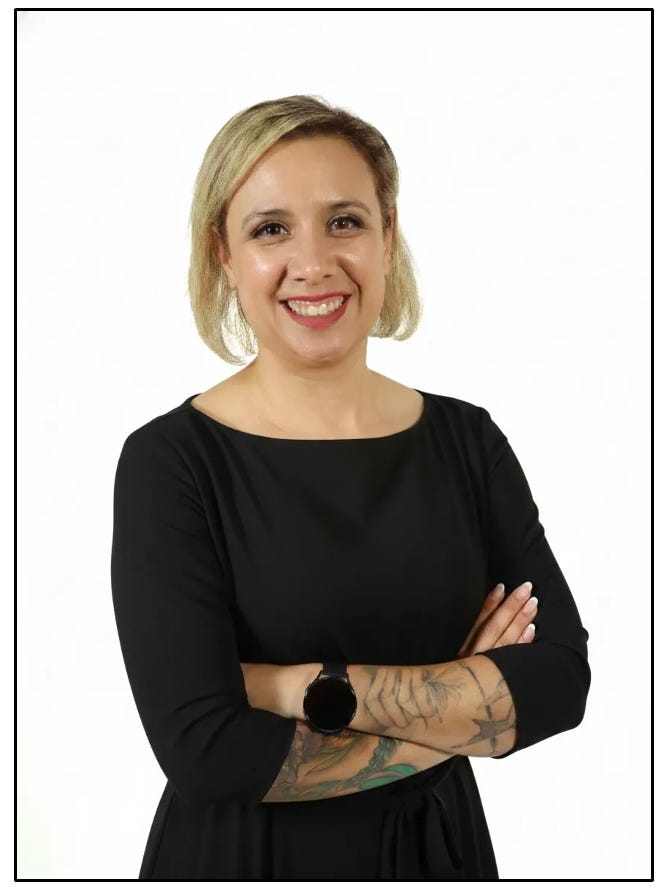
Which is the least likely of her ventures to date. Called Dr. Backup, the company provides fully outsourced data protection services to break-fix practitioners and MSPs too small to handle BDR on their own. Henriquez (pictured) had never heard of it when a friend told her about it, and had little interest in owning it right away either.
“Honestly, I didn’t really see myself being on this side of the MSP world,” she says, and especially not in backup. Then she took a closer look.
“It was a 20-plus year old company, and it was stable, it was profitable,” she says. It also had 100 partners with no more than a handful of employees each and a familiar set of challenges to cope with.
“I immediately saw, ‘OK, that’s where I can really help,’” Henriquez recalls.
Her unconventional plan for doing so treats backup and other services even the smallest MSP must offer as the foundation of a kind of Maslow’s hierarchy of needs pyramid for MSPs that layers on education, coaching, and peer-to-peer mentorship.
“And all of that coming up to the very tippy top of that pyramid, which is self-actualization,” Henriquez says.
The ultimate goal, she continues, is to help tech entrepreneurs who value independence over growth remain independent rather than sell to one of the many investors actively constructing MSP platforms.
“That’s not to say that growth can’t be achieved while remaining independent,” Henriquez says. “I think that it absolutely can, but it takes a community to do that.”
Which is why rolling out a partner program is priority number one for Henriquez at present. “If you resell or are one of the partners that works with Dr. Backup, our partner program will have some of the coaching practices that I have embedded into that,” she says, along with informal monthly member meetings.
“We’ll also bring in experts to help educate and encourage them in the ways that they need, whether that be sales support, whether that be marketing assistance, or whether that be operational assistance,” Henriquez adds.
Product upgrades, including integrations with popular RMM and PSA solutions and remote assistance, are on the roadmap too, along with white labeling, which Henriquez knows from personal experience matters a lot to MSPs who don’t want something as critical as backup to look like it’s coming from someone else.
“It’s their own, and we’re acting as their team,” she says.
And doing so 24 x 7, moreover. “I’m staying up at night so you don’t have to,” Henriquez says.
Let’s talk
When not writing this newsletter, I’m chief analyst at Channel Mastered, a consultancy that helps vendors build, grow, and optimize thriving MSP channels. Wrestling with a channel challenge of your own? Hit me up here: rich@channelmastered.com.

Also worth noting
CyberFOX has acquired Microsoft 365 tenant monitoring and hardening startup Optimize365.
Smart move from a cyberinsurer: Cowbell has introduced Risk Advisor, which gives policyholders personalized, prioritized recommendations for reducing cyber and AI risks.
Cisco’s new agentic collaboration features include AI teammates in Webex and a framework for giving customer service agents context across interactions.
Arcserve has launched ransomware protection and recovery suites that combine backup, immutable cloud storage, recovery testing, and more.
Agent adoption is outpacing agent governance: only 59% of organizations make agents obey the same governance rules they apply to human users, according to JumpCloud.
HYCU’s free aiR Graph tool is designed to discover AI agents, map their permissions and application access, and identify exposed applications lacking independent backup.
Don’t blame agents for everything: new data from Kaseya finds that 68% of IT professionals call human error their biggest unsolved cybersecurity problem.
Forcepoint and BeyondTrust have introduced an integration that connects identity risk with sensitive data exposure.
Security’s still red hot: Pinpoint Search Group reported that cybersecurity vendors raised $5.26 billion across 104 funding rounds in Q3, up 78% year over year.
Dell’s new AI Data Platform enhancements include semantic definitions, knowledge graphs, knowledge agents, accelerated processing, and more.
CrashPlan has added backup and recovery for Windows and Linux servers and Google Workspace to its small business data protection portfolio.
BackBox’s network cyber resilience platform is now named Kilter and equipped with AI-assisted vulnerability remediation and automation functionality.
TD SYNNEX has acquired BlueStar, a specialty distributor with expertise in mobility, point-of-sale, digital signage, networking, security, and more.
Electronic signature vendor SignWell is the newest addition to TD SYNNEX’s U.S. line card.
The new Parallels Desktop Partner Program and expanded Workspaces Partner Program are designed to help members with customer adoption, technical expertise, and service delivery.