


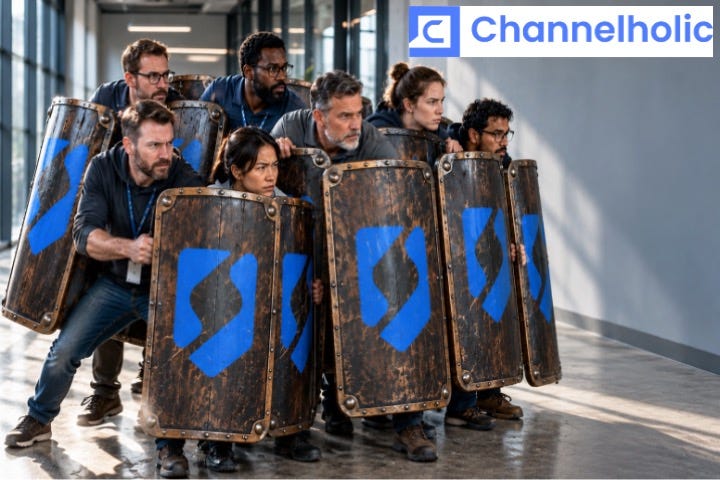
It’s easy to get distracted by the numbers surrounding Shield Technology Partners.
Like the $100 million of funding from Thrive Holdings and ZBS the company launched with last year, and the additional $100 million Thrive poured into the company this February.
Then there are the results Shield has gotten from the AI-powered managed services platform it built with some of that money. Called Forge, the system currently resolves half of all “actionable” tickets (i.e. service-related versus purely informational ones), and does so without a human in the loop 92% of the time. Forge closes comparable tickets 25 times faster than flesh-and-blood technicians do, moreover, with a median resolution time of 16 minutes.
All very impressive (though not wildly different from what Atera’s reporting) but potentially misleading as well if you end up concluding from such stats that Shield’s plan is to convert capital into AI, AI into productivity, and productivity into profits.
“The point of Forge is not efficiency,” says Mayank Jain, Shield’s head of technology.
Indeed, the longer you talk with Shield the clearer it becomes that the most critical piece of its operating model isn’t AI at all. It’s people.
“We, as a company, are long humans,” says Jim Siders (pictured), Shield’s CEO.

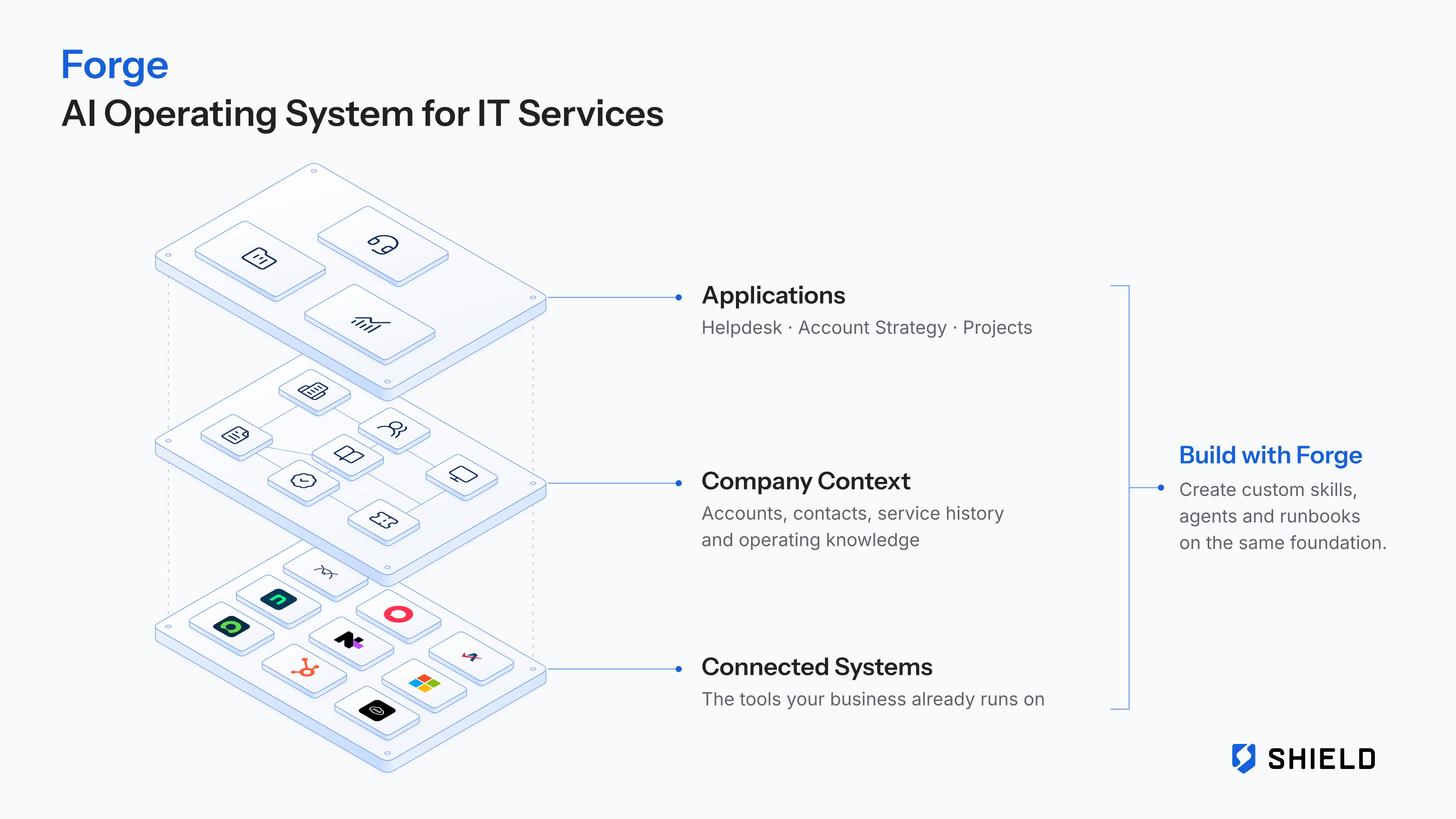
Make no mistake, they’re long AI too. An “AI operating system for IT services” in Shield’s description, Forge is a sophisticated and therefore expensive home-grown platform created by equally expensive developers. Still evolving, the system currently includes an agent that automates the help desk, another that automates project management, and a third that automates account management, as well as a fourth component for building custom skills, agents, and runbooks.
All of that draws on an underlying context layer packed with client data and operating knowledge plus integrations with a stack of RMM, PSA, and other tools that portfolio MSPs can customize to their own preferences.
As Siders and Jain alike emphasize, though, what Shield is building is ultimately less about AI than about three sets of people:
1. The people who use Forge. Technicians are valuable people in the current labor market. Forge makes Shield’s technicians more valuable still by freeing them up to anticipate problems rather than fix them. Help desk staff reacted to disk space alerts before, for example.
“Now we’re actually creating fewer disk space alerts in the first place, because our technicians are solving the core root cause,” Jain says.
That’s an example of what Siders calls “human-computer teaming,” a critical part of Shield’s strategy in which “computers do what they do best, increasingly skillfully, and let the things that are special and irreplaceable about our human engineers and technicians come to the fore.”
Which, of course, requires special and irreplaceable humans, so Shield is investing both in AI and in people. “If what we’re trying to do is human-computer teaming at the highest quality level, like the best in the world, we want the best computer,” Siders says. “We’re also looking for the highest quality humans.”
2. The people Forge benefits. Clients, needless to say, are even more valuable to Shield than technicians. Keeping clients happy by closing their tickets faster and more effectively is a big part of Forge’s mission.
“A lot of the threads one could pull through Forge and all of the research that we’re doing and all the R&D that we’re doing is around not just automating things and making them faster and more efficient and more profitable, but with an eye foremost to quality—quality of the interaction, quality of the problem solving,” Siders says. “That speaks directly to how deeper relationships are built and what earns us the right to harder and more existential problems in the customer’s problem space.”
3. The people who implement Forge. Forge has plenty of built-in AI, but so do other managed services platforms these days. What few of those other platforms have, however, are the forward deployed engineers Shield dispatches to new portfolio additions who spend weeks onsite heavily customizing Forge implementations.
“They’re hands-on-keys technical talent, world-class technical talent, but they’re really just a conduit for what our IT providers are looking for and wanting to do their job the best way possible,” Jain says. Shield can offer that conduit to its MSPs, he continues, because it only has 19 of them to scale across at present rather than thousands, like a managed services software maker.
Actually, it’s not 19. Miami-based Nerds Support became the 20th firm in Shield’s portfolio last week. One imagines its technicians worrying about the future that awaits them after Forge is doing work they used to do. They needn’t, in part because while the percentage of tickets Forge resolves is climbing, it will never reach 100%, according to Jain. Which from Shield’s perspective, perhaps surprisingly, is good news.
“That’s the beauty here,” Jain says. “You need human judgment and technician judgment to be able to do these tickets. I don’t see that ever not being the case.”
Lighting an AI fire for customers
That said, Forge is closing a lot of tickets now and will close even more in the future, which means the humans in Shield’s “long human” vision will have more bandwidth for something else. To watch Siders’s face light up when you ask him what that something will be is to understand the real strategic heart of Shield’s plan. The better Forge gets, the more capacity Shield’s MSPs will have for higher-impact, higher-margin, growth-generating client projects.
Some of which will involve customer-facing AI services. Shield won’t say much about those services right now, except that a) defining them is the goal of a project code-named Ember, and b) it’s 100% confident there will be demand for whatever Ember produces.
“The clients are screaming for it,” says Siders of AI-based transformation, “and nobody knows how to deliver it. A software company can’t. A giant platform can’t. OpenAI tried. They can’t. So who’s going to do it?”
How about a thoughtfully assembled collection of MSPs with a growing supply of technician capacity, thanks to Forge, and access to leading-edge AI?
“We have a few different irons in the fire,” Siders says. “A lot of them are a little early to talk about, but it’s definitely something that’s on our mind.”
And it’s “reasonable,” he adds, to think we’ll get our first glimpse of Ember’s irons next year.
Teaching and learning from OpenAI
Don’t take Siders’s skepticism about OpenAI delivering end user solutions as a broader judgment on the company. Shield and OpenAI have been working closely ever since the frontier lab bought a stake in Thrive Holdings last December and Siders considers their relationship a competitive advantage.
“There’s literally OpenAI engineers embedded with our teams,” he says.
They’re learning as much as they’re teaching, he adds. “We feel that the current LLM landscape isn’t actually well suited for doing very nuanced differential diagnosis or troubleshooting of most IT issues,” Siders says. “That’s something that we have an open dialogue with OpenAI about.”
And yes, if you’re wondering, they also have an open dialogue about the many, many, many security incidents OpenAI models have been responsible for in recent months.
“We want them to create great tools, and some of the anxiety that’s out there in the mass media right now is not in the direction of great tools for our businesses to use to bring better and more impactful solutions to our customers,” Siders says. Shield isn’t shy about telling OpenAI that.
“If there’s something that we can add to that conversation for everybody’s benefit, we have a responsibility to do that,” he says.
New on the MSP Chat podcast: Service as a software
Remember Treeline, the unconventional, AI-forward, venture-backed Shield competitor a whole lot of you have interest in judging by the response to my two articles on the company? Its chief growth officer, Jeff Gaines, was our interview guest on the latest episode of MSP Chat, and he had plenty to say about AI in managed services. Tune in here to listen, and then drop by this page to check out our many, many other insight-laden interviews.
GTIA and ASCII meet in the community middle
Veterans of the channel and long-time Channelholic readers, along with ConnectWise, TD SYNNEX, and many others, know that community is more than just a feel-good concept in managed services. It’s a critical growth engine that has helped newcomers launch businesses and veterans grow them for more than 20 years.
It’s also, however, a somewhat vague term, as three conversations concerning four very different organizations (all of which are, in one sense or another, communities) have made clear in recent weeks.
Let’s start with two of those organizations, GTIA and the ASCII Group, which GTIA recently acquired. Both are communities, but in different ways to different degrees and at different scales. GTIA, though it maintains global member communities, is an industry trade association with its finger in things like regulatory and standards initiatives.
“We are industry advocates. We invest at the industry level,” says Nancy Hammervik (pictured), GTIA’s chief channel officer. “We’re identifying trends. We’re trying to help the industry manage challenges.” The ASCII Group, on the other hand, focuses on individuals.

“The intent is to help the individual member grow,” Hammervik says. Put differently, she continues, GTIA serves the channel top down while ASCII serves it bottom up. Everyone benefits, in Hammervik’s view, where the two meet in the middle.
For ASCII Group members, the biggest of those benefits are financial, beginning with lower membership fees and extending from there. “We have a marketing team. We have an operations team. We have an education team. We have a research team,” Hammervik says, all of which ASCII has long wanted but couldn’t previously afford. “Now they’ll have more opportunity to do those things and add more value to their members.”
GTIA, meanwhile, now has more members to serve. One third more, to be precise. According to Hammervik, buying ASCII grew GTIA enrollment from 3,000 to 4,000 overnight.
“Our mission is to connect every member of the channel with the resources and the people that they need to advance their careers or their businesses,” Hammervik says. “The acquisition of ASCII helps to expand our footprint in how many practitioners we’re actually helping and how many practitioners we can represent and be advocates for and engage with to drive the industry forward.”
Most ASCII members are comfortable being part of GTIA so far, according to Hammervik. But not all.
“Some people may be a little bit skeptical and taking a wait and see approach,” she says. Here are a few things GTIA is telling them:
1. Almost everything you like about ASCII is staying just the way it is. “Our intention right now is to do no harm, leave everything intact, and continue to operate ASCII as it was,” Hammervik says. “All of the programs, all of the events, all of the resources that they offer are going to continue.”
Former ASCII CEO Jerry Koutavas (last seen here in Channelholic a few months ago) will continue to lead the group, she adds, reporting to MJ Shoer, GTIA’s chief community officer.
2. ASCII’s buying consortium is sticking around too. One of the big differences between what community means to ASCII and what it means to GTIA is that ASCII’s definition since the late Alan Weinberger helped found the group 42 years ago has included leveraging collective bargaining power to secure reduced pricing on software and hardware. That will remain true going forward, according to Hammervik, and apply to the same vendors as before, whether or not they’re GTIA members.
3. Every ASCII member gets a GTIA membership too now at no extra cost. Every GTIA member can join ASCII as well for a discounted fee. Except vendor members, that is.
“We’re going to protect that ASCII is practitioner only,” Hammervik says.
4. ASCII will remain independent. Or rather, quasi-independent, just like GTIA’s regional member communities. “Nobody’s really independent,” Hammervik says, but everyone has a voice in shaping the association’s shared priorities. ASCII will be no different.
“They will still have their advisory committee that they always had, the same individuals. Two of them will now sit on the GTIA Global Leadership Committee,” says Hammervik, who spent part of last week listening to and reassuring members at the group’s first post-acquisition event in Chicago.
“Our intent is to take good care of them,” she says.
MSP OneShare’s whole different community paradigm
Reduced product pricing is one reason MSPs join the ASCII Group, even after ASCII’s acquisition by GTIA. It’s very nearly the only reason they join MSP OneShare.
ASCII is a onetime for-profit community now owned by a nonprofit trade association. MSP OneShare, which parent organization International Business Products Inc. (IBPI) launched in March, is something altogether different, a 100% member-owned and led community dedicated chiefly to securing lower prices on software and hardware.
“It’s a whole different paradigm,” says Lynn Williams (pictured), OneShare’s director of MSP partnerships and programs.
Indeed. For one thing, there are no fees involved in joining the group or renewing membership. MSPs pay $500, one time only, to buy one share in the community, which is all they’re ever permitted to buy and the inspiration for the group’s name. Members receive their share certificate on paper through the U.S. mail.
“If they ever sell or merge with another company, they sign the back like a check and they actually get their money back,” Williams says. By virtue of owning one share in the organization, moreover, members get one vote in the group’s decision-making.
“They are truly in control,” Williams says.
Among the biggest decisions made by members is who sits on OneShare’s board of directors. The board, in turn, decides who qualifies to be among OneShare’s “preferred vendor partners,” of which there are presently 39.
Vendors, which pay a one-time $5,000 fee to attain preferred status, are obligated to match or beat the lowest price they offer any other association and to give members what Williams calls “the little icing on the cake” that comes with being OneShare owners: an annual rebate on all the purchasing they do.
“We always pay in April right after taxes,” Williams says. This year’s checks, calculated against the roughly $7.5 billion members spent with partners in 2025, totaled $1.27 million.
Much of OneShare’s purchasing happens at membership meetings, which occur annually now and will become semi-annual next year. Neither OneShare nor IBPI makes money on them.
“Our vendors pay enough to feed and house the members that come, but we don’t take a profit off of that,” Williams says. The idea is to prevent cost from reducing partner attendance.
“The better we can help them form relationships with our members, the more we engage, the more we buy, and the more buying power we have,” Williams explains.
And with that goal in mind, OneShare gives vendors at its events a kind of speed dating service with members versus a booth in an expo hall.
“We bring eight business owners to their table every 14 minutes,” Williams says.
Members profit from another set of relationships as well, she notes. IBPI’s original mission was serving managed print providers, many of which now wish to provide managed IT services too without investing in new tools and people. Via OneShare, IBPI can help them create go-to-market alliances (backed by signed non-compete agreements) with MSP partners.
“They share their trusted clients,” Williams says, along with their MRR. “It’s on average a 20% profit share between the two.”
One can imagine that and everything else about OneShare sounding a bit mercenary to MSPs who value communities principally for the peer-to-peer support and business growth advice they provide. I regard it as a reminder that there are lots of ways to define and profit from community in the channel, most of which have something to offer.
Central Mafia User Group keeps it in the family
And then there are communities that really, truly are just about people helping people, like Central Mafia User Group. Juan Mack, who is technology and business operations manager at Jasper, Ind.-based MSP Matrix Integration, has been an enthusiastic member since he first came across it 15 years ago.
“It was very eye-opening when I first started going how the MSP community is so open to share their success and how they achieved that success,” he says. “It’s amazing when you get in a room and you get them talking what they will share.”
Manny Rivelo had nearly the exact same reaction when he became ConnectWise CEO, and it’s not Central Mafia User Group’s only tie to ConnectWise. The group originated as a ConnectWise partner community until ConnectWise launched its IT Nation community and CMUG became an independent, vendor-neutral organization dedicated to member education and peer-to-peer knowledge sharing. It kept the moniker ConnectWise gave it back in the day, for reasons lost to time, though.
“Central Mafia is a super cool name, so we always call ourselves the Central Mafia,” Mack (pictured) says.

That was possibly the easiest choice the group made after going out on its own. The harder ones involved determining how to turn what started out as a peer group that met once or twice a year into a full-fledged, year-round, member-led community. Mack and fellow member Sean Lardo, a ConnectWise exec who leaves his corporate ID badge at home when engaged with CMUG, leaned into the challenge.
“We just got a group of MSPs, a group of friends that we’ve made there, together and we just started talking,” Mack recalls. We need a newsletter, they decided. We need to livestream meetings every month and create a Slack channel to keep people engaged between livestreams.
And yes, they agreed, we need in-person meetings. These days, they host several of them regionally, like the one coming up in southern California early next month. Attendance is free for MSPs thanks to fees paid by sponsoring vendors, who speak onstage but not about themselves.
“They’re not promoting their product,” Mack says. “That’s something that we specifically ask the vendors: If you’re going to present, please do not pitch your product.”
Not because members don’t use or care about products, of course, so much as that they participate in CMUG in the hope of learning very specific lessons about very specific issues, like going to market with AI.
“MSPs are struggling on how to resell and package AI services to their clients,” Mack observes. “How am I going to provide a solution that is flexible for them and make it repeatable, which is the secret of the MSP?”
People appear to be satisfied with the answers they’re getting to such questions through CMUG, because what started out as a roughly 120-member organization currently distributes its newsletters to nearly 10,000 MSPs.
Over on Business of Tech
Host Dave Sobel must be running out of industry luminaries to speak with on his weekly live shows, because his most recent one featured a repeat appearance by me. Tune in on demand to hear us explore Flamingo’s per-token pricing model, tokenomics more broadly, Integris’s CORE solution, and more.
Also worth noting
Barracuda AI Data Security combines AI use visibility, sensitive data protection, threat defense, policy enforcement, and compliance capabilities in one package.
More from Barracuda, and it spells opportunity for smart MSPs: 38% of organizations the company surveyed lack the skills or expertise needed to secure and govern their AI tools.
Agentic Data and AI Security, from Proofpoint, is a unified agentic system designed to treat data and AI security as one discipline instead of two.
Agentic Collaboration Security, also from Proofpoint, combines an intent-based detection model with agentic capabilities to stop threats targeting employee communication.
Version 5.0 of Cynet’s cybersecurity platform offers a new cross-site dashboard, enhanced SIEM capabilities, deeper operational integrations, and more.
GravityZone AI Visibility and Control, from Bitdefender, gives businesses and MSPs visibility into employees’ use of AI tools and controls.
Unit 42 Continuous Frontier AI Defense, from Palo Alto Networks, is an agentic offensive security service that continuously identifies, prioritizes, and helps remediate exploitable vulnerabilities.
SentinelOne has expanded its Wayfinder Threat Hunting service to AWS, Microsoft Azure, and Google Cloud.
Email Trust Platform, from EasyDMARC, is designed to help organizations manage security, governance, reputation, and deliverability across complex email infrastructures.
The latest functionality from access control vendor Portnox identifies unauthorized AI applications and agents and automatically restricts access when they violate policy.
KnowBe4 has added a Chrome and Edge browser extension to its Agent Risk Manager solution.
Okta, AWS, CrowdStrike, Databricks, and others have formed the Blueprint Alliance to develop a shared architecture and principles for securely governing agents.
Cork Cyber says that adding automated patching and vulnerability management to its platform has completed its AI remediation loop.
This should not surprise Channelholic readers: 77% of organizations surveyed by ShareGate have had at least one Microsoft 365 governance incident in the past year.
WatchGuard’s latest Global Threat Report says network attack volume fell 79% in the first half of 2026 but novel endpoint malware rose more than 2,000% year over year.
Initial findings from Darktrace’s new Signal Labs research unit suggest that agentic coding assistants can be manipulated by attackers to modify conversation histories.
Sound like anyone you know? 70% of security professionals surveyed by Object First say AI-powered cyber threats are increasing their workplace stress.
95% of organizations surveyed by Omdia on behalf of Cisco say existing AIOps tools can’t keep pace with operational demands.
79% of organizations surveyed by Omdia on behalf of Dell have had an AI-related security incident in the past year, yet 79% also say they’re confident or very confident they can manage AI risk.
D&H now distributes the HPE Networking portfolio to U.S. partners.
Devolutions has launched Devolutions Ventures, a venture division that will invest in companies and projects in secure access, network performance, automation, AI, developer tools, and open source software.