



Here’s an irony for you. My job brings me to Las Vegas all the time and I don’t gamble.
Not much, anyway, and certainly not as much as MSPs must in these still early days of AI. As the folks at Nerdio and The ASCII Group can tell you, more or less all of them know they should add customer-facing AI services by now. The hard part is determining which ones.
“Everyone is calling this the era of AI and they’re not wrong, but there’s a big difference between naming an era and determining what to build in it,” observed Colin Blair, vice president of cybersecurity and emerging technologies at distributor D&H, during the company’s NEXT+ Summit in Austin, Texas last week.
It’s a question made harder by the constant evolution of AI technologies, harder still by the endless variety of ways to use those technologies, and perhaps hardest of all by the fact that few of the services you can invest in today will pay off for you today as well.
Indeed, by Blair’s calculations, there’s some $2.61 trillion of capital committed to AI at present, a giant number up $100 billion just in the last 45 days. Yet only 20 to 25 percent of that money’s committed to services, and most of that will flow to global system integrators like Accenture and Deloitte.
“How much of that spend is reaching you? How much of that spend is reaching your customers?” asked Blair (pictured) of the SMB and mid-market IT providers in his audience. “The honest answer is not a lot.”
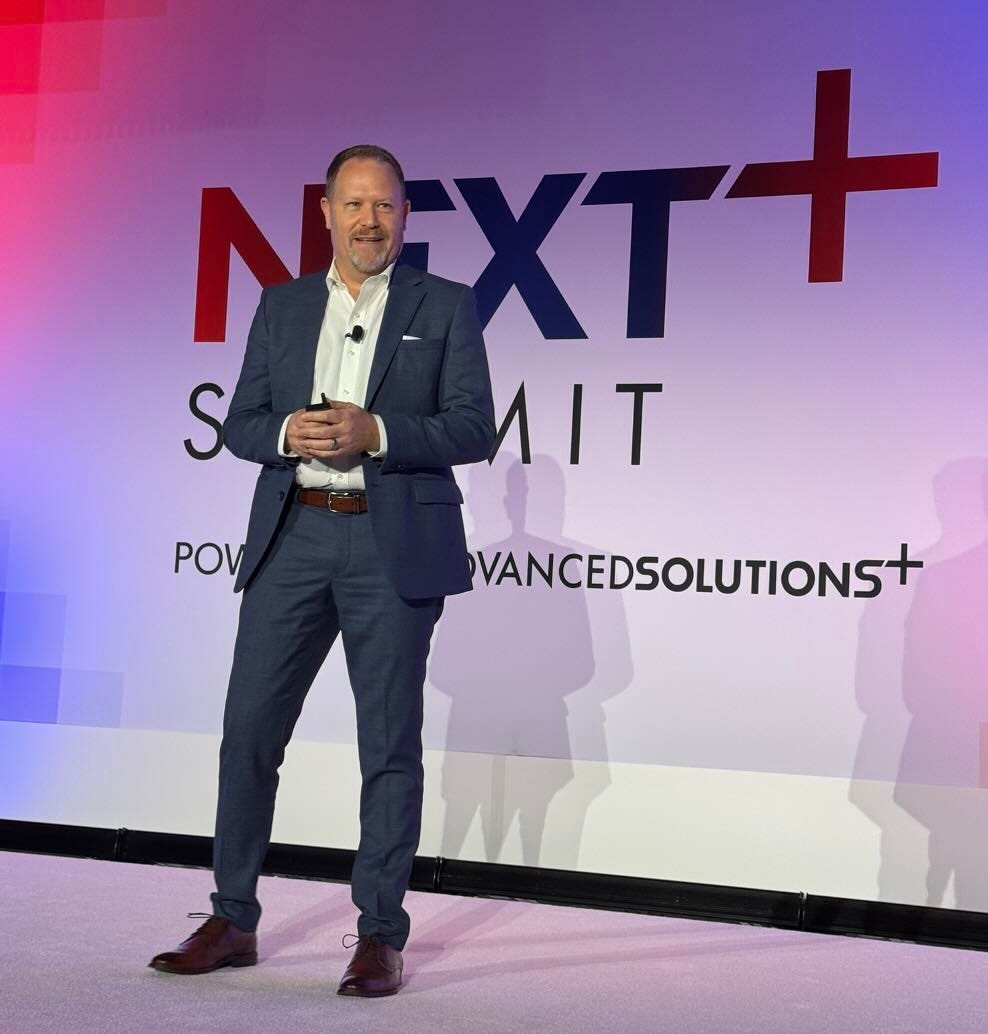
Or rather, not a lot yet. “It’s coming,” Blair added.
Predicting where it will land when it arrives, however, is a bit like placing a high-stakes wager involving plenty of risk and uncertain reward right now. MSPs who make the right bet on the right services will be building their way to a prosperous future. Those who make the wrong bet on the wrong services, Blair warns, will be building their future on sand.
“And sand does not compound,” he says.
End users, not coincidentally, are playing the same game at present. Whether to invest in AI is not at issue. How best to do so very much is.
“Interest is everywhere. Scale is rare,” writes Forrester in a recent blog post. “The reasons are stubbornly consistent, and they start with money. ROI uncertainty traps enterprise ambition in pilot mode because most companies can’t justify production beyond narrow efficiency gains.”
In reality, however, most businesses are less uncertain about ROI on AI spending than unhappy about it. Only 29% of organizations surveyed by enterprise AI platform vendor WRITER have gotten significant return on their genAI investments so far and nearly 70% of executives polled by HR software maker Globalization Partners are prepared to scale back next year’s AI budget if this year’s goals remain unmet.
“Everybody in the world is struggling to quantify AI ROI,” observes John Harden, founder and CEO of AI transformation startup Lemhi.
As regular Channelholic readers know, Harden is a one-time MSP and former founder of Saaslio, a SaaS management vendor acquired by Auvik in 2022. His new venture, officially launched last week, is based on insights gleaned from 100 conversations with MSPs in a roughly 120-day span. Over and over again, he says, people referenced two ways they’re gambling on AI services at present. One is performing AI readiness chores like cleaning data, implementing security measures, and drafting acceptable use policies for customers. The other is designing and deploying custom agentic AI solutions for them.
“They’re saying, ‘let’s find a $200,000 workflow in your business. Let’s charge you $40,000 to solve it, and then we’ll get maybe a $4,000 a month retainer after that to keep maintaining it,’” Harden says.
Both motions are producing good project revenue, but only for the subset of customers willing to pay either for decidedly unsexy prep work or complex, and therefore expensive, automation work. Neither looks to be a good bet for achieving sustainable AI success.
The Lemhi moment
Which brings us to the “Lemhi moment” MSPs find themselves in, according to Harden, and the inspiration for his new company’s name and mission. The name is a reference to the Lemhi Pass, the point in their journey across North America where Lewis and Clark, expecting swift passage through the Rockies to the Pacific, discovered “immence ranges of high mountains still to the West of us” instead.
“The maps were wrong,” Harden (pictured) explains during an interview on the podcast I co-host, which left the two explorers with a decision. “They could either traverse the mountains moving forward and chart a new path or they could turn back and go home.” They moved forward, obviously, and Lemhi’s mission is helping MSPs who’ve followed flawed maps to sluggish, non-recurring AI revenue do the same.

“We believe that the industry has to chart a whole new path forward,” Harden says.
Lemhi’s platform is designed to guide MSPs along that path, prescriptively and automatically, toward an end state in which they’re rolling out client-facing AI services “repeatably, responsibly, and at scale,” Harden says. The scale part, he continues, comes from the solution’s exclusive focus on AI-enabling the Microsoft software almost every SMB uses. The responsibly part comes from ensuring that every AI rollout begins with governance, security, and policy setting.
But then doesn’t end there. As we’ve seen, governance and security on their own leave business owners yawning, so Lemhi makes them a relatively small part of a much larger conversation about something far likelier to excite customers—making and saving money.
Engage, Lemhi’s first solution module, is designed to provide a repeatable structure for holding that conversation. The system guides a client’s leaders and employees through a survey process that (like similar products) covers technical readiness but also (unlike competing products) a wide range of non-technical topics, such as how comfortable they are with AI at present, how often they use it, and how they’d like to use it in the future.
“Would you benefit from more research, or having automated research? Would you benefit from being able to do Excel insights and analysis quicker? Would you benefit from being able to recap your day and have meeting recaps sent to you on the fly?” Harden says.
Most importantly, he continues, the survey asks users to estimate how much time the items on their AI wish list would save them. The goal is to establish a set of baseline metrics and ROI targets specific and compelling enough to get business managers interested. The output is a detailed roadmap that begins with technical readiness, governance, and security but moves quickly past them to an implementation and training process informed by best practices from the likes of McKinsey and Forrester.
“We have a 30/60/90 day sprint of work to clean up and then we’re going to help you with an adoption sprint,” Harden says.
That in turn is followed by a regular series of “re-pulse” surveys to assess usage, measure impact, and provide advice for increasing both. If Lemhi’s software and the MSPs using it both do their job right, the client should see measurable productivity gains worth paying handsomely for.
“Would you give me $3,000 a month if I could help activate nine hours a month for every one of your employees?” Harden asks.
Or how about nine hours a week, which is what the business leaders surveyed by WRITER say their most AI-savvy employees are saving on average, 4.5x the two hours a week AI laggards are freeing up. Just over half of all laggards and leaders alike at the big businesses Boston Consulting Group surveyed recently are saving eight hours a week, and 67% report higher job satisfaction. MSPs who bring similar results to SMBs can charge appropriately for them.
“The margin should be really high,” Harden says.
And it’s ongoing. After that first roadmap is complete, Harden says, MSPs can offer clients virtual chief AI officer services. “You’re coming in and you’re offering a monthly or quarterly session dedicated to AI and strategy with their business.” Compass, a forthcoming Lemhi module due to reach early design partners this summer and everyone else in the fall, is designed to facilitate those engagements.
“It’ll be the natural extension of continued ROI visibility, continued roadmap implementation, continued governance and security over the whole AI transformation journey,” Harden says.
One last note
And an apt one as I make my way today to Pax8’s 2026 Beyond conference, where agents and agent marketplaces are sure to figure prominently on the agenda: None of what Lemhi’s building involves agentic AI.
“I believe deeply in the fact that there is no agent that you can build for any small or medium business today that will outweigh the value created if you activate the entire workforce with AI,” Harden says.
More about Lemhi straight from its founder
The rest of that interview I referenced with Harden is available on the latest episode of the MSP Chat podcast. Ready when you are right here.

D&H rides the advanced solutions train
Lemhi may not be thinking much about agentic AI yet, but D&H sure is.
“This is what’s emerging for us,” Blair says. “62% of organizations are experimenting with AI agents. There’s a lot of work to be done here.”
It’s going to be a while before most businesses and IT providers are ready to do it though. “Three-quarters of enterprise leaders tell us they’re adopting agentic AI. Only a small minority have it running in meaningful production beyond ‘agentish’ chatbots, and true scaled multiagent systems are rarer still,” writes Forrester in a recent blog post, mostly because the technical sophistication and organizational readiness necessary to implement them are equally rare.
“The technology is a runaway train,” the post says. “The enterprise is the heavy load it has to pull.”
Fortunately, D&H has plenty of room to make money in big, fast-growing markets like cloud computing and security in the meantime. Indeed, the whole point of NEXT+ was to get partners excited about joining the distributor’s effort to expand beyond its traditional focus on PCs and conference room gear into advanced solutions as well.
“When you look at D&H for the last 15, 20, 30 years, we’ve really focused on selling to VARs and system integrators,” says Adam Crockett (pictured), senior director of services in the company’s Advanced Solutions+ business unit. “We’re kind of known as the end user compute distributor.”

It’s been a great role to play in the channel too. “We’ve grown the company over the last 10 years from a little over $3 billion to over $7 billion, which is 3x the growth of North American distribution,” said Jason Bystrack, D&H’s SVP of cloud and Advanced Solutions+, during a keynote presentation, noting that the company grew $260 million more just in May, the first month of its new fiscal year. D&H wants to extend that momentum now from the front office to the back office.
“When it comes to distribution and total available market, we’ve had a very large share of the desktop, laptop, and end user compute space, but we’ve had a small market share when it comes to advanced solution technology manufacturers,” Crockett says. “All of our growth over the next 10 to 15 years is going to come from advanced technology vendors, because that’s where we’re so under indexed.”
Several of those vendors, including AMD, Extreme Networks, Fortinet, and HPE, made general session presentations at NEXT+. D&H itself made a point of underscoring its ability to wrap assessment, implementation, and management support around the products those companies sell for partners new to them.
“The mid-market partners we’ve grown up with and helped mature along the way may not have a deep bench of technical resources in a specific product line,” Crockett notes. “We just want to help them be able to deliver on the associated services that would go along with an advanced solutions purchase.” The idea, he continues, is to help partners add profitable new revenue streams faster and with fewer upfront investments by embracing a “borrow, not build” model.
“The professional services growth that we’ve had in the last couple of years has been based on that,” Crockett says. “Borrow our facility, we’ll do the pre-deployment work. Borrow our technical resources, we’ll do the onsite installation.”
Helping partners enter unfamiliar markets rapidly is a priority for D&H in areas beyond services too.
“We need to be able to provide them vendor-agnostic consultative pre-sales enablement, technical resources, people who know the OEM programs, how to apply for the best economics, how to make sure they take advantage of all their backend programs and post-sales service and support,” Crockett says, “all the things they need to learn about manufacturers that are new to them.”
Remember that whole managed services thing?
Interesting fact about those end user compute partners at NEXT+: A lot of the same ones intrigued enough about advanced solutions to make the trip to Austin are also intrigued about managed services. Blair said as much during his keynote while citing data showing that 75% of IT spending is now on operational versus capital expenses.
“If I would have shown you the OpEx to CapEx ratio a couple of years ago, this would have been swapped. So it would have been 40% OpEx and 60% CapEx,” he said. As a result, he added, “many of you that were in the traditional VAR/resell model are becoming MSP-like. It’s because you’re paying attention to how your customer is buying.”
And still learning how to accommodate that demand, he could have added, which is why D&H recently launched its Success Path to MSP Toolkit, a series of live and on-demand webinars offering detailed guidance on the nuances of launching a managed services practice.
“You don’t want to build out a service desk and a NOC or a SOC without understanding how you need to thoughtfully consider changing compensation models for your sales organization to drive that behavior” for example, Crockett says. “You’ve got to be a little more methodical, a little more coordinated about making that leap.”
The kit includes additional information about automating and scaling managed service offerings, adding managed security capabilities, zero trust, cloud security, and more.
“We found that many of our partners who are somewhere on that journey of transitioning from more of a VAR or a system integrator into becoming a managed service provider need a kit that brings all these fragmented tool sets and processes and different software options out there into some sort of coordinated discussion,” Crockett says.
The toolkit’s useful in a further, less intentional way as well for those of us who’ve been covering the shift from VAR-based business models to managed services for over two decades now. Cycles like the AI one just getting underway take a very long time to play out, it shows. There will probably be partners gratefully consuming Success Path to AI Toolkits many years from now.
Over on The Business of Tech
Host Dave Sobel is getting ready for his upcoming SMB Online Conference, which runs noon to 3:30pm Eastern each day June 23-25.
The theme is “Profitable is Enough,” the content’s aimed at independent MSP owners more focused on running sustainable, profitable businesses than chasing growth at any cost, and the speakers include Jay McBain, Tiffani Bova, Arlin Sorensen, Rayanne Buchianico, James Kernan, Amy Babinchak, and Sobel himself.
Registration is $399 for the general public and zero for members of Sobel’s Small Biz Thoughts community. Learn more at www.smbonlineconference.com
Also worth noting
GTIA Presents, a brand-new podcast from GTIA, bills itself as the place “where member insight turns resources into real business results.” New episodes on YouTube and wherever else you get your pods.
Mere weeks after its launch, Veeam’s added new operational privacy, governance, and control capabilities to its DataAI Command Platform.
The 20 MSP, which you’ve encountered here on Channelholic before, has acquired four more MSPs, raising the total size of its portfolio to 48 companies.
Jim Fanning is the new (and first) president of Hatz AI.
Cisco’s new Cloud Control platform is designed to help organizations build, manage, and secure AI agents that can operate and defend critical IT infrastructure at machine speed.
Speaking of Cisco Cloud Control, Auvik’s network intelligence capabilities are now available to AI agents in that platform.
Portal26 now offers a free version of its AI governance, security, and token control platform for business users of Anthropic’s Claude.
Yet more agent control: Noma’s new Agentic Access Control is designed to help organizations manage and secure AI agents and MCP servers across the enterprise.
Insight’s new Managed Exposure Defense service combines continuous threat exposure management, patch execution, XDR, and 24x7 monitoring.
More reasons to make AI governance a priority, from Ivanti: While 85% of organizations have AI policies or oversight mechanisms in place, only 42% say accountability for AI decisions is clear, and just 24% say AI policies are followed very consistently in day‑to‑day work.
Bad news from IRONSCALES: Phishing now costs businesses a little under $52,000 a year per security analyst. Good news from IRONSCALES: AI-powered defenses cut the cost of dealing with a phishing email by 12%.
Benji Pays has a new integration with Elavon Payment Gateway designed to give users additional payment processing options.