


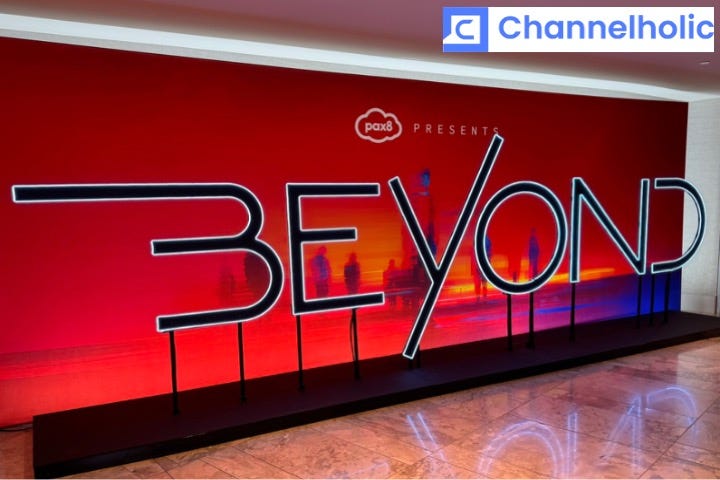
The last time I spoke with Chance Weaver, Pax8’s global vice president of AI adoption, was in November, about five months after the company first began urging managed service providers to remake themselves as managed intelligence providers at its 2025 Beyond event. How many MSPs out there qualify as MIPs today, I asked him. Hard to know, he answered, but just 13 of roughly 600 partners he’d interviewed personally arguably cleared the bar.
Has the number risen since then, I asked Weaver at this year’s Beyond conference last week? Yes, he replied.
To 17.
Let’s be clear, the issue isn’t lack of desire among MSPs to join those trailblazers. There were over 3,500 people from some 30 countries at Beyond this year, every last one of whom knew going in that Pax8 would be serving them MIP for breakfast, lunch, and dinner multiple days in a row. Whether to offer AI services, per several recent posts here on Channelholic, is no longer at issue for MSPs.
“The challenge is how to,” says Lane Brannan, Pax8’s EVP and general manager for the Americas.
It’s a steep challenge. MIPs need technical know-how and consultative muscle most MSPs lack at present, not to mention an entirely new lineup of repeatable, scalable solutions to offer. That’s way more than an evolution of technology, observed Craig Donovan (pictured), Pax8’s chief experience officer, during a Beyond keynote appearance.
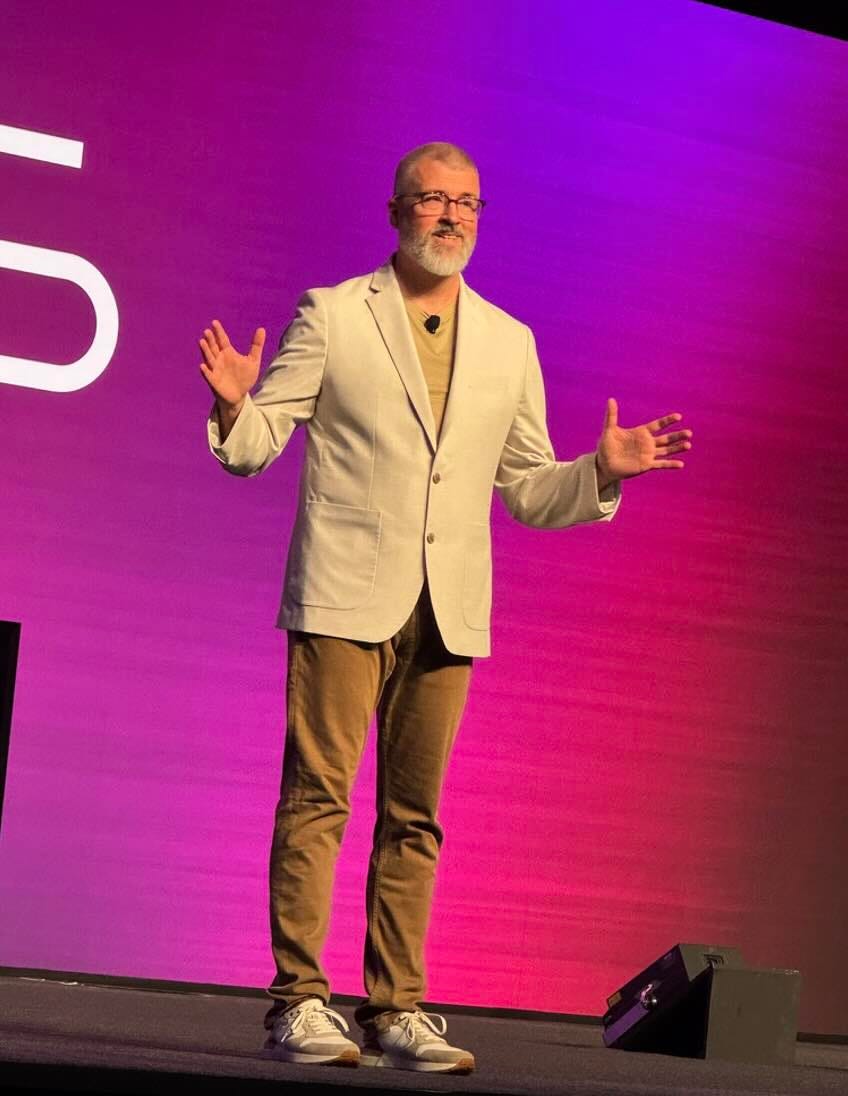
“It’s a fundamental shift in how all of us have to operate,” he said. “It requires a discovery conversation that you know how to run, and someone on your team that can do process discovery and mapping. It means having a playbook for what happens after the sale and an execution capability that many of us are still building.”
Pax8 is well aware that acquiring all of that will take time. It also knows that time is a commodity in short supply for both it and its partners right now. The window of opportunity to get in on AI may be wide open today, but it won’t be forever. That’s the thing about windows, Donovan noted.
“As fast as they open, they can close just as fast,” he said, and this particular one’s no exception. “The SMBs that your clients are competing against, they won’t wait.”
Indeed, they aren’t waiting. “Customers are coming to us all the time, constantly, every day” for AI solutions, says Elliott Hyman, CEO of mega mega MSP Lyra Technology Group, on the latest episode of the podcast I co-host. Lyra’s begun hiring AI-focused forward deployed engineers of the kind Palantir made famous to meet that demand as a result, in no small part because if it doesn’t give AI-hungry clients what they want the AI consultants already calling into its accounts will.
Or maybe Anthropic will. The AI giant recently announced a $1.5 billion venture aimed at bringing AI solutions directly to midsize businesses, not because it aspires to be a player in the services game (it doesn’t) but because it’s under massive financial pressure, has an IPO approaching, and can’t wait around for the channel to catch up.
A lot of people, in other words, are feeling an urgent need for speed with respect to AI right now, including Pax8, which is why the company sought to strike a delicate balance with the would-be MIPs in its audience last week. Hurry up, it told them, but get it right.
The Managed Intelligence Provider Program Pax8 launched during the show targets the get it right part. Available free to the company’s partners, the new enablement offering walks MSPs step by step by step through the journey to becoming an MIP, whether their ultimate goal is to be a broker of third-party agents or a builder of custom agentic workflows.
That journey’s a long one, however, and there are no shortcuts along the way, so Pax8 also introduced Managed Intelligence Services, a set of white-label offerings delivered by Pax8 itself on behalf of partners, to help with the hurry-up part of the equation in the meantime.
“All of you will get there. It’s really a question of when,” Donovan said. “And I think when it’s a challenge of timing, of roadmap, sometimes you just need a bridge. You need a team there to support you while you cross the chasm, and that’s why we built Managed Intelligence Services.”
Together, MIS and the MIP Program form Pax8’s answer to the problem statement everything the company said at Beyond this year scrolled up to: The power of AI is real, the market for it is enormous, bringing it to SMBs is hard, and your customers won’t wait while you figure it all out.
“And in a world that no longer waits, the advantage belongs to those who don’t either, those who turn agents into outcomes and intelligence into industry,” said Scott Chasin (pictured), Pax8’s CEO, during a Monday keynote. “This is the race to managed intelligence, and the clock is already ticking.”

MSPs have the inside track in that race, Donovan noted, because they have something neither those AI consultants nor whatever Anthropic’s building can match.
“It’s your history. It’s your relationship. It’s the fact that when something breaks, your clients call you,” he said. It is in a word the trust (my word of the year for 2026) that clients place in their MSP to guide them through whatever IT throws at them next.
“That’s your moat,” Donovan said. “In fact, I’d argue that is the moat, the one that matters. But it only stays a moat if you protect it.”
Like, right now.
Moonshot
To get a sense for just how heavy a lift becoming an MIP is, put yourself in Rex Frank’s shoes for a while.
Few people are more qualified than Frank to gauge the difficulty of that process. A former IT provider and long-time MSP consultant, Frank has been vice president of Pax8 Academy, the company’s partner education unit, since 2021. His was the team on point for devising the MIP Program’s training content, and Frank knew it would be hard work from the moment he first heard Chasin commit Pax8 to turning MSPs into MIPs. So much so, in fact, that he immediately thought back to a similarly ambitious proclamation by another chief executive, JFK.
“I felt like the engineers probably felt when Kennedy got on stage and said, ‘We’re going to go to the moon in this decade,’” Frank (pictured) recalls. “It was kind of a feeling like, ‘How are we going to do that?’”
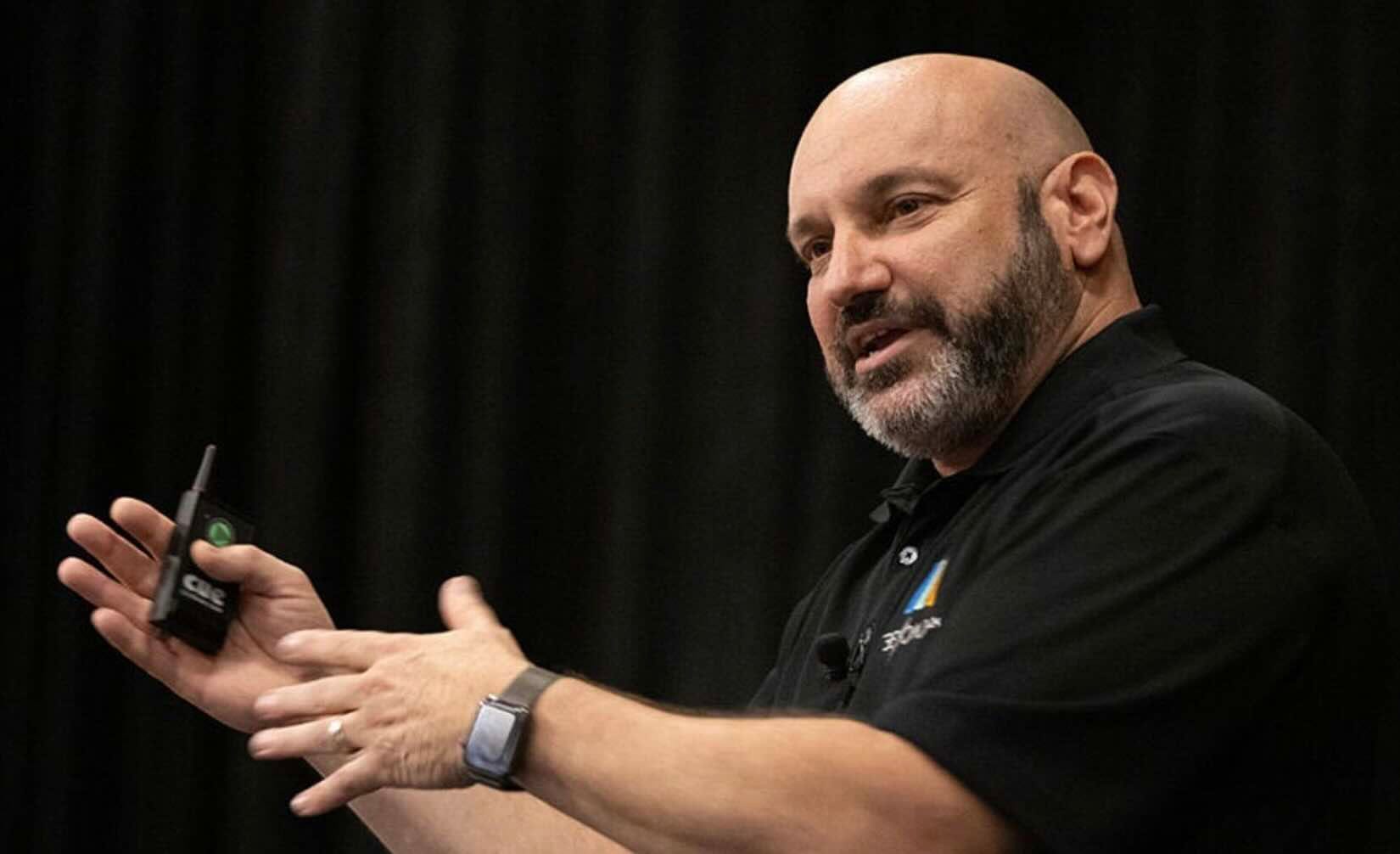
At the time, remember, no one even knew what an MIP was. How are they staffed? What do they sell? How should they sell it? How should they price it? The parallels to the Apollo program seemed so apt to Frank that he asked everyone in the Academy group to watch a television mini-series about it, because designing the first MIP curriculum would be a little like designing the first space suit.
“The answers don’t exist,” Frank told his team. “We need to go invent them.”
The way they did so calls to mind the “square peg in a round hole” scene from Apollo 13: gather a lot of smart people, assemble everything available to start from, brew a lot of coffee, and get going.
In Pax8’s case, the smart people involved were its own employees and MSP members of its AI innovation partner community, followed eventually by 125 MIP Program trial enrollees. They had a lot to do. In addition to everything they created from scratch, the team had to update MSP-era materials about nearly 150 internal processes for the MIP era. And for reasons we’ve already covered, they needed to do it, per Gene Kranz in the movie, rapidly.
“The speed at which all of this needed to be revised was sometimes mind numbing,” Frank says.
Technical topics were definitely part of the agenda. Frank’s been encouraging MSP owners to focus on business rather than technical topics for years, but AI’s upended that advice. MIP owners need hands-on experience building and deploying agents, he contends.
“The owner needs to go back to being tech-curious and doing the technical work,” he says. “They’re going to have to step back to some of their roots where they were the ones doing the work so that they could define what their offering was.”
For most MSPs, however, the harder task will be learning to host a consultative client dialogue. Frank has an exercise he likes to perform with MSPs where he puts a pencil, a cheap pen, and a fancy pen on the table and asks them to sell him one. Way more often than not the MSP picks something up and start talking about its features.
“About 20% of the time, I get the answer I’m looking for, which is somebody starts asking me questions about what I would use a writing instrument for,” Frank says. “I’m looking for them to dig into my pain.” If they do, he tells them he often has to start all over on something he’s been writing because he made a mistake.
“The A+ answer is to sell me the pencil because it has an eraser,” Frank says.
The MIP Program spends an appropriately large amount of time familiarizing participants with that kind of needs discovery process. If it succeeds in teaching a bunch of engineers to think like McKinsey consultants, it will have done something long overdue in the channel.
“As a former MSP founder, I like to say that it’s the conversation we always wanted to have but never really did,” Weaver says. “Well, now we have to.”
Hear the story from Frank himself
He tells the tale of building the MIP Program’s content on the latest episode of MSP Chat, the podcast I co-host, which features an interview with Elliott Hyman too. Check it out here.

Building the tool continuum
Skills, I suspect, will ultimately loom larger than tools in what makes for success in managed intelligence. But tools matter too.
“One of the clearest signals we’ve heard from partners is AI is not the problem,” said Nick Heddy, Pax8’s president and chief commerce officer, during a kickoff morning keynote. “The access point is the problem. You know what you want to do, you can picture the workflow, you can see the outcomes, but assembling the right agents, integrating the right tools, and managing the deployment seamlessly, that’s where it usually breaks down.”
As it happens, I touched on a piece of that problem myself here just a few weeks ago. Like it or not, I wrote, MSPs need to master the byzantine complexities of managing token costs before customers start screaming at them about out-of-control AI bills, and it sure would help if there was an MSP-oriented tool to assist them.
It’s a fairly obvious thought, so I probably shouldn’t be surprised that Pax8 was far enough ahead of me on it to have such a tool ready to ship at Beyond. Called the Agent Gateway, it’s aimed squarely at the issue I discussed not only a few weeks ago but also a few weeks before that.
“Right now, there’s not really a straightforward way for our partners to monetize token consumption at a client-by-client level,” said Chief Product Officer Libby McIlhany (pictured) during a keynote appearance. The Agent Gateway, she added, is designed to fill that gap.
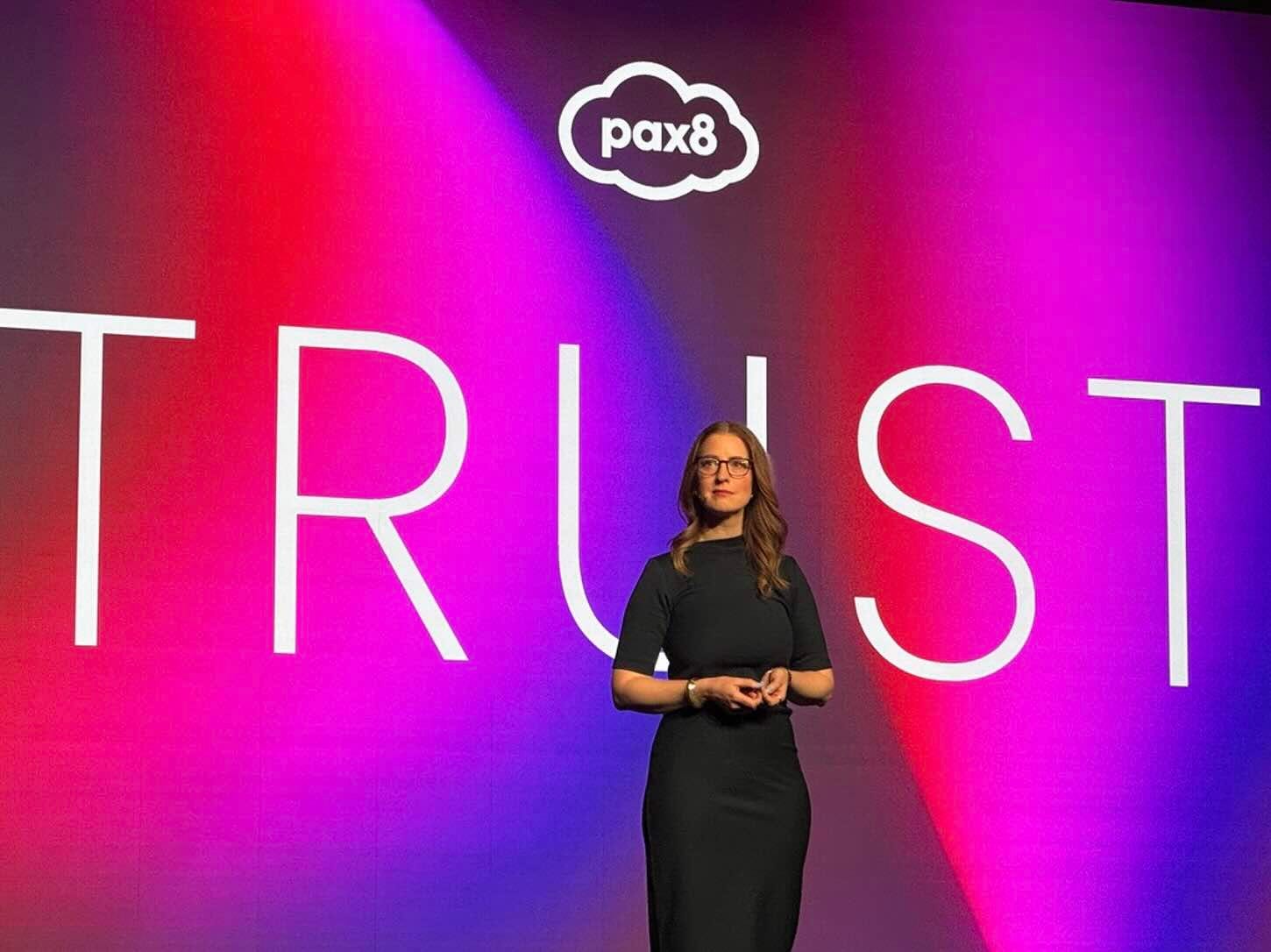
“Every call is openly metered and attributed to the right client, you see exactly what each client spends, and every token lands as a line item on the same Pax8 invoice that you’re already using with margins that you choose.”
“Model routing” functionality helps steer agents to the right LLM for the work they’re doing based on real-time price/performance calculations as well, while a credential vault keeps API keys accessible yet secure. The system does health monitoring and compliance reporting on agents too, and automatically assigns them Microsoft Entra IDs.
The goal is to give MSPs the channel-friendly, comprehensive agent oversight tool no hyperscaler, distributor, or frontier lab offers them today. “Our central argument is that AI agents need to be governed, deployed, and monetized at scale across hundreds of small business clients simultaneously, and we’re not seeing anyone do this in the market today,” McIlhany said.
The Agent Gateway was just one of three products Pax8 discussed during Beyond. The Agent Store the company previewed under a different name a year ago officially went live during this year’s show, with a growing list of offerings from multiple vendors, and the company also showcased a forthcoming orchestration and commercialization platform for rolling out home-made agents, something MSPs do on a one-off basis today, according to McIlhany.
“We are building them a platform that enables them to build an agent once and deploy it across their entire client portfolio, with each client in a structurally isolated tenant,” she says. “What that means is it handles fleet-level governance, per-tenant budgeting, step-level observability, and commercial infrastructure for pricing agents by subscription, usage, and outcome.”
Together, McIlhany notes, the Agent Store, Agent Gateway, and Orchestration/Commercialization platform (final name still TBD, thankfully), form a continuum for MSPs at various levels of agentic maturity. Agent Store listings are your entry point, she says.
“They’re how you introduce AI with a recurring revenue line that starts immediately. The Agent Gateway is what makes that scalable and yours to own. Every model those agents run on, every token they consume governed by client, securely vaulted, and billed on the invoice you already send. And the Pax8 Agent Orchestration and Commercialization platform is what turns all of that into a business you own.”
AI Switzerland
Questions worth asking about SaaS are often worth asking about AI as well. Why should people get either one from Pax8, for example, when they can get it straight from Microsoft or AWS instead?
The answer with respect to SaaS, according to Pax8, is that we connect you to multiple hyperscalers at once. The same logic may well apply to AI, according to one of my favorite bloggers in a recent post.
“No enterprise is going to run only Microsoft’s agents. Or only Anthropic models. Someone has to govern the multi-vendor mess (the parallel was multi-cloud). Set policy across all of it, clear actions across all of it, hold the audit trail across all of it, etc. Become the ‘single pane of glass.’ The incumbents can’t credibly be neutral here (Microsoft governing Salesforce’s agents? Good luck). That neutral seat is a super strategic position in software right now.”
As far as agents for MSPs go, Pax8 has that seat to itself at the moment.
Four final notes
1. Prepare your farewells for per-user pricing. Consumption-based pricing of the kind Pax8’s Agent Gateway’s designed to support is one of several AI-era revenue models MSPs are experimenting with at present, along with outcome-based schemes and others I’ve written about. The one approach pretty much everyone agrees won’t work before long is the user-based model most MSPs rely on today, because the better AI gets, theoretically, the fewer users their clients need.
Except that “before long” might be sooner than we all thought. According to Hyman, several Lyra Technology Group MSPs are already serving “healthy growing businesses with declining headcounts.” That’s something they’ve been anticipating for a year, he adds, but never encountered before. “We’re starting to see it.”
2. No signs of the SaaSpocalypse. AI is where Pax8 will make money; SaaS is where it does make money. So if AI is eating into SaaS spending, you’d expect Pax8 to know about it early. So far, it’s seeing no signs of the slowdown Wall Street fears is coming.
“We’re growing at the rates that we’ve grown in the past,” Brannan says.
3. Partnering with AI partners will be an option for Pax8 MSPs before long. The MIP Program is Pax8’s go-to resource for MSPs who want to build an agentic practice. Its equivalent for MSPs who don’t want to build an agentic practice but do still want to be relevant to their customers is a forthcoming program that will let partners who lack AI know-how outsource services to partners who have it. Weaver’s team is hard at work on it now, and apparently still has a ways to go.
“We have to understand both from an opportunity perspective and a delivery partner perspective what that looks like, what the rules of engagement are, how we can automate the process and take any human intervention out of it so that there’s no bias and that all the partners have the same level of opportunity,” Weaver says. “I hope that we have something that’s actionable by the end of the year.”
4. More proof that MSPs matter at Microsoft like never before. Pax8 immediately saw Microsoft Agent 365, the software maker’s control plane for AI agents, as a potentially useful tool for MSPs the moment the product debuted last November. If, that is, it had a few extra features.
“It was governance, it was security, it was deployment across multi-tenancy, it was controls where you could set policy for multiple agents,” among other items, Heddy says, all of which Pax8 captured in a spec sheet and sent directly to Microsoft last December. Somewhat astonishingly, Microsoft shipped a version of Agent 365 based on that spec sheet scarcely six months later.
“This is the first time I’ve seen Microsoft deliver that fast,” Heddy marvels.
It’s consistent, however, with a larger pattern I’ve written about before suggesting that people at very senior levels within Microsoft have belatedly realized they need MSPs to grow Microsoft cloud adoption among SMBs, and are investing accordingly.
“There are now big teams of people that are dedicated to small business, and I believe that they’re listening to us,” Heddy says. “That’s an amazing thing.”
SHARE
Over on The Business of Tech
Host Dave Sobel is just nine days away from the start of his 2026 SMB Online Conference, which runs noon to 3:30pm ET each day from June 23 to June 25.
The content, from luminaries including Jay McBain, Tiffani Bova, Arlin Sorensen, Rayanne Buchianico, James Kernan, and Amy Babinchak, is built around the needs of independent MSP owners more focused on running sustainable, profitable businesses than chasing growth at any cost.
Registration is free for members of Sobel’s Small Biz Thoughts community and $129 for everyone else. Details at www.smbonlineconference.com.
Also worth noting
NinjaOne’s $400 million secondary has raised its valuation from $5 billion to $12.3 billion in just 16 months.
AI system of record vendor Lexful has raised $7 million of its own in a seed round led by Top Down Ventures and York IE.
MSP-aaS’s outsourced tool and service stack for would-be MSPs, which I’ve written about previously, is now available on the Pax8 marketplace.
Kaseya has introduced MSP Success, a unified growth ecosystem that combines enablement, services, resources, and strategic guidance intended to help MSPs scale their businesses worldwide.
Guardz has introduced Agentic Reporting, a new capability designed to provide AI-generated operational and security insights.
Inforcer’s new Threat Detection and Response service aims to unify left of boom and right of boom security management within a single platform.
ConnectSecure has launched Patch 360, a patch management solution intended to give MSPs centralized and automated control over software patching across customer environments.
JumpCloud’s Agentic IAM service is now available on Google Cloud.
Field Effect has joined CrowdStrike in adding an AI detection and response product to a broader security platform.
Cato Networks has introduced an integration hub and technology partner program.
Cavelo has unveiled an AI Security Analyst that uses AI to help MSPs rapidly identify, prioritize, and address customer security risks.
FlexPoint’s new agents are designed to automate MSP back office operations like billing, collections, payment reconciliation, and financial administration.
Sigh. 76% of organizations do not fully govern or monitor non-human identities, according to new data from Netwrix.
Axonius has extended its asset intelligence capabilities into AI security, beginning with support for Claude Enterprise.
Cloud security trails AI security as a training priority for businesses, but not by much, according to the latest research from ISC2.
Rubrik’s platform is now available as an AI agent, allowing users to interact with Rubrik through natural-language workflows and agentic AI environments.
Rubrik has also launched Rubrik Agent Cloud for Claude Code, extending cyber resilience and data protection capabilities to AI-driven software development workflows.
TeamViewer’s Digital Employee Experience platform has achieved FedRAMP In Process status.
Fahad Qureshi is the new CRO at Devicie, who you’ve met here before.