



If MSPs give ConnectWise CEO Manny Rivelo credit for nothing else, they should at least acknowledge his candor.
Last year at the company’s IT Nation Connect event in Orlando, Rivelo spent much of his opening day keynote acknowledging the many things partners had grown to dislike about the business he inherited late in 2024, a list so long and deep, he said, that addressing it had taken a year’s worth of firing, hiring, and rebuilding.
With that behind him though, Rivelo assured his audience, ConnectWise was ready to begin making stuff again. 12 months later at this year’s edition of IT Nation Connect, Rivelo picked up that thread by identifying with characteristic frankness what stuff in particular the company most needed to make.
“Two years ago when I joined, we were probably AI illiterate,” he told his audience.
Well, maybe not illiterate exactly, notes David Raissipour, whom Rivelo brought in to be his chief product and technology officer shortly after stepping into his current role. ConnectWise introduced an RPA tool and AI assistant all the way back in 2023 after all.
But in the years since, as Pia, Thread, and an ambitious crop of young startups were all furiously innovating in AI for service desks, ConnectWise made little to no visible progress in that increasingly strategic market.
That began changing early this year, when the company jumpstarted its help desk automation efforts by purchasing one of those ambitious young startups, a company named zofiQ that Channelholic readers had first met 11 months earlier. That investment paid off two weeks ago with the introduction of what ConnectWise calls “the industry’s first agentic RMM,” a set of AI-driven tools capable of handling the ticketing lifecycle all the way from triage to remediation.
Atera and Kaseya, among others would probably quarrel with that “first” claim and debate whether ConnectWise is at or simply near the frontier for AI in service desks, but it’s certainly taken a meaningful step in that direction. The question now that ConnectWise is finally in position to join the last big battle in managed services software, though, is where it intends to take the fight next.
It’s a question with real strategic importance. The first great era of managed services, broadly speaking, was all about managing networks, devices, and identities. That’s essential work that keeps the systems businesses rely on to be businesses continuously available, and ConnectWise has designed its increasingly proactive and autonomous software to help MSPs perform that work faster, more effectively, and more efficiently.
“If you were spending eight hours a day doing tasks, maybe you only need three hours, or two hours, or five hours,” Rivelo (pictured) says. “The rest of that capacity then gets invested in things that generate differentiation.”

Which are the things that matter to MSPs who want to continue mattering to their customers here in the second great era of managed services, the era of managed intelligence.
Because no matter how efficiently you deliver it, infrastructure management remains a commoditized service increasingly delivered out of sight and out of mind by MSP agents talking to end user agents. Growth comes from the consultative managed BPO services today’s businesses crave. The retooled platform ConnectWise unveiled in June sets the stage for that growth by (per the vendor’s newly redesigned home page) letting “AI agents handle the busywork.” Does ConnectWise see a role for itself in driving the growth that efficiency makes possible?
Yes, but all we know about it so far is what we learned during the company’s product keynote Thursday morning, which is that at some point in the next several months an expanded set of early access users beyond the six already in place will be able to supplement the readymade agents ConnectWise is building for them with custom agents they build themselves, using what executives variably call an agent lab or factory.
“All they have to do is click a button,” Rivelo says. “We’ll train the agent for them and give them the agent.”
Which they’re then free to use as they see fit. Rivelo expects that to be internally for the most part at first. Eventually though, he predicts, as partners gain confidence with the system, they’ll begin building agents they can sell to customers as well.
Which is when ConnectWise will advance from laying the operational groundwork for growth by automating commoditized services to producing growth for MSPs as well.
Going headless
ConnectWise, of course, isn’t the only company facing a future in which most of the users are agents and most of their activity happens out of human eyeshot. The same goes for every sponsor in the IT Nation Connect expo hall as well.
To a degree that surprised me at times, few of them seem worried about it.
Take BCDR vendor Slide, for example, which has been living in the headless future MCP made possible for well over a year now. “We had an MCP server when MCP had existed for like four weeks,” says Austin McChord, the company’s interim CEO, who estimates (because concrete data is unavailable) that a majority of the more than 1,000 MSPs using Slide’s software access it via MCP at least some of the time currently. Does the prospect of that percentage rising, the users becoming agents, and the customers who pay him barely knowing he’s there make him uncomfortable?
Far from it. “I love that,” McChord says. “Backup is best when forgotten. You want to just deploy it and then never have to think about it.”
Not true in other fields, though, so maybe a bad example. What about Lemhi, which you read about here in June and whose flagship solution officially went GA a few days ago? Surely a company whose goal is helping MSPs build AI service practices is leery of letting Claude get in between it and its customers, right?
“We just announced full Claude integration yesterday,” says CEO John Harden (pictured). Partly, he adds, because Claude integration was the number one request made by early adopters of Lemhi’s software and partly because Lemhi will come out strategically ahead every time a partner uses that feature.
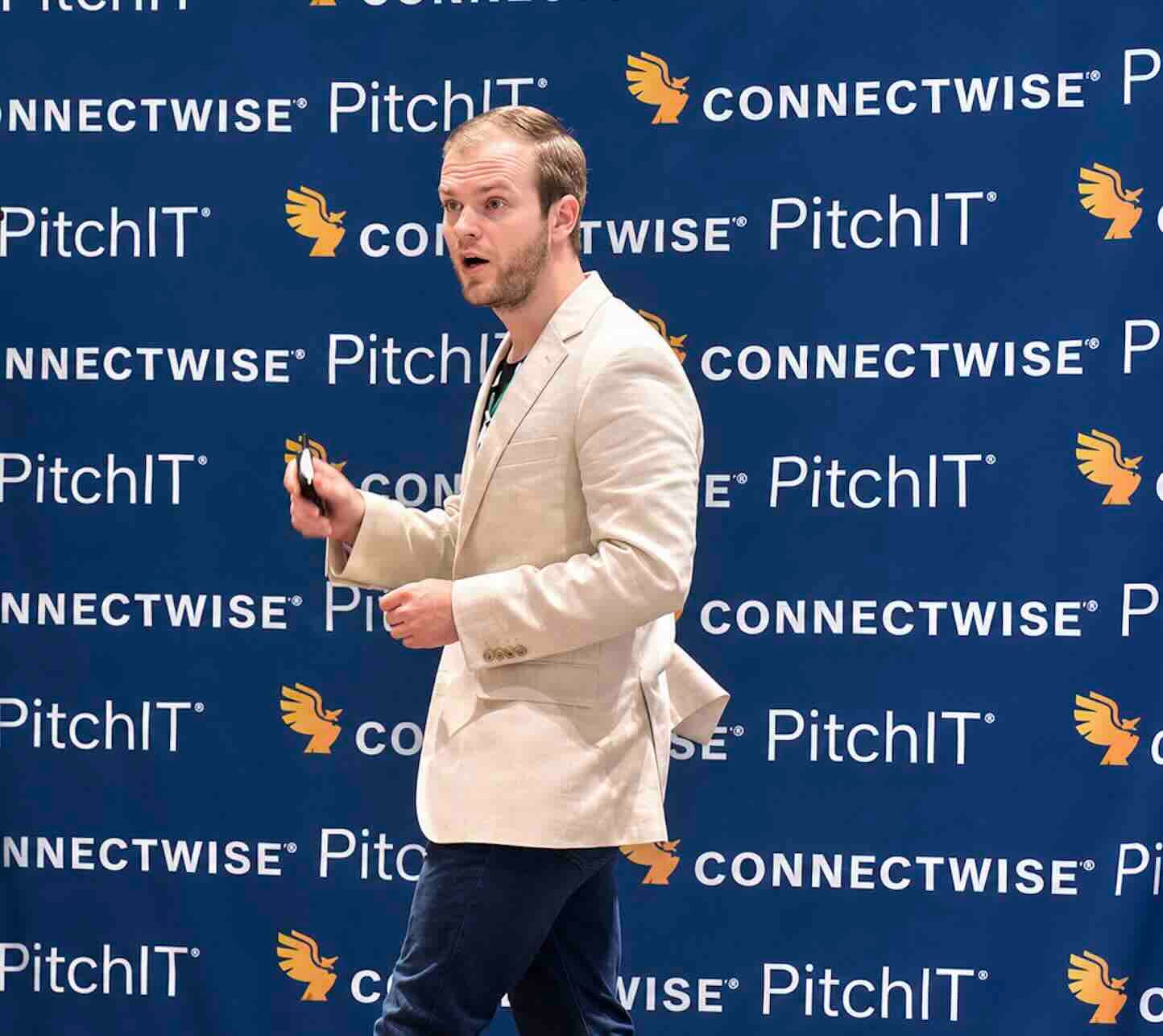
“You integrate your workflows so deeply into an MCP that the stickiness factor is quite high,” Harden says, noting that ChatGPT integration is due by end of year.
ConnectWise, it’s worth noting, is taking a more cautious approach to headlessness than many of its expo hall occupants. The company will ship an MCP server soon, it says, but only after readying its existing infrastructure for an inevitable deluge of agentic activity.
“Our system handles about sixty billion API calls a month,” says Raissipour, and will receive many billions more when MCP connectivity becomes available. “So we’re busy building better, more scalable API gateways that sit in front of our servers and can handle things such as authentication and authorization for the calls that come in.”
Rivelo, for his part, sounds less than enthusiastic about the prospect of headless interaction being the only kind that matters.
“We hope that we don’t get relegated to the back seat,” he says. “Our job is to make our interface more elegant and better to use.”
Not a bad job to pursue, but maybe not the most important one either at a time when, as Syncro, Rewst, TD SYNNEX, and most if not all of the vendors at ConnectWise’s own conference will tell you, MSPs care less with each passing day about conventional interfaces.
AI’s turning roadmaps into speedways
Here’s one more issue vendors have to think through these days, of the good-problem-to-have variety. To a degree I should have anticipated yet didn’t appreciate until last week, AI coding tools are speeding software makers down their roadmaps at genuinely astonishing speeds.
How astonishing? I have several examples, but let’s start with this one, because it’s timely. Remember the exploit affecting users of ConnectWise’s Cloud Backup product last month? According to Huntress CEO Kyle Hanslovan (pictured), it wasn’t just an exploit affecting users of ConnectWise’s Cloud Backup product.

“Most people don’t know, but dozens of other vendors were hit by that same technique,” he says. “Atera, for instance, was hit by the same threat actor using the same technique.”
Which made the technique in question a big enough problem, now and going forward, for Huntress to figure a long-term fix was warranted. So it designed new functionality, coded it, tested it, and rolled it out to otherwise vulnerable partners.
In seven days.
“The team was able to crank it out from zero in a week,” says Hanslovan of the Detection and Shut Down of Suspicious Service Principals feature Huntress officially introduced along with six others last week. “That would have taken three months before.”
It’s not an isolated example either. Some of Huntress’s dev teams are barreling down their roadmap at 4x the earlier speed. And it’s not just top-tier engineers doing the barreling either, according to Hanslovan, citing Rich Mozeleski, product manager for identity threat detection and response at Huntress, as an example.
“Rich is putting out more code than most people on our engineering team and he’s a product manager, not an engineer,” he says.
The picture is similar at Lemhi. “The expectation in my organization is that customer success people, marketing people, salespeople, tech people, engineers—they all are builders for their own individual departments,” says Harden. “Everybody’s creating things at breakneck speed.”
And that’s before autonomous “autopilots” from companies like Hermes and Duet get good enough to identify and fill code needs without human prompting, he continues. “The level of things that get created is just going to skyrocket.”
Literally every founder and/or CEO I spoke with at IT Nation Connect told the same story. “We’re actually at a unique time in history, in that it’s never been a better time to build stuff and make things,” says McChord, who expects Slide to complete its 2027 roadmap next month.
“The speed that we’re moving at is incredible,” he says.
The same is true at service desk automation vendor Thread, according to co-founder and COO Matt Linn. “We’re moving things into this quarter that we were planning for the end of next year,” he says.
Which gets us to the good problem to have I alluded to before. Or good problems, rather. I count three off the top of my head:
1. You may be moving too fast for your customers. Just because producing new features has gotten easier for you doesn’t mean digesting them all has gotten easier for end users. McChord’s biggest concern about Slide’s turbocharged release cadence, for example, is that “we’re actually bad at telling people about it.”
2. Fast is no longer fast enough. If you’re advancing down your roadmap at a mere 2x the prior rate versus 4x, expect lots of “why so damn slow” questions from users and investors in the future.
3. Get used to continually reorganizing your development team. Thread, for example, has turned its product managers into product engineers after discovering that 40% of its massive output gains were coming from two coders on a team of 20 who didn’t answer to PMs. Huntress is rebuilding its engineering org in response to the increasing power of AI dev tools too, and Hanslovan doesn’t expect this redesign to be the last.
“I think I’m going to have to keep doing this every three quarters,” he says.
Over on Business of Tech
Host Dave Sobel has thoughts on the wider implications of my recent story about DataCorps Technology Solutions using the skills it’s acquired building its own PSA software to make solutions for customers too:
Hear the order of operations. The time went in first, on DataCorps’ own business. The skill came out of that time. Only then was there anything to sell.
In plain terms, AI value is a process someone rebuilt, not a product someone bought, and the rebuilding comes before the revenue.
Which leaves the real question: who can afford to go first?
And that answer looks very different depending on who owns the MSP.
ConnectWise has token-based pricing on the way
Just over $26 billion of Anthropic’s revenue through Q3 this year, representing 79% of revenue overall, was consumption-based, according to the frontier lab’s amended S-1. If we assume the story is similar at OpenAI, we can further assume that token-based LLM pricing is here to stay.
That means it’s here to stay for vendors, MSPs, and end users downstream of the frontier labs too, and there are really only two ways for that fact to settle out: either everyone accepts the new reality of buying AI functionality in unpredictable usage-based quantities or someone upstream of the end users (meaning MSPs or vendors) agrees voluntarily to pay for tokens in unpredictable amounts and bill for them in flat amounts.
So far, with a rare exception or two, vendors have been shouldering that burden for their MSP partners, and suffering the accompanying margin fluctuations as a result. Will that remain true forever? Rivelo doesn’t think so.
“The industry is not going to allow data to flow in and out for free, probably, forever,” he says. “We’re going to have to go to a token-based world.”
That “we” includes ConnectWise. “We’re moving to token consumption,” Rivelo says. Not immediately, but it’s coming, probably next year in a form that’s still TBD but is likely to combine conventional per-seat pricing for conventional SaaS applications like ConnectWise PSA with consumption-based pricing for agents like the RMM trio the company just introduced. Though the agent pricing will probably have an element of predictability to it too.
“Over time, what we’ll do is we’ll give you a fixed amount, I’m going to say a contract for $300 worth of tokens, and you’ll be able to monitor how we use the $300 worth of tokens and we’ll be very clear on how we’re using that,” Rivelo explains.
That clarity won’t make MSPs happy about the change initially, he concedes, for reasons he completely understands. “The struggle they have is the fixed price makes their margin profile very clean,” Rivelo says. “That’s going to have to change over time.”
And not just for MSPs but for their clients too. “The conversation has to shift,” Rivelo says. “Long term, at the end of the day, it’s going to be how much work do you want me to do, and how much does it cost to do that work in an agent-based world. Then you put your margin on that, and you run a business with it.”
The shift may not be as hard as you think either, Rivelo adds. HubSpot, Microsoft, and many other familiar names already use credit- or consumption-based pricing to some extent, he notes. End users won’t object to their MSP doing the same so long as the AI-powered work they get in return for their usage-based spending makes a meaningful impact. I use AI constantly, Rivelo observes, and pay for the privilege accordingly.
“But it probably makes me maybe an order of magnitude more effective,” he says, which makes the variability of his spending a non-issue.
“It doesn’t matter, and I think the world will have to adjust to that,” Rivelo says. “We all have to adjust.”
Mystery solved? An update on service margins from Service Leadership
Channelholic regulars may recall a July article here based on a June interview with Peter Kujawa, the EVP in charge of ConnectWise’s Service Leadership unit and IT Nation community, about a mysterious service multiple of wages trend in Service Leadership’s recent MSP market data.
In extremely crude terms, service multiple of wages divides the fully burdened cost of delivering services into the revenue those services generate. Kujawa (pictured) considers it one of the most critical metrics an MSP can track.

“When I’m asked to look at somebody’s results when they start benchmarking with us, my eye first goes to their profitability. The second place my eye goes is service multiple of wages, because it really tells you how well run the service factory is and it ultimately is going to lead to greater profitability,” he says on an upcoming episode of MSP Chat, the podcast I co-host.
Service Leadership has long advised MSPs to shoot for a 2.5 SMW and long watched best-in-class MSPs in the industry’s top quartile average 2.7. Until suddenly, in the middle of 2025, top-quartile SMWs began rising quarter over quarter from 2.7 to 2.8 to 2.9 to an all-time high of 3.01 in Q1 of this year, even as the middle 50% of MSPs saw minimal improvement and bottom-quartile MSPs saw none.
The mystery was why, and Kujawa’s theory was that AI was the answer. Best-in-class MSPs appreciate the value of advanced tooling and spend more on it, he reasoned, so they were probably earlier, heavier adopters of service desk automation software than their less profitable peers and getting outsized returns from it.
Real-world example: WheelHouse IT eliminated over 90% of the Microsoft 365 work its human technicians had been responsible for after deploying Thread’s automation software, according to Linn. “That ended up being about 19% of their overall service request volume. Zero touch.”
Stories like that had Kujawa predicting, during our conversation this June, that average SMWs for top-quartile MSPs could reach a new all-time high of 3.4 by next June. It sounded a little crazy five months ago, but not so much now. Because it turns out that SMWs for top-quartile MSPs hit 3.32 in Q3, a full nine months ahead of schedule, per data Kujawa presented at IT Nation Connect in the left-hand graph below.
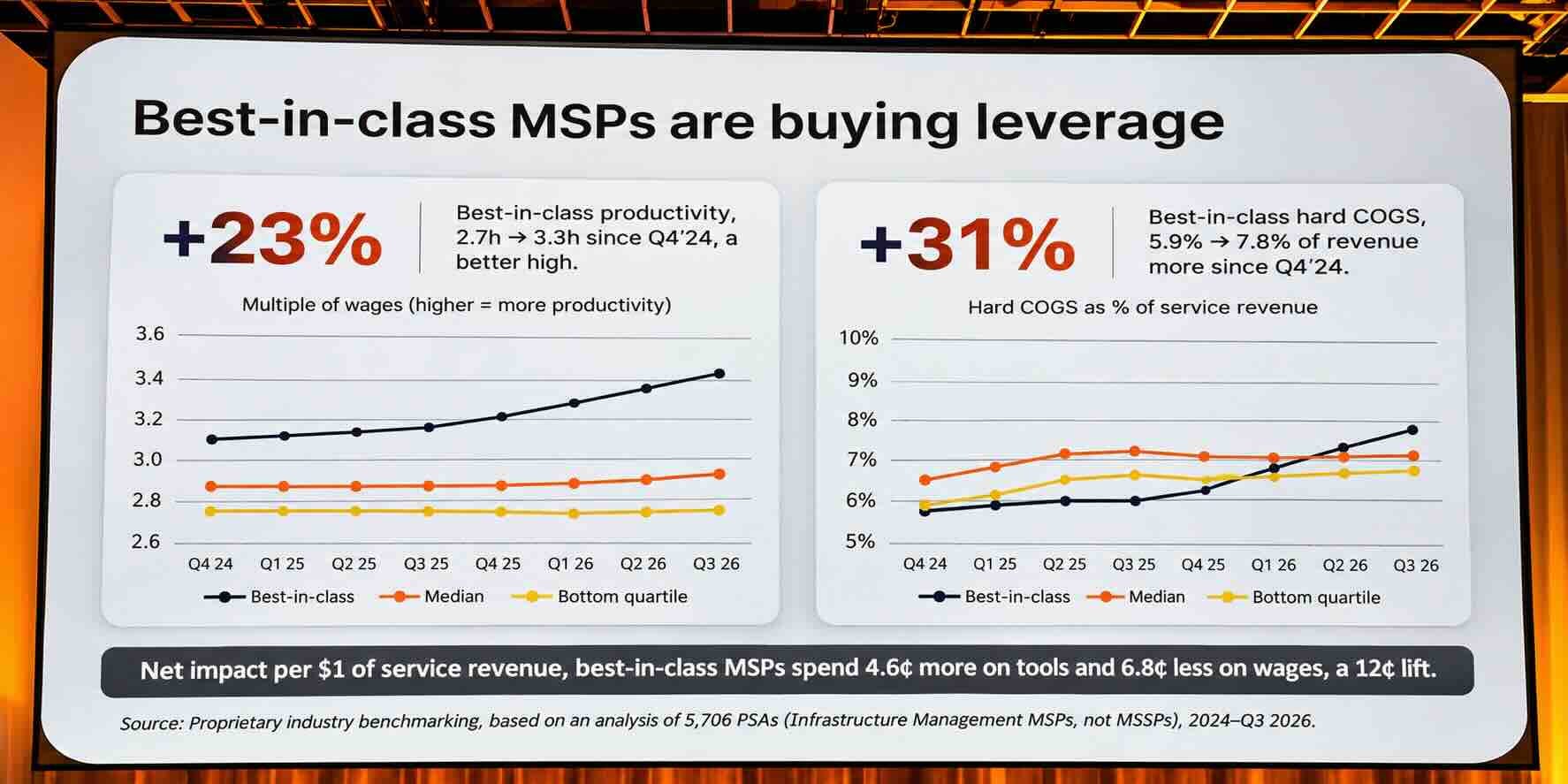
“What we’re seeing is the best in class hitting numbers we’ve never seen in 21 years,” Kujawa says.
Accompanying data in the right-hand graph hints heavily at what’s responsible. The same top-quartile MSPs outgrowing everyone else on SMW are also outgrowing everyone else on tool spending, as measured by cost of goods sold. And per additional data not depicted on either graph, they’re hiring new FTEs at a significantly slower pace than the rest of the pack too.
Which means the most profitable MSPs in the industry spend 4.6% more than others on a modest expense, tools, and 6.8% less than others on their biggest expense, labor. And since service desk automation software is still getting better and early adopters are getting better at using it, there’s every reason to expect further SMW gains ahead.
“At the pace of improvement we’re running, it’s plausible that by the end of next year we could see a 4.0,” Kujawa says.
I’m not prepared to call that crazy at this point, either. How about you?
Get the whole story straight from Kujawa
That MSP Chat interview with Kujawa may well be live by the time you read this, and if so you really shouldn’t miss it because it gets into other interesting trends concerning matters like rising revenue per employee. That episode and all our others with industry thought leaders are eagerly awaiting your attention here.

Also worth noting
ChromeOS device support, from NinjaOne, extends the market leader’s endpoint management capabilities to organizations managing Chromebook fleets.
Auvik has introduced an automation framework and CVE Monitoring Agent to help IT teams automate network operations and proactively identify vulnerabilities.
Hatz AI, which you last read about here, has introduced Spaces, collaborative AI workspaces designed to help MSPs and their customers share AI tools and workflows.
ScalePad CS, from ScalePad, is an MSP customer success platform combining client planning and automation, SaaS management, and workflow automation functionality.
CloudBolt has added AI agent governance capabilities to its cloud management platform.
MSP360 has launched an MCP server that lets users interact with and manage backup operations through AI assistants including Claude and ChatGPT.
SuperIT’s AI-powered IT incident remediation agents are now available in North America. More to come on these folks in an upcoming post.
Guardz has integrated its unified security stack with Palo Alto Networks’ Prisma Browser technology to extend enterprise-grade browser security to small businesses.
Cynet has added AI security and identity protection capabilities to its unified attack path management platform.
CrowdStrike and Dell now have an integrated security offering for the Dell AI Factory with NVIDIA.
CrowdStrike has introduced an AI Kill Switch that allows users to terminate misbehaving AI agents, prevent them from restarting, and revoke their network access.
Also from CrowdStrike: the company plans to acquire agent observability and explainability vendor Fiddler AI and AI security testing vendor Dreadnode.
Fortinet now offers FortiAIGate on the Equinix Distributed AI Hub.
Keeper Security has introduced a self-managed version of its zero-trust privileged access management solution for air-gapped networks, critical infrastructure, and other environments requiring locally controlled security.
A CyberFOX survey of 361 IT and cybersecurity leaders found that 62% have left important security risks unaddressed because of staffing shortages, while 75% said security responsibilities have grown faster than IT headcount.
Just 29% of organizations looking for MSP support say they can secure compromised accounts and restore operations within hours of an incident, according to Barracuda.
40.3% of IT and security workers surveyed by DNSFilter called AI security and governance their top priority for additional cybersecurity spending, perhaps because 20.1% have experienced a security incident involving unauthorized AI connections.
Speaking of DNSFilter, Justin Foster is its new CTO.
Evergreen’s mega mega MSP Lyra Technology Group has launched a full-blown forward deployed engineer program based on the trial efforts you recently read about here.
Fellow mega mega MSP Omega Systems has launched a managed AI services suite for healthcare and financial services organizations that stresses secure adoption, governance, and compliance.
Also fellow mega mega MSP Thrive, meanwhile, has announced a redesigned managed services delivery model that expands the role of Client Delivery Managers to provide industry-specific expertise, proactive guidance, and measurable business outcomes.
66% of channel partners are accelerating investment in AI solutions and services yet only 21% derive a meaningful share of revenue from that spending, according to TD SYNNEX.
Omnissa’s new One Safe Place to Run initiative is designed to turn its digital workspace platform into a unified environment for securely delivering and managing applications and desktops.
Emma Walmsley is the new CEO at HP. I’ll get my first look at her in action next month at HP’s Amplify conference.
Ketan Tailor is the new chief customer officer at Kaseya.
HoJin Kim is the new CRO at Acronis.
Pax8 and Torq veteran Don Jeter is the new CMO at Abnormal AI.
Adam Ely is the new chief business officer at Check Point.
Congrats to the Channel Marketing Association’s 2026 Excellence Awards honorees. Congratulate them yourself here.
Congrats as well to the Channel Sales Association’s 2026 award winners, who are listed here.