



Unless you’ve spent the year napping, you already know that the biggest challenge MSPs face around AI at present isn’t generating demand for it so much as figuring out what to sell in response to that demand.
And unless you’ve spent the last few weeks in particular napping, you also know that the new AI hotness out of Silicon Valley is “persistent agents” like Meta’s Muse, OpenAI’s Dots, Microsoft’s Autopilot, and similar solutions from companies such as Instinct and Town.
Those solutions (with the exception of Autopilot) are principally meant for consumer rather than commercial use, however, and don’t come with management tools, multi-tenant or otherwise. Meaning that persistent agents are marginally business-ready at best and completely unfit for MSPs.
Until Q1 of next year, that is, when Pax8 plans to make a persistent agent it unveiled today at its Beyond EMEA event in Copenhagen generally available. Named 8bot and currently in early access release, the system is a “managed AI coworker” that will be sold exclusively through Pax8 partners to their SMB end users.
And it’s a lot. Among other things:
1. It’s something any MSP can sell today. Or by early next year, anyway. Which is important for reasons Pax8 knows well: MSPs that want to make big money delivering AI solutions must first acquire two sets of skills, one to diagnose a client’s business needs and another to create something that addresses those needs. Cultivating both takes time, and businesses aren’t waiting around while that process unfolds.
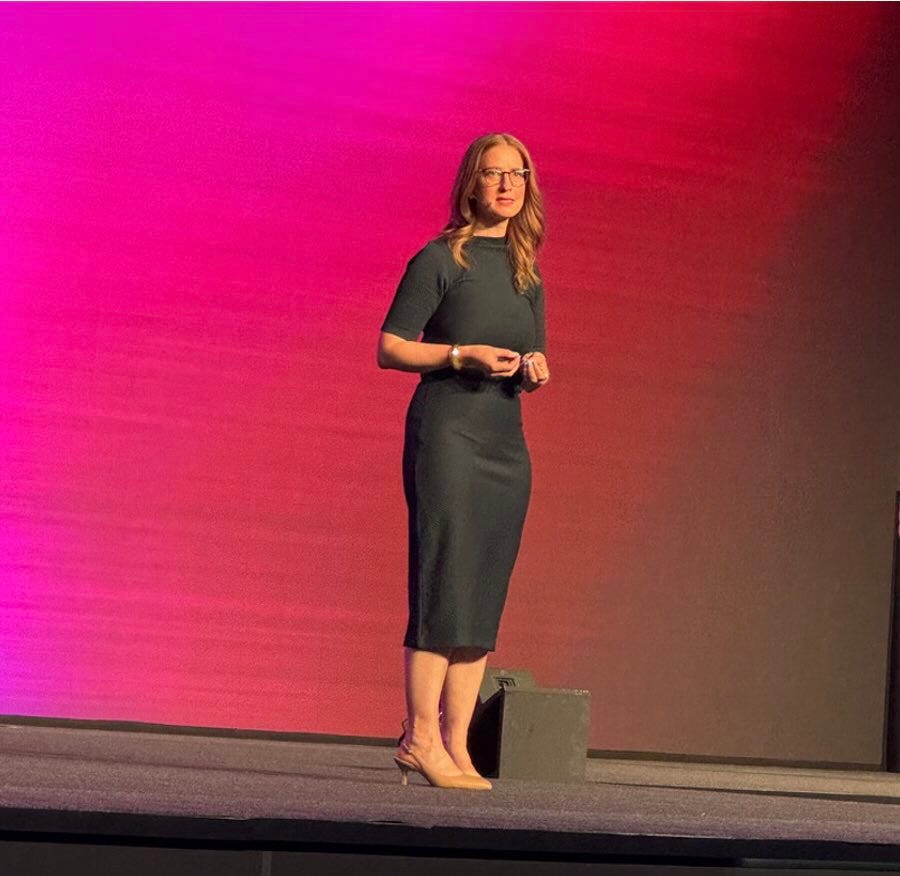
Enter 8bot, which gives MSPs something useful to offer customers right away. “We want our partners to be able to deliver AI value without building a custom AI solution,” says Elizabeth McIlhany (pictured), Pax8’s chief product officer.
2. It’s scalable. Building custom AI solutions is high-revenue, high-margin work, but also time-consuming, labor-intensive work best done with help from expensive forward deployed engineers. Pax8 partners can ship 8bot to every customer willing to buy it all at once as soon as the product goes GA.
“We’re packaging it so a partner can deploy and support it across their whole client base,” McIlhany says.
3. It’s easy to implement. Part of what makes 8bot scalable is that MSPs can roll it out to clients remotely in a matter of minutes.
“You don’t have to do a service engagement,” McIlhany says. “You send them an invitation, they accept the invitation, log in, and they’re off and running.”
4. It’s easy to maintain. According to McIlhany, there’s very little upkeep for MSPs to do once 8bot’s in use. “We want it to be pretty ‘set it and forget it,’” she says.
5. It’s autonomous. Autopilot’s still in private preview and there’s a lot about how businesses will use it and partners will govern it that we don’t know yet. Which means the most business-ready AI solution available to Microsoft partners for the moment is Copilot, and Copilot is neither persistent nor truly agentic.
“It’s super helpful, but you have to keep prompting it,” McIlhany says, and what it knows about you is relatively shallow. 8bot, by contrast, works 24/7 for users, proactively suggests new ways to be helpful, and continually accumulates context and memory.
“That context and memory build value over time, because it’ll really learn the client’s business,” McIlhany says.
6. It’s flexible. 8bot runs on a menu of closed and open source models that MSPs can employ in customized ways for specific customers and specific agents within those customers.
“We want to give a lot of optionality in terms of what our partners can make available to their downstream clients,” says McIlhany, who expects many MSPs to find the open source options appealing.
“Some of those models are really incredible, and we know that the SMB space can be pretty price sensitive,” she says.
7. It’s manageable. 8bot runs on a new Pax8 platform called 8os that provides monitoring and management functionality.
“When you first enter the product, it will show you all the things that need your attention,” McIlhany says, like perhaps a broken connector or expired API key. Critically, it will do that at both the fleet and tenant level.
“We know that our partners’ AI-based businesses are not going to scale if they have to log into a new vendor portal or log into a new client management portal or whatever every time they have to manage something on behalf of a different client,” McIlhany says.
8. It’s all yours. Unlike Autopilot, Muse, and Dots, 8bot is white label, or rather will be when the product ships next year. “We’re excited to have our partners be able to brand it however they want and be able to present it as their own service,” McIlhany says.
9. It’s priced … wait, how is it priced? “Pricing is something that we’re still in the process of exploring,” McIlhany notes. That said, she continues, the current thought is to offer tiered packages with a preset monthly supply of tokens and the ability to buy more on a pay-as-you-go basis.
“That’s kind of what we’re seeing most often in the market, and that’s something that our partners are telling us that they’re excited about, because it gives them that consistent monthly price that they want to give to their SMB clients but also gives their SMB clients the flexibility to use it as much as they want,” McIlhany says. Offering 8bot initially through a limited set of early access partners, she adds, will help Pax8 calibrate what to charge at each tier based on real-world consumption.
“We don’t want to go in with a price that’s too high or too low,” McIlhany says.
10. It’s governable. In terms of security, McIlhany explains, and also of spending. 8os, which integrates with the Agent Gateway Pax8 shipped in June, lets users set budget caps for specific clients and agents.
“People can be a little nervous about coming into a new technology when they’re not 100% sure, especially if it’s usage-based, how much it’s going to cost,” McIlhany says.
“We want to give them the reassurance that they can have a conversation with a client and have clear, firm guardrails around what spend could be.”
If you build it, will they come?
“Together,” McIlhany says, “8os and 8bot give partners a repeatable way to deliver measurable outcomes to their SMB clients, and to turn AI into a managed recurring service that scales in the right way for the channel.”
It’s a compelling value proposition, but not one guaranteed to succeed. How willing MSPs and their clients will be to set 8bot loose on apps and data is an extremely open question.
Pax8 knows it too. According to McIlhany, 8bot’s engineered to be trustworthy. Each individual user gets their own workspace with its own virtual machine, connectors, MCP server, plugins, skills, and messaging channels. Those workspaces, in turn, are completely isolated from one another.
“We have tested this really, really exhaustively,” McIlhany says. “We wanted to make sure that we would never have intermixing of data for different customers.”
Even so, it’ll be interesting to see how comfortable MSPs are offering 8bots to their clients at a time when headlines like this are less rare than they should be. 8bot makes selling persistent agents to businesses possible for MSPs. That doesn’t guarantee anyone on either side of that transaction is ready to act on that possibility yet.