


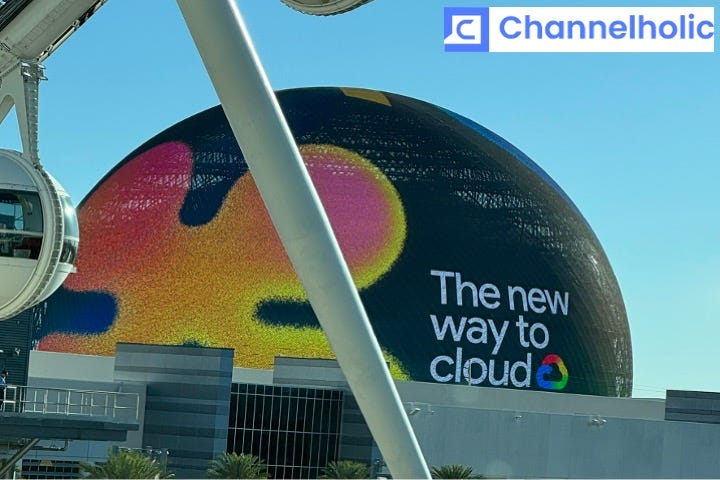
Some numbers are big even for a company the size of Google.
Like 1 trillion, as in the 330 businesses Google says consumed over 1 trillion LLM tokens each over the past 12 months, or the 35 businesses that gobbled up 10 trillion or more over that span.
Or how about 16 billion, which is the average volume of tokens Google currently serves up per minute via direct API use, a figure that has soared by 60% in the last quarter alone.
And then there’s 750 million. Let’s put a pin in that one and return to it after discussing a much smaller figure, 32,000, which is the approximate number of attendees at last week’s Google Cloud Next conference in Las Vegas. Google doesn’t know for sure how many were SMBs, except that it was in the thousands and significantly larger than in years past.
“It’s just really nice to have so many small to medium businesses here at Next,” says Sharon Prosser (pictured), Google’s vice president of Google Cloud SMB sales and scaled acquisition.

It’s also no coincidence. According to Prosser, Google went out of its way to grow SMB attendance. “We built a 13-session track for SMBs so that they felt like they could have a tailored experience,” she says, and devoted far more time than usual to showcasing SMB growth opportunities and success stories.
“We’re trying to give them some of the limelight,” Prosser explains.
For a very good reason. Though it’s outgrowing them both at the moment, Google trails AWS and Microsoft by double digits in cloud infrastructure market share, according to the latest figures from Omdia. And while its Workspace apps have 3 billion users globally, just 11 million of them are paying customers. Microsoft, by contrast, reported over 450 million paid Microsoft 365 seats in its most recent quarterly financials, up 6% year over year thanks primarily to strong adoption of its SMB and frontline worker offerings.
That’s cloud, however, a rapidly growing yet relatively mature market. AI is comparatively in its infancy and agentic AI’s so young that even the forward-looking folks in venture capital only really climbed on board in a big way last year, as the chart at the bottom of this page makes clear.
“Three quarters ago, companies were talking about how to use GenAI to improve a process,” says Phil Larson, managing director of the Google Cloud Partner Network. “Now it’s increasingly, ‘how can I rethink my business and rebuild it in an agentic way so that these processes are running independently?’” They’re looking to IT providers for answers, he continues, “so the partners are thinking through how their business models need to change.”
All of which tells Google that businesses and their partners are very much up for grabs in AI right now, especially in agentic AI and especially at the smaller end of the spectrum.
“If you think about enterprise organizations, they’ve been at this for several years,” Prosser observes. SMBs are just getting started. Indeed, though 76% of small businesses are currently using AI, according to Goldman Sachs, just 14% have fully embedded it in core operations and 73% want greater access to training and implementation assistance.
“This is going to be the next big frontier for AI adoption,” says Prosser of SMBs, adding that for Google it already is. “We’ve seen this hockey stick adoption of Google Cloud AI tools that we’re trying to keep up with.”
I know many people (the leadership teams at Nerdio and at Syncro come immediately to mind) who will scoff at the thought, but Google thinks it has an extremely legitimate shot at turning that early momentum into enduring SMB leadership.
Hear them out. They have a case.
Comprehensive and open
It begins with the company’s deep, and deeply integrated, AI stack. “No other hyperscaler can bring the hardware all the way up to the AI tooling to the customer base, and this is across small businesses as well as enterprise,” Prosser says.
Brooks Borcherding agrees. “It’s the most comprehensive toolkit for us as a services partner,” says Borcherding (pictured), who was once CRO at Datto and is now CEO of Google partner Pythian. “They have everything from infrastructure all the way up to the chat agents itself.”

They also own the infrastructure part along with the custom processor and server architecture it runs on, and have adequate supply—now, when the AI opportunity is at its ripest—not to mention the free cash flow to build more. Anthropic, by contrast, is so compute constrained that it’s selling equity to Google in exchange for chips it badly needs and doesn’t make, while OpenAI needs obscenely large funding rounds to rent capacity from companies that haven’t yet built a lot of it. Neither company is even close to profitable.
Unlike Microsoft, meanwhile, which relies chiefly on models from OpenAI and Anthropic, Google also owns Gemini, one of the industry’s most advanced LLMs. That’s a potentially big advantage for reasons the folks at Kaseya have been talking about for years: native integration eats external API integration for lunch.
“Google owns from top to bottom and can make sure each of the layers is actually working well together,” says John Campbell, SVP of Google solution sales at services giant Insight.
That includes the productivity layer, Workspace, which has come with embedded Gemini for over a year and gained even more AI smarts last week. Insight clients are switching from alternative productivity suites (presumably including M365) to Workspace as a result, Campbell says. Businesses want to use Gemini without turning sensitive data into training fodder, he notes. “The easiest way to do that is typically to procure Workspace.”
Workspace is often the gateway drug to the rest of Google’s AI offerings, moreover. “From there, they’re going into tools within Gemini Enterprise,” says Prosser, citing Agent Designer, a no-code, drag-and-drop agent writing platform launched last year as an example.
“I can’t emphasize enough the day one value, the ease of use,” she says. “Those have to be first order principles when we’re building products and thinking about small to medium businesses,” including products like the newly introduced and far more expansive Gemini Enterprise Agent Platform.
Solutions like that are paying off, apparently, and not just with SMBs. According to Google Cloud CEO Thomas Kurian in a recent interview with Ben Thompson, Gemini Enterprise revenue has grown 40% sequentially quarter-over-quarter. Google is using Gemini behind the scenes to make its AI software more secure as well, he adds.
“We’ve introduced Gemini inside our threat intelligence tools,” Kurian tells Thompson. “It’s 98% accurate and has processed 3.9 million threats in the last year, so that’s an example of Gemini being used as an embedded capability.”
It’s also not the only advantage Google has over rivals in security, says Campbell, noting that along with an AI infrastructure and models Google owns Wiz, Mandiant, and Chronicle, or Google Security Operations as it’s been known since Google parent Alphabet converted the system from a stand-alone “moonshot” project to part of the Google Cloud security portfolio in 2019.
“Those are all leading in the space, and I think that allows them to have a really good understanding of what they need to do to basically make sure [AI] compliance, governance, security are all there and working properly,” Campbell says.
They’re exhibiting interest in letting other companies in on that understanding too, according to Ingram Micro CISO Forrest Smith. “I’m seeing hints and signals that they’re looking at security very broadly,” he says. “They’re looking at, can I do security across Gemini and Anthropic and GPT?”
Which gets to another Google strength, in its own eyes and that of its partners—an openness to peaceful co-existence with AI products from other companies.
“On any transformation of this magnitude, you have to come to customers where they are, not where you wish they might be,” Larson says. “There’s going to be a bunch of models that do very, very targeted things extraordinarily well, and we embrace customer choice in that.”
Borcherding likes that about Google’s AI stack. “It’s open,” he says, citing Google’s Model Garden as an illustration of that philosophy in action. “It doesn’t restrict us from still deploying what would be the best model in the best scenario.”
Sanjib Sahoo, president of Ingram Micro’s global platform group, appreciates Google’s willingness to play well with others too. “It’s cloud agnostic,” he says of the company’s AI platform, and even more so since last week’s release of a new cross-cloud Lakehouse that federates data from Google and non-Google sources in a single repository. Xvantage, Ingram’s AI-forward, next-gen platform, runs almost entirely on Google Cloud, Sahoo notes, but interfaces with a variety of other systems as well. Google’s openness makes that easier.
“They’re trying to play the connector, not just an individual cloud provider, which is, I think, really smart, because more and more you have to be cloud agnostic and you have to be solution agnostic,” Sahoo says.
Microsoft partners intrigued by Gemini Enterprise can take advantage of that agnosticism too, Prosser adds. “We’ve got connectors to the Microsoft tools,” she says. “We’re not saying that you have to rip and replace something that’s already in place. We’re giving you something to wrap around it and get even more value out of it.”
Building the channel
As impressive as everything we’ve discussed to this point is, though, all it does is get Google into the agentic AI ball game. To win that game, the company needs partners too. And it knows it.
“Customers are embarking on their agentic transformation,” Larson (pictured) says. “We need to build an ecosystem of partners to go help them.” The all-new partner program Google began rolling out earlier this year is purpose built for that mission, he adds.

But perhaps not sufficient to get the job done entirely on its own, which brings us back around to 750 million. That’s the number of dollars Google says it’s put into a new fund designed to accelerate agentic AI channel development, an amount so big it dwarfs the mere $100 million Anthropic set aside for partners just last month and left Borcherding a little giddy.
“I was doing cartwheels in the hallway,” he says. “That helps us make the investments that we need to continue to grow and expand and take advantage of the momentum that’s happening right now in the market, so I was thrilled with it.”
According to Larson, some of the new money will go into training and enablement resources. Some will cover the cost of implanting forward deployed engineers of the kind OpenAI has assigned to Shield Technology Partners with global system integrators like Accenture, Cognizant, and Deloitte. And several hundred million of it will serve as “deal acceleration funds” to help partners of all kinds and sizes conduct co-sell activities like workshops, assessments, and pilots.
Prosser hopes the sheer scale of that commitment, if nothing else, inspires partners who haven’t thought seriously about working with Google in a while, including the giant mass of SMB partners long aligned with Microsoft, to give the company a second look. “I think they’d be pleasantly surprised,” she says.
Borcherding, who’s been a member of Google’s partner advisory board since last fall, certainly has been. “They’re leaning heavily in with partners,” he says. “It wasn’t always like that at Google.”
That said, Borcherding continues, the company still has some work to do, like ensuring that its field sales reps both appreciate the importance of partners and know which one to bring in on which opportunity. Google aspires to attach a partner to 100% of deals, according to Prosser, in no small part because deals involving partners are 5% larger than direct ones on average and close at a 1.5x rate. By her own admission, though, it has yet to turn that aspiration into reality. “We’re close” is about as specific as she’ll get for now.
It’s one of many things partners serious about AI and open-minded enough to consider forging new vendor relationships will be watching closely.
Over on the Business of Tech
Host Dave Sobel is pondering the AI governance gap:
Here’s the mechanism: once GenAI touches real workflows, two properties dominate. It’s metered—cost scales with usage. And it’s probabilistic—outputs vary, and can be wrong. Put those inside a business process and you don’t have a software rollout problem. You have an operations problem.
Lots more thoughts on the topic available here.
A few more bits and pieces
1. Google feels the need for speed too. Remember this passage from last week’s post about how desperate partners are to capitalize on AI ASAP?
“I cannot tell you how often I’ve heard that,” says Pax8 chief strategy officer Ryan Walsh. “I want to go faster. If I have an insight, I want to go faster. If I have a good offering, I’ve got to go faster.”
Well, Larson is hearing it too, and factoring it into the ongoing launch process for the new partner program he leads.
“I’m used to having to take a measured approach towards rolling out partner programs because the ecosystem takes time to consume it,” he says. “Here, the partner’s message to me is very different. It’s go faster. There’s an inflection point here. We realize that this is the world’s greatest opportunity that we might see in our lifetimes, but also a threat if we don’t seize that opportunity and stay out in front of it.”
2. Google has no fear of agentic disintermediation. You may also remember my writing last week about N-able’s new MCP server and the decision it reveals inside the company to embrace an inevitable future in which agents bypass its interfaces to work directly with underlying data. Google has a similar attitude.
“There’s a strong recognition that the genie’s out of the bottle and it’s not going back,” Larson says.
Ingram Micro holds the same conviction. Its Xvantage platform has a new MCP server that some partners are testing right now.
“What we have to work out is the security components of MCP, where they’re working with us agent to agent,” Sahoo (pictured) says. Once that’s done though, he continues, MCP will play perfectly into Ingram’s long-term strategy for continuing to attract and retain partners despite competition from hyperscaler marketplaces.

“They’re not partnering with a distributor anymore. They’re partnering with a platform,” Sahoo says. “More and more, we are moving away from selling products to selling outcomes with intelligence. That’s what MCP will do for us.”
3. Google sees resellable agents as a partner opportunity. Regular readers have spent much of the last year following an active debate between companies like Pax8 heavily invested in the idea that selling ready-made agents is a partner opportunity and others like Ingram Micro that question whether ready-made agents are even a thing. Count Google as a member of Team It’s a Thing.
“There’s going to be agents of all kinds,” Larson predicts. “There’s going to be some agents that partners decide to use just internally. There’s going to be some agents that they feel like they can monetize with their customers.” Google will be more than happy to help sell those agents through its Agent Gallery, he continues, noting that there are roughly 2,000 agents in there now, and many more coming.
4. Data alone does not a moat make. Ingram CEO Paul Bay recently called the company’s 40 years of customer and partner data its competitive moat in the age of AI. Sahoo has a slightly more nuanced view of the matter.
Yes, he says, Ingram’s mass of data, which he spent much of his first year on the job with the company consolidating, is an incredible resource. But a data lake isn’t much use without a surrounding AI infrastructure.
“If you do not have your architecture abstraction right, it’s not going to work the same,” Sahoo says. “Our architecture is our secret sauce.”
But still not enough to sustain a moat on its own. People matter too.
“We’ve brought in a lot of engineering talent,” Sahoo says.
The security downside of agentic AI
Agentic AI is a source of immense promise for partners—and equally immense risk. Agentic security exec Avihay Nathan of Palo Alto Networks explains the risk part as only someone with his insider’s knowledge of the topic can on the newest episode of MSP Chat, the podcast I co-host. More episodes here.

Also worth noting
You’ve still got some time to influence where GTIA donates the $2 million it’s set aside to support non-profit technology workforce and community initiatives.
Just in time for Next: CrowdStrike has extended its real-time cloud detection and response capabilities to Google Cloud environments.
Acronis has launched GenAI Protection to help MSPs secure and govern the use of AI tools.
Todyl has introduced an assurance marketplace full of solutions enabling security proof, compliance, and insurability.
Zapier’s new AI governance features are designed to cover AI agents, MCP-connected AI assistants, no-code workflows, and every other surface where AI runs.
Who wants to bet AI’s any better: 34% of security pros say they have significant cloud security skills, 53% say they have some, and 13% say they have none, according to ISC2.
And not a moment too soon! Cisco has introduced a universal quantum networking switch to advance development of scalable quantum networks.
And not a moment too soon! Juniper Research says 27% of businesses globally are deploying post-quantum cryptography solutions.
And not a moment too soon! Portal26 has added AI agentic cost control capabilities designed to manage and optimize spending on AI-driven services.
Speaking of quantum, Cowbell has launched a new U.S. cyberinsurance policy offering coverage of emerging AI and quantum-related risks.
Zero Networks has launched AI segmentation technology designed to control AI agents, improve visibility, and prevent AI-driven lateral movement in enterprise environments.
Kamiwaza has expanded public-sector access to its ARIA 508 accessibility AI agent in alliance with TD SYNNEX and Hewlett Packard Enterprise.
Yikes: 53% of businesses are operating agents autonomously, according to research from the Cloud Security Alliance and Token. 59% say their monitoring of those agents is “largely periodic.”
Want more anxiety fuel? ShareGate says 93% of organizations say they’re confident their Microsoft 365 governance framework can support AI responsibly. Yet 29% also say AI tools have already surfaced sensitive data they shouldn’t have accessed.
Cato Networks says the new universal zero-trust network access addition to its enterprise browser eliminates the need for multiple browser-related tools.
Ivanti has added new autonomous AI-driven capabilities for IT and security operations to its Neurons platform.
Mega Mega-er: New Charter Technologies has acquired Florida-based MSP ICG.