


Note: ‘Tis the season, so Channelholic will be taking a channelho-ho-holiday break next week. See you again in the new year.

Until a moment ago, I assumed that my October story about Shield Technology Partners—a venture-funded MSP rollup built around state-of-the-art AI software coded by Silicon Valley engineers—was my biggest traffic generator of the year. Turns out I was wrong, though. As far as I can tell, it’s my biggest traffic generator ever, and not by a small margin.
Which is to say that curiosity about Shield and fellow VC-backed, AI-powered rollup Titan (featured in an earlier post that also drew a lot of page views) has been somewhat intense. And that was before we learned at the start of the month that none other than OpenAI has bought a piece of Thrive Holdings, Shield’s parent company alongside ZBS Partners, in connection with an agreement to embed OpenAI’s technology and people directly inside Thrive companies. Though not just any companies.
“The initial focus is accounting and IT services because these functions run high-volume, rules-driven, workflow-heavy processes where OpenAI’s platform can drive immediate benefits,” said OpenAI in a blog post about the deal.
That absolutely includes Shield, of course, and if you thought the “code red” we all read about within hours of the Thrive news breaking might slow things down, think again. OpenAI has research, product, and engineering teams working directly inside Shield right now.
Which makes perfect sense, actually. Shield’s general manager of technology is a veteran of industry superstar Palantir, a company famous for sending “forward deployed engineers” to work side-by-side with customers onsite, and sending FDEs of its own to acquired MSPs has been part of Shield’s master plan from the get-go. Hardly a surprise, then, that there are now FDEs from OpenAI working at Shield.
Indeed, factor in the appointment on Monday of ex-Palantir CIO (and former Level 1 technician) Jim Siders as Shield’s CEO, and a picture begins to form of a company deeply committed to the idea that the best way to harvest AI’s EBITDA-fueling power is to have leading-edge AI engineers working very, very near the people using their leading-edge AI. As in sitting at the next desk over, potentially.
It’s a fascinating proposition. Shield’s truest competitors, in my view, aren’t MSP rollups I’ve written about before like New Charter, The 20, and Lyra Technology Partners. They’re AI automation vendors I’ve written about before like zofiQ, Cyft, and Mizo. With the difference being that Shield doesn’t partner with the MSPs using its software. It owns them.
Unlike not only Thread and Pia but ConnectWise and Kaseya, consequently, Shield can roll out its latest AI functionality (written with assistance from OpenAI, let’s recall) exactly the way a corporate IT department rolls out updates to end users. And be absolutely sure that the functionality will be used to its fullest effect, because when and if necessary Shield (and perhaps OpenAI) FDEs will be onsite for the rollout.
It gets better.
“The large vendors in the market tend to build generalized products for the broader IT services audience. That approach makes sense for their business model,” said Raghav Kotha (pictured), Shield’s head of strategy and growth, in emailed remarks.

“Shield takes a more focused path. We build customized tools and products that help our specific partners scale and grow. We start by embedding our product and engineering teams directly into our partner operations so that they can get a better understanding of their goals and tailor solutions that fit their existing needs. Our goal is to create technology that feels like an extension of how our partners already work.”
“Tools and products that help our specific partners.” By virtue of owning its partners, Shield can mold its software around their exact needs while molding its partners around the exact capabilities of its software, resulting in a more or less airtight instance of product-market fit.
“We believe the most powerful applications of AI will emerge from creating tight feedback loops between research, product, and engineering teams, in lockstep with domain experts within businesses,” Thrive notes in a blog post about the OpenAI alliance. “By training the most advanced models for specific tasks within our businesses, guided by both company-specific data and expert feedback, we believe we can continuously improve model capabilities and ultimately establish AI as an integral driver of long-term enterprise value.”
Users over builders
I breezed past Siders joining Shield before, but it’s worth dwelling on that a little before moving on. Palantir, as I write this, has a market cap nearing $461 billion and an eye-popping 114% Rule of 40. Just spitballing here, but I imagine Siders has received a few other job offers in the past. Why did he accept this one?
“As technology becomes more embedded in how companies operate, many aspects of IT services—like what it means to make workers more productive and impactful—are rising to the top of companies’ strategy priorities,” Kotha says. “Because of the breadth and depth of responsibilities in IT services across the org, Jim sees this as a huge opportunity for these firms to move from being seen as a necessary cost to a business to operating as true strategic advisers.”
I’m guessing that, like Thrive and OpenAI, Siders sees it as a huge investment opportunity as well. As Bloomberg’s Matt Levine wrote shortly after Thrive’s big news broke:
“With a sufficiently general-purpose technology it’s not clear whether the value will mostly accrue to the builders of that technology or to its users. But surely it is at least plausible that AI will mostly make its users richer, so the way to bet on AI is mostly to bet on regular, non-AI companies that don’t use it yet but eventually will.”
Or in other words, if you really believe in AI’s transformative power then it’s not crazy to believe as well that while developing great AI software will produce a lot of revenue, using great AI software will produce a lot of growth, and therefore a ton of return on invested capital.
Evergreen Services Group steers its own course to AI
Sounds sensible enough, right? Does it point the way forward to a major new development in managed services?
“It’s really tough to tell,” says Ramsey Sahyoun, co-founder of Evergreen Services Group, one of the MSP rollups you’ve met here before. “I think it comes down to what happens after they buy the companies and how well those companies perform—how well they retain and serve customers, what their strategy is around operating the businesses.”
Which only time will tell and could end up either way, Sahyoun (pictured) continues. But he has some doubts going in. Though people have tried, he says, there aren’t a lot of instances out there of service providers successfully creating proprietary software.
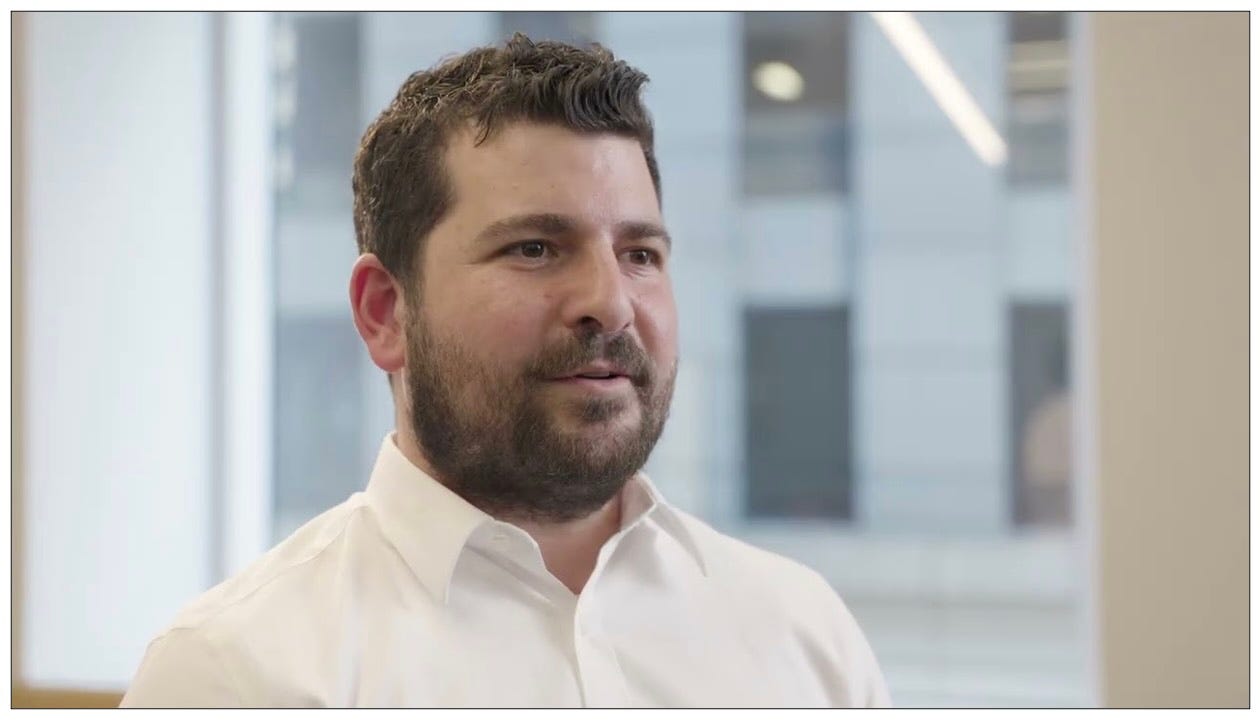
“It’s expensive to build and maintain quality technology products and run a services business,” Sahyoun says, a problem made more acute by the fact that software makers have greater cash flow to fund R&D with than a services business.
“Your addressable market would only be the businesses that you own, so you just have a lot less capital coming in. Whereas somebody that has business coming in from all the MSPs in the world gets a lot more capital to innovate and support their technology,” Sahyoun says. “I just don’t know that it scales.”
Or that it’s necessary, he adds. “I think we could see a lot of innovation coming out of the third-party tools.” We already are, in fact, he continues.
“There are a few existing tools out there—I won’t get into name-dropping vendors—that I think are pretty game-changing,” Sahyoun says, adding that Evergreen will test highly customized deployments of two such tools in the field soon, and more perhaps later.
“We have over 100 MSPs, so we’ve got a very high number of experiments that we can run,” he notes.
Evergreen will be experimenting with AI-native business models in addition to AI-native software. “We’re going to take a couple of our MSPs and rebuild them from the ground up in an AI-native way, with a completely new team. Completely rip out everything you think you know about how an MSP should run and rebuild it from first principles,” Sahyoun says. His expectation is that a highly effective model for building the AI-first MSP of the future will emerge from that trial and error.
“It’s our job to figure out how we apply that to the rest of the operating companies,” he says.
Everest likes the Palantir model too
So say you’re an MSP who very much likes the sound of FDEs with a Silicon Valley pedigree helping you roll out AI updates, but don’t want to sell your business to Shield. To the best of my knowledge, you have one option right now, a startup named Everest that bears an interesting resemblance to Shield.
For one thing, it’s backed by venture capital, in its case venture investor Y Combinator. For another, it dispatches FDEs to its partners.
“We’ve adopted a Palantir model of high customization,” says co-founder Yolanda Cao (pictured). “We travel to our customer’s office, sit with their technicians to customize and fine-tune our platform, and make adjustments based on technicians’ feedback, because each MSP runs slightly differently and people have different habits.”

That typically includes about two weeks of initial onboarding, she continues, but can extend to additional engagements later. “It’s almost like we are embedded into their team as a growth partner,” Cao observes. “They don’t just get service desk automation. They get our expertise and advice on how they can add new ideas and new areas of automation to their business, or sell certain solutions to their customer base.”
That last bit is important, because it points to something that separates Everest from most of its competitors in the AI-for-MSP vendor community.
“We enable our customers to resell us to their customers,” Cao says. Meaning MSPs successfully using Everest’s voice AI functionality to handle support and sales calls, for example, can pocket extra MRR selling the same feature to clients. Which further means those MSPs can be for their clients what Everest wants to be for its partners.
“Our goal is almost to be a managed AI service provider for MSPs,” Cao says.
The inspiration for that goal came to her during an earlier stint working the help desk for some 3,000 users at Netflix. “There were just four of us and each of us got 50 to 100 tickets a day sometimes,” Cao explains. “It was very repetitive, a lot of tasks and questions. So we started building up some automation internally to help our lives become easier.” A conversation with an MSP friend eventually opened her eyes to the fact that a lot of people who’d benefit from those same tools didn’t have them.
“That kind of inspired me to quit my job and build for the channel,” Cao says.
The service she and co-founder Spencer McKee (a former software engineer at Microsoft) created doesn’t come cheap. “It’s in the range of a few thousand to maybe $20K per month,” says Cao of Everest’s pricing. “It really depends on the level of customization and their scale.”
Which, of course, reduces the number of MSPs big enough to buy what Everest sells. “But we generate a lot of value for each of them, and then the contract size becomes larger,” Cao says. “It adds up.”
Guess what?
ConnectWise is thinking hard about this AI stuff too. No better way to find out specifically what it’s thinking than to tune into the latest episode of the podcast I co-host, MSP Chat, which features an interview with CEO Manny Rivelo. Other great interviews with industry leaders are available here.

MSPs battle the AI backlash
I cast myself as the Grinch in a recent post, but you can make the argument that the real Grinch this holiday season is AI.
I mean, I’m not the one driving electricity prices so high that the only Griswold holiday house most Americans can afford these days fits on a countertop. Nor am I responsible for driving up the price of everyone’s favorite holiday gifts by commandeering a huge hunk of global DRAM output.
Those (semi-)facetious complaints aren’t the biggest ones on people’s minds, either. A lot of folks blame AI for things like the higher unemployment recent college graduates are experiencing relative to workers overall, and there’s at least some evidence they’re right: Employment’s down 16% for “early-career” workers in “AI-exposed” fields like software development and customer service relative to more experienced peers in the same roles, according to researchers at Stanford.
Is it any wonder, then, that next to the much-feared AI bubble, the AI backlash might just be the biggest AI-related story of 2025? Indeed, research by CNBC last summer found that 68% of Americans are “uncomfortable with AI,” while a Pew Research Center study published two months ago suggested the U.S. is a global leader in being more concerned than excited about the technology.
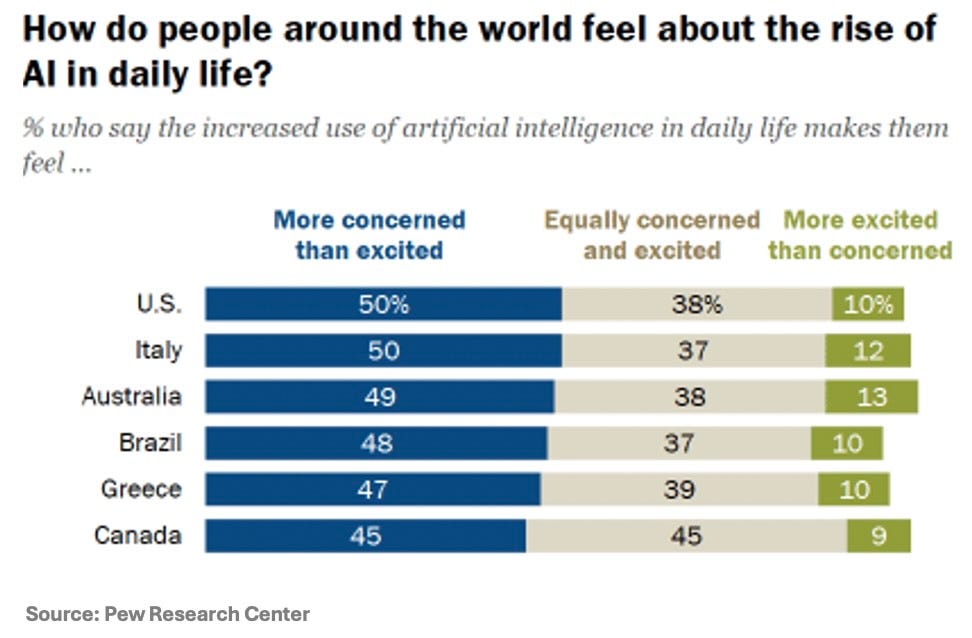
The thing of it is, though, some Americans are if not excited about AI then at least optimistic about it. Roughly 93% of corporate leaders and 80% of investors believe AI will have a net positive impact on society, according to non-profit Just Capital, while 68% of CEOs plan to increase AI spending next year, according to advisory firm Teneo.
Which raises an interesting question: What happens when MSPs, following advice from me and many others, start talking clients into deploying AI business solutions that yield disappointing results because AI-wary employees resist using them?
It’s not a theoretical question, either. I asked three of the most AI-savvy MSPs I know if they’re seeing this kind of thing, and all three said yes.
Sometimes, anyway. “I notice it most when people are trying to come up with a problem to solve to implement the technology, instead of implementing the technology to solve a problem,” says Jake Van Buschbach, CEO and president of Burnaby, B.C.-based Umbrella I.T. Services. “I have experienced almost no pushback at all when it is being used to deliver reports, automate mundane tasks, create resources, and other back-end tasks.”
Plenty of people are using AI at work in the shadows, moreover. Indeed, 81% of workers and an astonishing 88% of security professionals use unauthorized AI tools on the job at present, according to cyber risk management vendor UpGuard. So the real issue probably isn’t resentment of AI generally among rank-and-file employees so much as wariness of unfamiliar AI solutions forced upon them by management.
Which points the way to the techniques for overcoming resistance that my trio of contacts are having success with so far, all of which hinge on cultivating trust.
“The key to overcoming resistance is deliberate adoption pacing. Start small, celebrate quick wins, and build confidence,” says Brian Weiss (pictured), CEO and chief AI officer of San Luis Obispo, Calif.-based ITECH Solutions. Weiss typically introduces users to AI via productivity-boosting capabilities baked into Microsoft 365, like intelligent meeting recaps and Copilot Chat, rather than big, disruptive workflow overhauls.

“These deliver immediate wins without massive complexity,” he says.
Dave Blake, general manager of the Seattle regional office at Convergence Networks, says that letting employees see AI produce results without being part of it has a similar effect.
“We find it’s best to focus an organization’s first steps into AI adoption on projects that don’t require employee involvement, such as automating a workflow or billing process,” he says. “Once some wins happen independent of adoption, there is something to point back to and it’s a bit easier to get buy-in on more employee-centric AI implementations going forward.”
Above all, Weiss urges, don’t oversell the technology. “We’re upfront about today’s limitations: AI still needs human oversight, and it won’t solve everything,” he says. “When we frame it this way, employees usually shift from skeptical to curious pretty fast.”
Also worth noting
Google has a new three-tier partner program with a revamped competency framework and rewards model coming early next year.
Speaking of Google, it’s expanding its strategic partnership with Palo Alto Networks for securing AI workloads on Google Cloud.
WatchGuard has introduced a new Zero Trust Bundle that unifies identity security, endpoint protection, and cloud-delivered secure access into a single platform.
Auvik has integrated its network management platform with ServiceNow’s CMDB to keep network and device inventory up to date automatically.
KnowBe4 has a new customizable deepfake security training experience that lets organizations create realistic simulations featuring their own leaders.
ScalePad’s Lifecycle Manager now integrates with Liongard to automatically sync Liongard-discovered devices.
The glass half full take on new data from Guardz showing that 43% of U.S. SMBs suffered a cyberattack in the last year is that it means 57% somehow managed not to.
CloudBolt has signed a multi-year Strategic Collaboration Agreement with AWS.
According to new research from The Channel Marketing Association, channel marketing plans for 2026 boil down to four words: Flat budgets. Rising expectations.
Dell and Equinix are partnering to offer a cloud-adjacent data center architecture featuring Dell PowerStore and PowerFlex hardware running in Equinix facilities.
Still no end in sight to AI infrastructure spending. Global data center capex was up 59% year-over-year in Q3, according to Dell’Oro Group.