


Perhaps it’s time to rethink resilience.
OpenAI certainly thinks so. There are nine references to “resilience” and “resilient” in the company’s recently published thought piece on AI’s social, economic, and political implications, only one of which is (glancingly) about the kind of resilience we in IT know best, which is cyber resilience.
N-able thinks so too. Protecting systems and data is critical stuff, the company believes, but bring it up with a CEO and they’ll pass you along to their CIO, or whoever else they pay to worry about systems and data.
Business resilience, by contrast, goes straight to every CEO’s innermost anxiety: business continuity. As in, will I continue to have a business if it gets hit with something dangerous and unexpected. Same underlying technologies. Different, more compelling conversation, which is why encouraging partners to discuss business continuity in the existential sense was high on N-able’s agenda during its Empower conference in Fort Lauderdale last week.
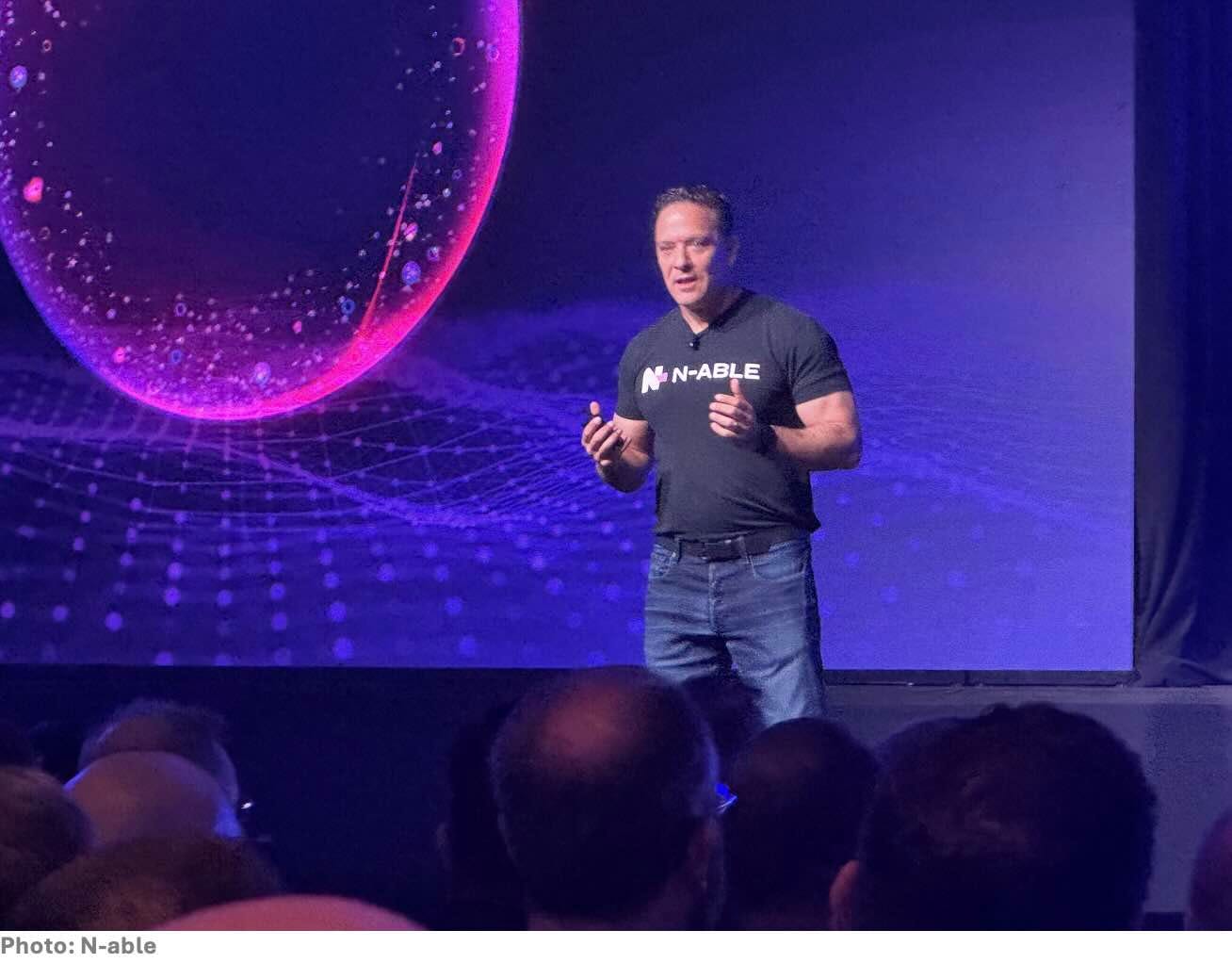
“The goal really is to make sure that there’s a resilience layer around businesses so they’re not disrupted,” says John Pagliuca (pictured), the vendor’s president and CEO.
He was talking about the kind of disruption associated with downtime, of course, but I’d argue that in the AI era the kind of disruption associated with Clayton Christensen is at least as relevant to business continuity. SMBs appear to agree too. 62% of them, according to data from Pax8 last month, think AI has become a requirement for continuing to be competitive, and 67% expect to use AI more often in the next year as a result.
The problem, however, is that AI refuses to stand still. With new models, new tools, and new growth strategies, both real and illusory, popping up faster and faster, true business resilience these days is about more than being ready for cyberattacks. It’s about being ready for anything.
“There’s a workforce level of resilience that we need to be thoughtful of. There’s a financial level of resilience that we need to be thoughtful of. There’s a technological level of resilience,” Pagliuca observes.
And, if you’re an IT provider, a level of “unit economic resilience and margin resilience” as well, according to Will Dawson, mideast regional CEO of Lyra Technology Group, the managed services arm of mega mega MSP Evergreen.
“For me, the first step to resilience is owning your P&L and having that P&L discipline so you can react and then reinvest or shift as necessary,” he says. “You can’t be nimble, you can’t react in real time to macroeconomic market changes and market dynamics that are occurring, unless you actually have that very, very dialed in.”
Especially now, when the real time you’re trying to react to keeps accelerating. “The world is speeding up and it’s going to just get faster and faster in this agentic world,” Pagliuca observes.
MSPs are desperate to keep pace. “I cannot tell you how often I’ve heard that,” says Pax8 chief strategy officer Ryan Walsh. “I want to go faster. If I have an insight, I want to go faster. If I have a good offering, I’ve got to go faster.”
Which is why I’m starting to think that the strategic software asset MSPs most need might not be systems of action, per an earlier post, after all. Action is fine when you’re talking generative AI. It’s too slow when you’re talking agentic AI. To win under agentic conditions, you don’t need a system of action. You need a system of speed.
When humans are too slow
It’s a clumsy term that I just made up, so you’ll probably never encounter it again, but the underlying logic is clear enough. A system of action automates work. A system of speed accelerates automation by taking humans as far out of the loop as one dares.
The most obvious use case, per my RSA Conference writeup a few weeks ago, is security. Businesses used to have a good two weeks to detect and remediate a breach before data was exfiltrated, encrypted, or both, says Robert Johnston, the VP and general manager in charge of N-able’s Adlumin MDR/XDR unit.
“Now you might have 10 minutes, 20 minutes,” he notes. “We’re going to be outpaced by attackers if we’re not able to change the way we do defense.”
And overwhelmed, one might add, once frighteningly effective models of the kind Anthropic has teased us all with make finding and exploiting vulnerabilities much, much easier.
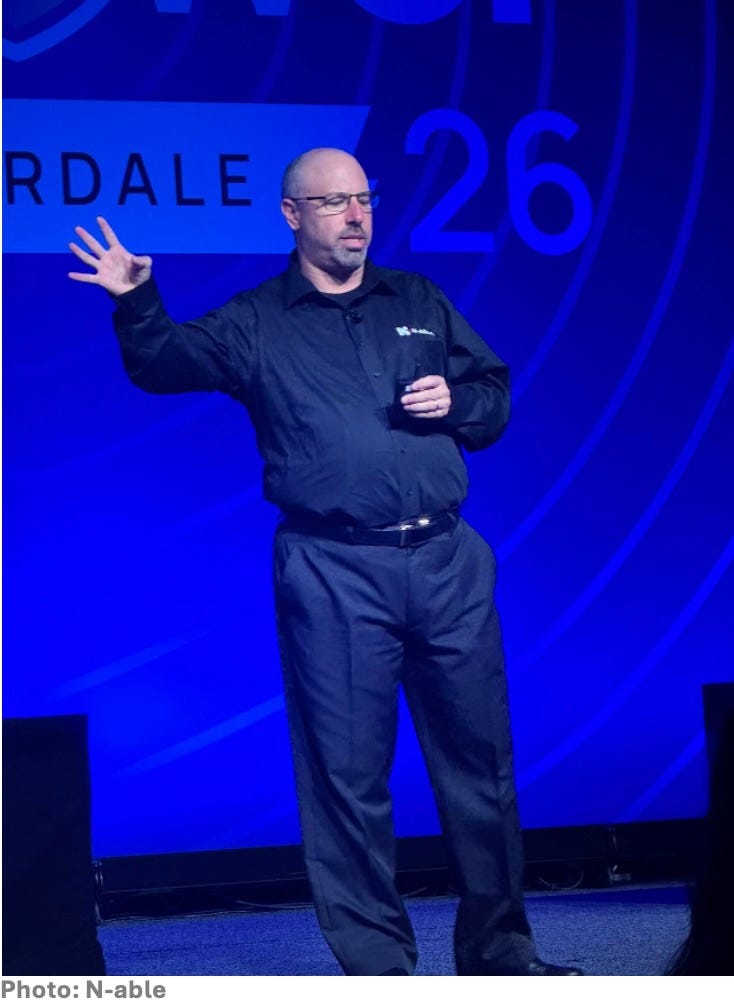
“There’s a tidal wave coming,” says Mike Adler (pictured), N-able’s chief technology and product officer.
Adlumin is N-able’s system of speed for coping with that tidal wave. Powered by the same AI that attackers are exploiting, the service handles 90% of incidents that “might have taken you hours, maybe the better part of a day” to tackle, according to Pagliuca, in more like 14-16 minutes instead.
Modern Threat Protection is ConnectWise’s equivalent. Introduced earlier this month, the combo managed EDR, SIEM, and email security solution employs seven role-specific agents to triage and analyze security events and then, if necessary, isolate affected endpoints, open a ticket, and attach a detailed incident report, all at a speed humans can’t match.
“People, especially in tier one, are too slow,” says Russ Humphries, the vendor’s EVP of product management for cybersecurity and data protection.
They also make too many mistakes, Humphries adds. Agents, by contrast, are reliable enough for ConnectWise to offer a 15-minute SLA and money-back guarantee on the managed EDR portion of Modern Threat Protection now, and an additional portion soon.
“All of that agentic goodness, all of that auto-ticket generation, all of that auto-triage, and the SLA promise will be coming to our SIEM offering by the end of this quarter,” Humphries says.
ConnectWise, as we saw earlier this year, is bringing system of speed functionality to ticketing as well. So too now is N-able. Among its several product announcements at Empower was the launch of N-zo, an AI-powered technical expert embedded in N-able’s unified endpoint management solutions.
“It’s really a series of experts,” Adler says. One, for example, specializes in scripting. Others focus on patching, asset management, backup, and the like. Right now, all of them provide real-time advice through a natural language chat window. Later this year, they’ll begin accelerating response times by handling tasks (with human approval) autonomously for users as well. Longer term, according to Pagliuca, forthcoming proactive AI technologies will cut response times to zero by reducing the need for response times in the first place.
“The real goal is not to respond to a ticket fast,” he says. “The real goal is to alleviate the majority of tickets from happening before they even need to happen.”
Partners like Frank DeGeorge, CTO of Lake Forest, Ill.-based Impact Networking, are willing to wait for advances like that, from N-able and others. But not forever. Vendors are making a lot of AI-related profitability promises right now, he notes. Sooner versus later, that ROI needs to start materializing in objectively measurable ways.
“So revenue per employee, profit per employee, number of endpoints per engineer, first call effectiveness,” DeGeorge says. “Those are the things that I’m going to look for in the next 12 months, because all this is BS if it doesn’t move that number. There has to be real operating leverage.”
N-able and ConnectWise agree: SecOps alone does not a platform make
The need for speed isn’t the only thing N-able and ConnectWise agree on. They’re also big believers in the power of platform. As you’ve read here before, most MSPs these days like the sound of sourcing more products with tighter integration from fewer suppliers.
“MSPs prefer to consume full end-to-end solutions that provide them an outcome, and if they can get that from a single vendor, that’s a win,” Adler says.
The DRaaS solution N-able introduced during Empower illustrates why, he adds. MSPs need BDR solutions and post-disaster recovery environments. Getting both from the same vendor saves time and money.
“I can test a runbook from beginning to end, and I only have one vendor to worry about, and I know that it’s all integrated,” Adler says. “That’s just tremendous value.”
It’s also something most security platform purveyors don’t offer, making it part of a larger edge both N-able and ConnectWise claim over companies like Palo Alto, CrowdStrike, and Trend Micro. Those vendors do security operations, notes N-able CMO Vikram Ramesh. We do security operations, IT operations, and data protection operations in a single, natively-integrated package.
“Our competitors offer one piece of the story, or they may offer the second piece with a partnership, but they don’t have all three,” Ramesh says.
That N-able does saves its partners time during investigations and remediations, Johnston notes, and saves them money on service delivery.
“When you look at our customers, the same people doing IT operations are the same people doing security operations,” he says. Handling both functions in one place boosts technician productivity.
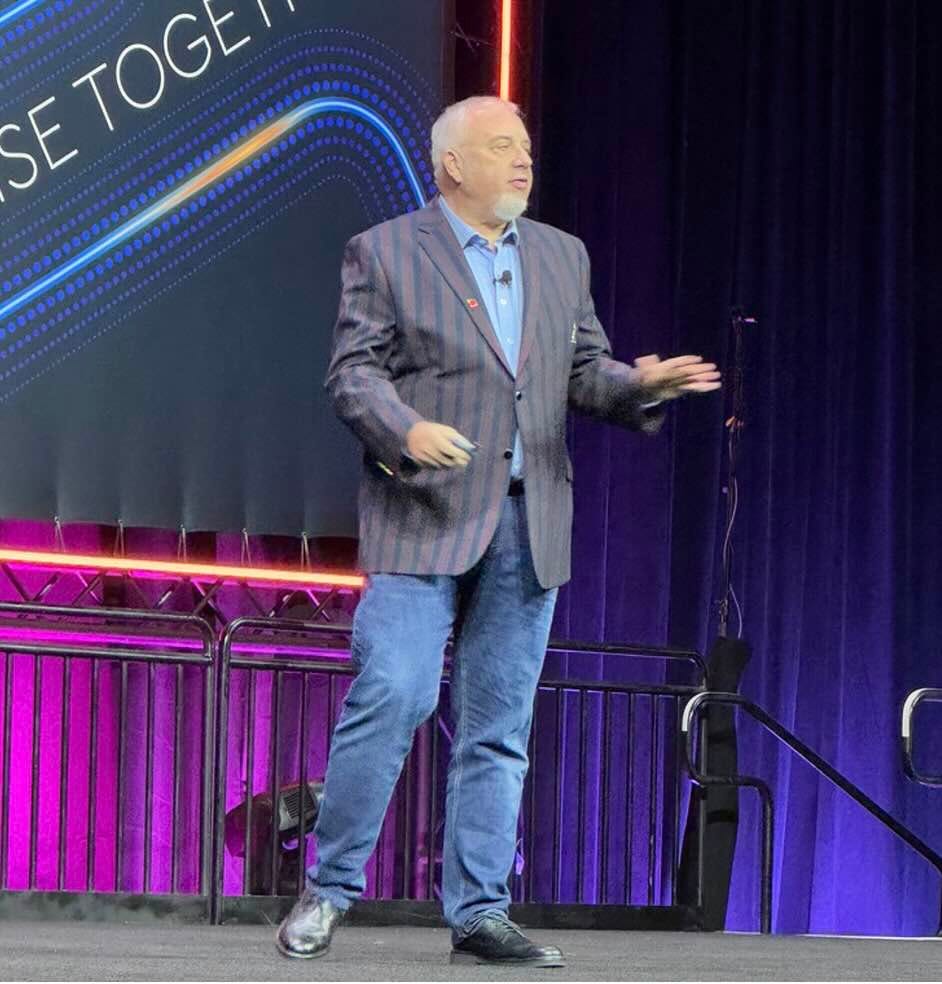
Humphries (pictured) agrees. Security vendors can promise the same result via “perceptual” platform connections with alliance partners, he observes, but can’t deliver the same results without the kind of deep integration made possible by real platforms like ConnectWise’s Asio.
“Perceptual platforms are quite often a set of modules that are glued together with plumbing,” he says. “A real platform has services and a microservice architecture and service buses.” MSPs, Humphries asserts, want the real thing.
From the department of corrections
Mea culpa. Remember when I said that N-able’s now a security vendor last November? I was wrong. Or rather, I was right, but only partially so.
Talking with N-able executives last week about the vendor’s unified SecOps/ITOps/DataOps platform made clear that while N-able is a security vendor, it’s also an endpoint management vendor and data protection vendor. That, in turn, means its competitors include not only Barracuda and Sophos, but ConnectWise, Kaseya, NinjaOne, and Veeam as well. That’s a lot of well-known, well-funded businesses to outflank, Ramesh concedes, but key to the company’s value proposition as well.
“We’re the only vendor focused on the SMB space that has the three pieces of the story,” he says.
Over on the Business of Tech
Host Dave Sobel spent time talking about Treeline, the venture-backed MSP I wrote about recently, with someone who looks a whole lot like me.
Because he was me. Or is me, rather. Listen to the whole conversation here.
Some vendors fear SaaSpocalyptic disintermediation. N-able doesn’t.
At least three companies I’m aware of made MCP-related news last week. One was N-able, which unveiled a new MCP server giving third-party AI solutions direct access to data in the company’s unified endpoint management systems. The other two are Salesforce and GreenCore Solutions Corp.
And who, you ask, is GreenCore Solutions Corp.? Why, none other than the maker of the TreeFree Diaper®, an environmentally responsible alternative to the likes of Pampers and Huggies that’s now also, thanks to GreenCore’s new MCP server, “the first AI-ready diaper SKU in the market.”
Laugh if you like, but I applaud their vision. Parents have done the diaper shopping for about as long as retailers have sold diapers, but in the not-too-distant future their agents will perform that function instead. Rather than fight that development and its troubling implications for brand awareness and customer relationships, GreenCore is embracing the inevitable.
So is N-able. Some CEOs undoubtedly fear becoming an invisible data lake for MSPs who use Claude or ChatGPT as their primary help desk tool. Pagliuca (like the folks at BDR vendor Slide) is entirely chill about it.
“Some folks in MSP-land and enterprise are going to choose to have a different interface experience, and so they might not be spending all of their time in the SaaS tools, which troubles a bunch of SaaS vendors,” he says. “It doesn’t bother me.”
Everyone else should get used to it too, Johnston adds. “The writing on the wall is customers expect to be able to chat and interact with their systems and command them to do things and consume information from them in a natural language format,” he says. “That’s just the bandwagon all the software vendors have to get on, because consumer expectations are going to go that way.”
And by consumer he very much means MSPs, and all of them, within perhaps five to seven years. No matter how intuitive their design, today’s RMM solutions take time to learn. “What MCP kind of allows you to do and AI allows you to do is erase that to zero. You just have to know what you want and somewhat what the system is capable of doing, and then you can just chat it in or voice it in and it’ll figure it out for you,” Johnston says. “You don’t have to learn the UI anymore.”
N-able doesn’t even mind the disintermediating prospect of ending up a contributing data provider to someone else’s newer system of action or more all-encompassing system of record.
“Different folks will bring different AI solutions to the market,” Adler says. “We can provide them pieces. We gain economic value. They gain economic value. It’s a win for both of us.”
And a source of competitive advantage over less forward-thinking peers, he adds. “We’re able to service different kinds of customers from the same avenue.”
Two pod interviews for the price of one!
And that price is nothing. I spent the first part of last week, before my visit to N-able Empower, at the Channel Partners Conference & Expo, moderating panels, speaking (off the record) with Shield Technology Partners CEO Jim Siders for the first time, and recording two interviews for MSP Chat, the podcast I co-host. One was with Bobby DeMarzo, the impresario in charge of the Channel Partners show. The other was with Peter Kujawa, the EVP in charge of ConnectWise’s IT Nation and Service Leadership groups. Both are included in the latest episode, available here.

Also worth noting
Speaking, as we have been, of cyber resilience, 87% of U.S. SMBs feel slightly to very confident that their business is cyber resilient, according to research from ESET. I’ll be getting into that with the company on an upcoming episode of MSP Chat.
According to Kaseya’s 2026 State of the MSP Report, 48% of MSPs rank AI and automation as their top client needs for 2026, but just 13% are generating revenue from them. I’ll be getting into that on another upcoming episode of MSP Chat.
Veeam’s latest research says that 90% of security leaders believe they can recover quickly but only 28% hit by ransomware could fully restore all affected data. I’ll get into this with the company a little under a month from now at its VeeamON event.
New Charter Technologies is mega mega-er following its acquisition of GraVoc.
Microsoft’s Windows 365 Business service will be 20% cheaper starting May 1st.
TD SYNNEX has added dedicated NVIDIA HGX B300-based clusters to its Nebius AI Cloud offering.
TD SYNNEX is also partnering with Orca Security on AI-driven cloud security.
D&H’s new Success Path to MSP Toolkit is designed to help resellers become MSPs or MSSPs.
Salesforce has launched a Forward Deployed Engineer Partner Network and AgentExchange, a Pax8-esque marketplace for AI agents and related solutions.
WatchGuard is integrating its cloud-based management interface with Halo’s rapidly up-and-coming PSA solution.
Bitdefender has introduced GravityZone Extended Email Security to provide advanced email threat protection.
Axonius has released AI-powered remediation capabilities across a wide range of asset types and environments.
And not a moment too soon, either: Sectigo has added private post-quantum cryptography certificates to its Certificate Manager offering.
KnowBe4’s new Agent Risk Manager aims to secure both human users and AI agents against security threats.
Aura has launched a BYOD security offering for MSPs designed to protect employee-owned devices in business environments.
Cork has introduced an automated data mapping feature to address the “dirty data problem” in MSP cybersecurity programs.
Blancco and Cambrionix have launched an integrated solution for erasing and reimaging Apple devices at scale.
86% of businesses expect AI agents to outpace their organization’s security guardrails within the next year, according to Rubrik.
Keep in mind that Anthropic’s Project Glasswing is scarcely two weeks old and that Synack probably hasn’t seen Mythos Preview yet before deciding whether or not to take Synack’s new Glasswing Readiness Assessment.
Trustifi has introduced AI-powered security awareness training videos.
Keeper Security has added new governance and visibility capabilities to its Endpoint Privilege Manager solution.
According to HP, Poly Edge V Series desk phones all use NoiseBlockAI technology to deliver next-gen call clarity.
80% of IT professionals see their role shifting from operator to AI orchestrator, according to new research from SolarWinds.
SolarWinds has also launched SW1, an agentic AI teammate designed to automate and enhance IT operations.
Procure IT and NetWolves are partnering to deliver AI-driven intelligence and technology expense management.
Tracy Thibodeau is the new VP of product, AI, at Monjur.
AppDirect has acquired PartnerStack to equip its B2B subscription commerce platform with built-in PRM.
The Alliance of Channel Women has announced winners of its 2025 IMPACT and Sponsor Awards recognizing contributions to the channel community and its 2025 LEAD, INSPIRE, and EMPOWER awards honoring influential women in the channel.
Cloud Girls Rising’s Women to Watch awards program has recognized six emerging women leaders in technology.
Tech4Change has announced the winners of its inaugural Heart of the Channel Awards.