


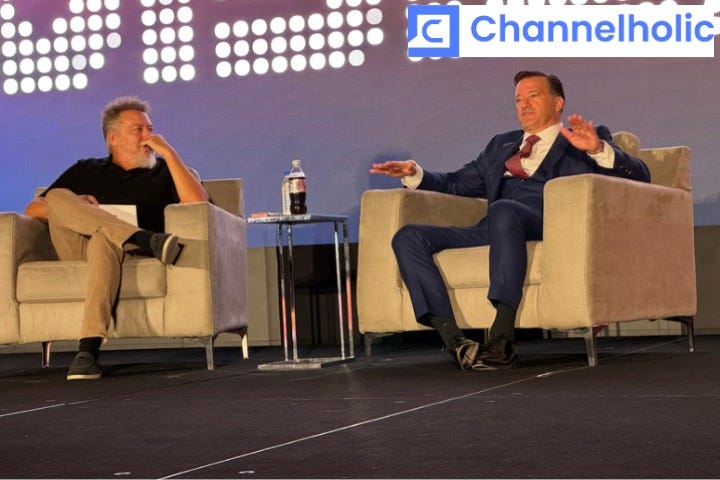
I wouldn’t necessarily count Fred Voccola among the AI accelerationists, but he undeniably shares some assumptions with them.
“AI is the single largest disruptive innovation humanity has ever seen,” he said last week during an appearance at MSP rollup The 20’s annual Vision conference in Dallas.
That includes innovations like the written word and electricity, he added, except that the former took centuries to reach fruition and the latter took decades. AI will do the same within about four years.
Channelholic readers, I trust, need no introduction to Voccola (pictured right above), who spent over a decade turning Kaseya from a promising young RMM vendor into one of the biggest names in managed services software, valued at $12 billion in 2023, which as far as I can tell is the last time the company publicly discussed the matter.
You probably haven’t heard much from him since last January, when he unexpectedly stepped down as CEO, but he’s been keeping busy. Among many other things, Voccola currently sits on six corporate boards and chairs two, including that of AI-powered business management software maker Simpro, where he’s also CEO. Much of that, however, came after what Voccola calls “a tough year, a personal year” following his departure from Kaseya (which he continues to serve as vice chair) spent clearing his head and dealing with “family obligations” presumably tied to the death of his father late in 2024.
Some of that year, however, was also spent going down a research “rabbit hole” on AI that he re-emerged from in November with both a book called The Coming Disruption: How AI First Will Force Organizations to Change Everything or Face Destruction and a deeply held conviction that AI is destined to transform more or less every aspect of life on earth.
“The implications that it’s going to have on business, education, society are like nothing we’ve ever seen,” Voccola says.
All of those implications interest him, but none more than the business ones judging by his decision to chair not one but two vertical industry AI vendors, Simpro, which serves trade service providers like plumbers and electricians, and Upshop, which serves retailers. Both companies go beyond merely accelerating workflows to offloading them altogether from humans to agents, or “digital workers,” as Voccola calls them.
In Simpro’s case, those workers include one named Fast Cash. Launched four months ago, the service autonomously manages billing collections. “Companies in the field service trades run on like a 5% margin,” Voccola says. “A 5% margin company can’t afford to hire an $85,000-a-year expert in the process of collections.” They can, however, afford to hire a digital surrogate for something like $4,000 a year.
“That digital agent replaces two, three, four hours a week that the owner of the business or the business manager does trying to collect money from 70 downstream customers,” Voccola says. “It also does it much better because it’s an expert.”
That’s just one of many use cases Simpro addresses, too. “Most of our customers can’t afford a full-time marketer, a full-time collections person, a full-time sales administrator, a full-time reporting person,” Voccola says. “Now they all have them because we’ve deployed digital workers to do those [jobs], and that’s tripled the profit margin of their business.”
It’s paid off well for Simpro too. The company’s tracking toward about $300 million in revenue, according to Voccola, and growing fast. Building Kaseya into the business it was when he left took more than a decade, Voccola says. Simpro is “creating something that will be twice as valuable in one third of the time.”
Off the chain margins
Could vertical agents work similar wonders for MSPs? Absolutely, says Voccola, because businesses can’t get profit-tripling returns from digital workers just by swiping a credit card. They need implementation and configuration help from experienced professionals who don’t come cheap.
“If Kroger spends $5 million, $3 million on Upshop, they’re going to spend $3 million implementing it,” Voccola says.
The numbers coming out of SMBs will be smaller but just as lucrative, according to Tim Conkle (pictured), The 20’s CEO. “Everybody in this room will be able to add, I think, thirty, forty percent revenue to your company without adding a single customer,” he told Vision attendees.
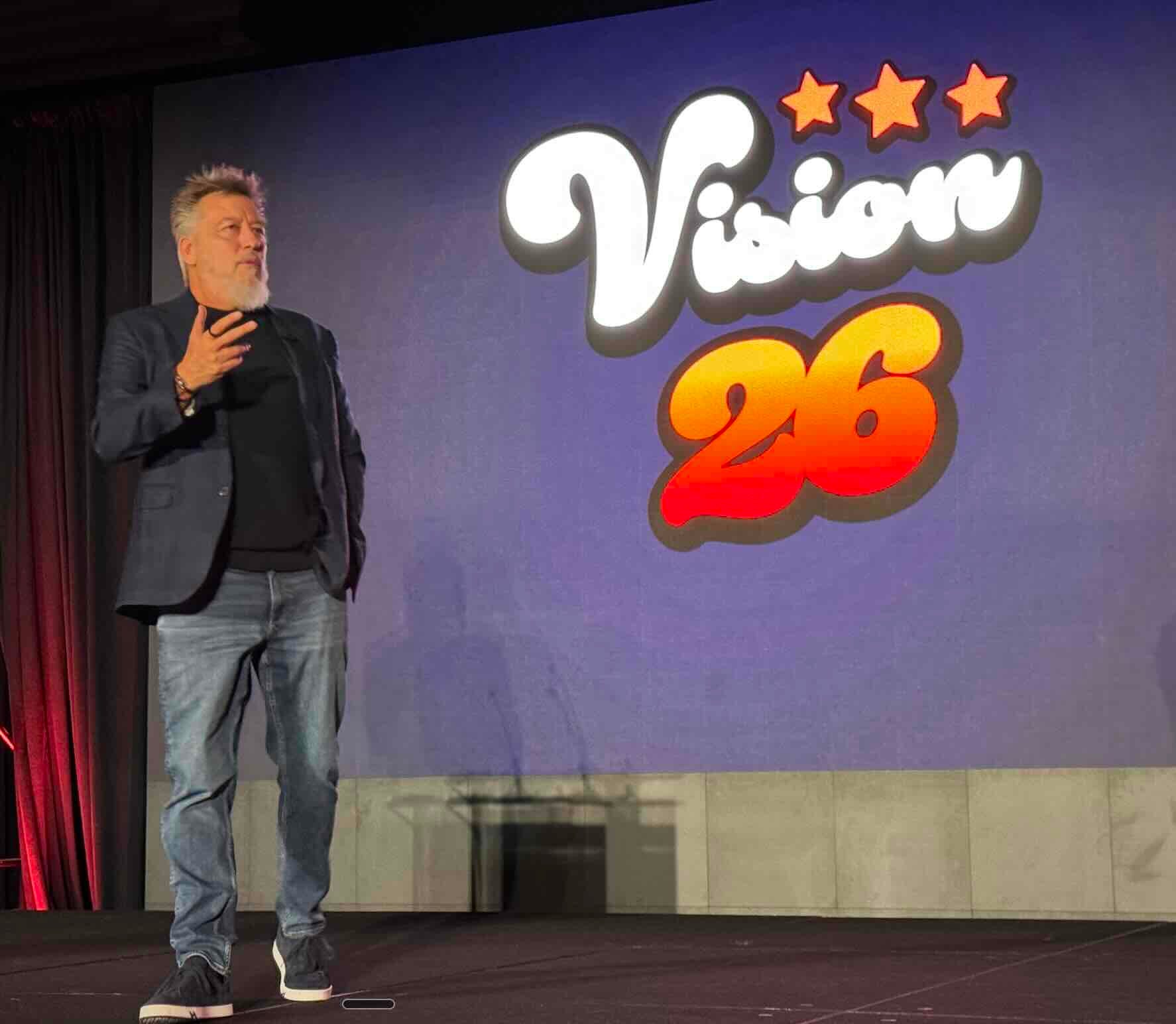
And retain that revenue more or less indefinitely, he added. Someone has to manage, monitor, and update digital workers once they’re on the job, and end users aren’t qualified. “There’s going to be tons and tons of professional services hourly work,” Conkle says.
The margins, he continues, are “going to be off the chain.” Say a digital worker does everything a flesh-and-blood equivalent does for 60% less money. “You give me 40% and I keep that employee working and upgraded and doing all the things that it needs to do,” Conkle says.
Unless, of course, you decide to scrap that deal and suffer the consequences, he adds. “When you stop paying me the 40%, I turn the employee off.”
Margins that steep and sticky can have big implications for exit valuations. A $1 million MSP with 20% margins generates $200,000 a year of EBITDA. Push that to 40% margins and $400,000 of EBITDA via digital workers, Conkle notes, and you’ve significantly increased your multiple without doing anything all that different.
Size matters
Sounds good, but there’s a wrinkle that’s easy to miss. The same agentic expertise that doesn’t come cheap to end users doesn’t come cheap to MSPs either, and most can’t afford it.
“There is absolutely no way individually anybody in this room is going to take AI—real AI—to their customer, I don’t care what you say,” Conkle told Vision attendees. “You’re going to have to have a team that actually goes into your customer and actually starts dissecting their business and trying to figure out how can we automate it or how can we use AI to make their company efficient.”
Which is simply too expensive for a small provider to handle, he continued. “You’ve got to be a big MSP to actually put the money on the table to actually start bringing this to reality.” The 20, which has been making the “go big or go home” argument to MSPs for a long while, has been doing just that.
“We’ve already made the hires to start that department,” Conkle says, and they’ll hire more in the future as demand for consulting services grows. “I don’t think that’ll ever end.”
Nor will the work done by The 20’s R&D unit, a separate team of eight people actively building custom internal automation tools for tasks like performing client account analysis, practicing sales calls, and preparing quarterly business reviews.
“It would take an account rep between three and four hours to build a QBR. It’s a click now,” Conkle says, followed by a few minutes of waiting while AI does the actual work for them.
In theory, you don’t have to be a mega or mega mega MSP or have access to giant pools of private capital to develop custom tools and recruit consulting experts, Voccola says. Any “smart, aggressive, and capable” company can potentially pull it off. But being big sure does help.
“All else equal, size matters and scale matters,” Voccola says, and by enough to materially increase your odds of success.
“60% chance,” he explains. “That kind of materially.”
The SaaSpocalypse cometh, but not for everyone
Simpro and Upshop are both AI businesses, which makes them eminently investable in the current venture capital climate. They’re also, however, SaaS companies, which in some minds makes them significantly less investable. Clearly, then, Voccola is not a believer in the SaaSpocalypse, right?
“I’m a huge believer,” he says. But with one key twist. “It depends how you define SaaS.”
AI-native SaaS vendors like Simpro and Upshop, Voccola argues, are high-growth, high-margin businesses delivering measurable ROI to their users. And by high growth, high margin, he means high enough to redefine the SaaS world’s traditional Rule of 40.
“A company growing 30% at 40% margin is at a Rule of 70,” Voccola says. “That trades at a nice premium.” It also gives a SaaS vendor room to exchange margin for innovation in ways that can widen its lead over time, Voccola adds.
“Theoretically, a company growing at a much faster rate can afford to run at a lower profit margin because the value is seen more in the growth,” he says. “If they’re running at a lower profit margin, it means they’re investing a larger percentage of their money in their product. If you invest a larger percentage of your money in your product, it’s not a guarantee but the chances are your product will be better and faster than your competitors’.”
So is the SaaSpocalypse real? Voccola believes it is, but its victims won’t be companies like Simpro and Upshop. It’ll be companies with no differentiation from LLMs, no defense against vibe coding, or too much legacy overhead to get in on the AI opportunity before it moves on without them.
“A lot of legacy software companies have not been able to adapt to the AI era fast enough,” Voccola says. “They still run their operations as if it was 2023 and they haven’t been able to figure out how to deliver product their customers need.” Most of them are financially sound, he continues, but their upside is limited.
“They might see two, three, four, five, six, seven percent growth and they might run at thirty, forty, forty-five percent margin, but they’re not growing thirty or thirty-five percent at forty percent margin.”
Voccola calls those companies zombies, and there are a lot of them out there. Indeed, about 40% of PE-owned U.S. companies, representing more than $860 billion in net asset value, have been held for seven years or longer, according to PitchBook, marking the third straight annual percentage increase and the highest percentage, period, since 2016. That’s a problem for their owners, according to Voccola.
“A lot of the private equity firms that bought them overpaid, and it’ll be a long time before they see any value,” he says. Which, he adds, “has implications downstream.” One way or another, Voccola predicts, the PE guys will come out fine.
“They’re smart people who figure out ways to make money,” he says. Whether the same is true of people who’ve built a zombie company’s solution into their tool stack is harder to say.
“If I owned an MSP, I would look at that dynamic in my vendor selection,” Voccola says.
Want more thoughts on the SaaSpocalypse?
First, read this blog post by David Schwartz, CEO of Pia. Then check out my interview about it with Schwartz on the latest episode of MSP Chat, the podcast I co-host. Lots more equally good stuff here.

The system of record edge
Simpro’s prospects would be limited if it trained digital workers the way companies have long trained human ones.
“You teach them stuff. You talk with them,” Voccola says. “They sit down with a peer. They learn.”
Digital workers, by contrast, learn by ingesting data, at a speed and on a scale no A+ scholar can match. The more data you feed them, moreover, the smarter and more effective they end up being, especially if the data in question is not only big but domain specific.
Which returns us to a topic I covered in my first post of the year. “Digital workers learn from systems of record that provide them with data,” Voccola says.
Simpro, which has details on 500 million service jobs from over 250,000 users and 40 partners worldwide in its database, is exactly such a system, Voccola says, and what makes it investable isn’t just that it’s AI native or in a high-growth, high-margin business. It’s that the company holds the strategic high ground available only to systems of record.
“If you are a system of record that means you control, you own, you have the data, the intelligence about that business in your archive somewhere,” Voccola says. “Whoever controls the system of record data can train the digital workforce to augment or supplement the human workforce.” Which gives system of record makers a durable edge over frontier labs and smaller AI-powered competitors.
Unless, of course, they give everyone who wants it access to their data via open APIs and watch the breadth and depth of their competitive moat evaporate. Voccola won’t go so far as to say open APIs are a bad idea (Kaseya, after all, is now “an API-first company” ), but for certain vendors in certain markets, they can be a risky one.
“Companies like Simpro have to ask the question, ‘Am I going to open my APIs to third-party vendors so they can build agents that will compete with me?’” Voccola says. “It doesn’t make sense to do that for the most part.”
Which is why Simpro competitor ServiceTitan recently told about 1,000 customers it shares with Podium, a maker of digital sales and marketing workers, that integration between the two platforms ends next month. The details are worth investigating before you assume ServiceTitan and every other system of record operator is destined to lock down their data, but the story does call into question whether the MCP-powered spirit of openness most vendors in the MSP ecosystem have exhibited to date will endure.
Voccola, for one, is skeptical. Just because vendors say they’re committed to data sharing doesn’t mean they truly are.
“Who’s going to say they’re not going to be open?” he asks. “No one has the balls to say that.”
Over on The Business of Tech
Host Dave Sobel draws an easily missed line between AI slop, Anthropic’s new digital watermarking, and MSP client relationships:
“… the thing that used to separate providers — being able to produce a good-looking assessment, a clean runbook, a thorough review — just stopped separating anybody. Every competitor you have can generate that document tonight for nothing, and the market has been handed a test that proves it. What’s left to compete on is a written review standard and somebody’s name on it, which is the one thing in your delivery that can’t be downloaded, matched in a quarter, or undercut by a firm that bought the same tooling you did.”
Worth mentioning as well that I’ll be on the show live this coming Wednesday at 3 p.m. eastern to discuss AI pricing trends, early signs of serious ROI from AI automation software, and more. Tune in here.
Also worth noting
D&H is newly authorized to carry Dell’s complete storage and server portfolio in the U.S. and Canada.
Nearly 96% of SMBs surveyed by Corsica Technologies trust their MSP “at least somewhat.” Nearly two-thirds may switch providers within the next year anyway for better cybersecurity, data integration, AI readiness, and other services. (Corsica Technologies)
62% of businesses use AI to vet vendor sales claims and 56% have removed a vendor from consideration after finding a discrepancy, according to the newly launched AI Revenue Institute.
Fortinet has acquired Virtue AI to augment its AI security capabilities.
Keeper Security’s new Microsoft Power Platform connector integrates Keeper Secrets Manager with Azure Logic Apps to help users avoid hardcoding credentials into automated workflows.
The new CPQ capability in Impartner’s PRM platform helps users create, submit, and get approval for sales quotes with less manual help from vendors.
IGEL users can now centrally reboot Windows endpoints into IGEL OS during cyberattacks or outages thanks to the vendor’s new Emergency Mode feature.
Napster—no kidding, folks, that Napster—has rolled out multilingual agentic AI call center functionality by adding SIP support to its Azure-native Napster API.
The Channel Marketing Association is accepting nominations for its fourth annual CMA Excellence Awards, which include new categories. Via its “Play to Pay” initiative, the group will also donate $5 for every nomination and application submitted.
The MSP OneShare community and its backer, International Business Products Inc., have named Bradley Gross its exclusive MSP legal resource.
Corey McCarthy is the new CMO at Devicie, a company you’ve read about here before.