


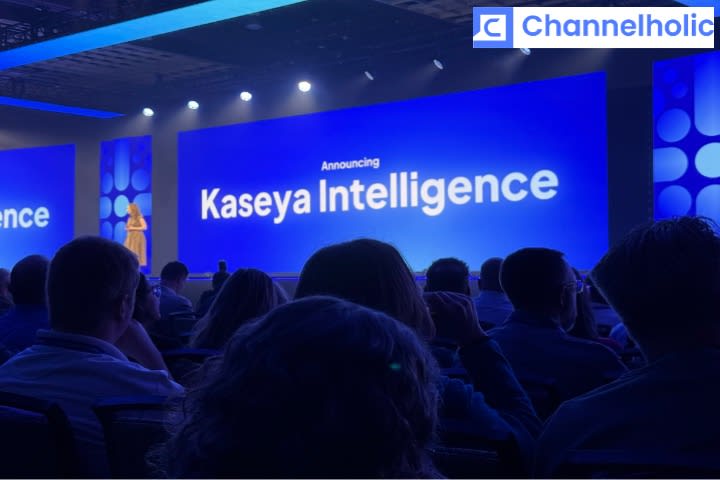
Raffael Marty has bad news for a lot of companies in our industry now: The thing you seem to think will best set you up to be among the software world’s next great success stories won’t.
“The winners are less likely to be those with the loudest AI messaging and more likely to be those with the strongest combination of data, workflow ownership, and commercial leverage,” says Marty, currently an operating advisor to security startups and formerly head of ConnectWise’s security product unit, in a recent blog post.
Or to state the matter sequentially, more data yields better workflows yields more customers, partners, and profits, along with the kind of defensible, durable commercial leverage software companies crave at a time when AI-native startups and frontier model makers both pose existential threats.
“This is not just a consolidation story. It is a data gravity story,” Marty writes, and it compounds upon itself.
“The vendor that sees more telemetry, sits in more workflows, and becomes harder to dislodge can improve models faster, distribute new capabilities faster, and defend retention more effectively.”
Marty’s describing the flywheel effect Kevin Lancaster of BetterTracker discussed with me earlier this year. Lancaster was talking about MSPs, but the core lesson applies to legacy software companies too: everything good these days flows downstream from data.
Rania Succar (pictured) knows it too, which explains what caught her eye when she became Kaseya’s CEO last June.
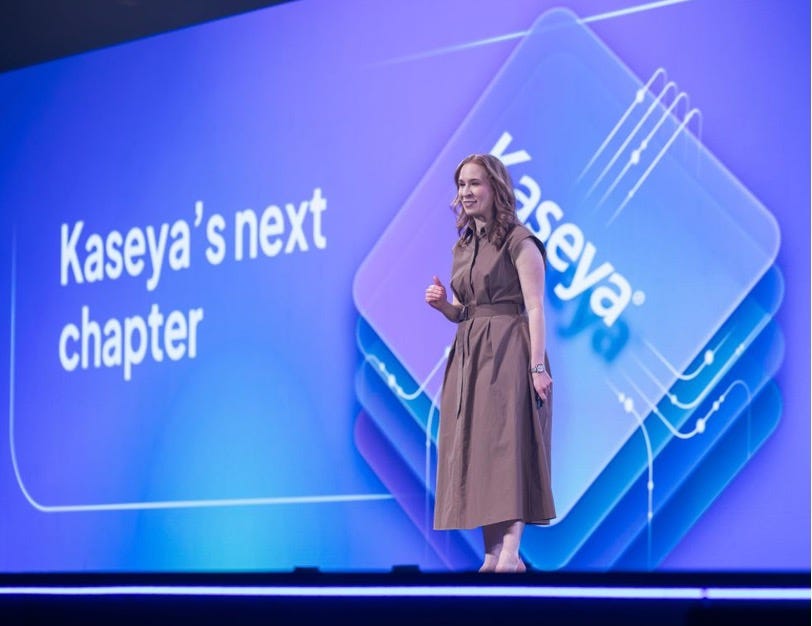
“The first thing I saw was the most extensive network of data about small and mid-market businesses when it came to IT and security,” she said last week during a keynote presentation at Kaseya’s 2026 Connect conference in Las Vegas. “There is not a network of data like this anywhere else.”
Hard to verify, but she may be right. Kaseya has 3 billion gigabytes of backup data on its servers today, plus all of the facts, figures, and notes associated with 1 billion help desk tickets. It’s currently supplementing all that with data from 44.4 billion backup jobs, 1.2 billion patch applications, and 16.9 billion security events every year too.
If data, as we’re all fond of saying, is AI gold, that data repository is Kaseya’s answer to the N.Y. Fed basement.
“This is the backbone of intelligence,” Succar said as she introduced the world to Kaseya Intelligence, the company’s new cross-product, cross-workload agentic AI engine. “Only when you have data this rich can you let the system be autonomous. Only then can you trust it to get to the right decision.”
Hence the energy Succar, per an interview last August, devoted early in her time on the job to consolidating and cleaning all that data. But AI’s not the only way data is useful to Kaseya, and arguably not even the way it’s most useful. That mass of data is an immense potential source of gravitational magnetism for both MSPs and other software companies, especially other AI software companies.
Actually, scratch the potential part of that statement. During an interview with Channelholic at Connect, Succar said she met last year with the founder of an unnamed AI automation startup akin to the ones I’ve been profiling in recent months.
“He said, ‘can you please open up IT Glue for us? We need it.’” Other vendors have made similar requests, she adds.
“They’re constantly knocking down our doors saying, ‘can you open the API?’”
Which she has to an initial degree, per a little noticed press release published early in February offering a progress report on the unexpected pledge Succar made during a keynote at last fall’s DattoCon event to turn Kaseya into an “API-first” company.
That promise grabbed my attention at the time but didn’t come fully into strategic focus until now. Indeed, despite what the headlines told you, I’d argue that the most significant announcement out of Kaseya Connect last week wasn’t the launch of Kaseya Intelligence so much as the forthcoming launch in July of a new family of unified APIs. According to Succar, they’ll first pay off by helping Kaseya integrate the many solutions in its product portfolio more deeply.
“Historically at Kaseya, we’ve been loosely connected as a platform, but with these APIs we’ll be fully connected,” she says. That’s only benefit number one, though, she adds.
“The next benefit is partners can then tap into the API, in and out, to get their own use cases, however they want to use it,” Succar says. “We’re an open platform and we want our customers to be able to use it whatever way they need to.”
Now, theoretically, of course, that’s a risky thing to want because it means companies Kaseya competes with could soon be helping themselves to all that gold in the company’s basement. Then again, that cuts two ways, doesn’t it? What’s to stop Kaseya from enriching its own data with data from its API partners?
Nothing apparently, because it’s already happening, per a keynote comment about the new API family from Kaseya CTO Pratik Wadher. “It brings together data from 60 different data sources across the ecosystem outside Kaseya, third-party data. It puts it in one place. It starts to analyze it, look for anomalies, and then starts to surface it very quickly.”
And that’s just the beginning. All those vendors Kaseya foresees using its system of record to power their systems of action will also be making Kaseya’s data mass more massive, more valuable, and more gravitationally irresistible in the process.
“We expect more consolidation onto the Kaseya platform,” says Succar of the API initiative. “We’ll get more share of wallet.”
They’ll also, per Marty, get harder to dislodge. Yes, competitors will ship copycat versions of Kaseya’s new ticket triage agent, noted Paul Burke, who runs the company’s agentic “digital workforce” platform, during a main stage appearance. But they’ll be starting from zero.
“Your Kaseya digital workforce will have months of proprietary intelligence specific to you and impossible to replicate,” Burke said. “This is not a feature. This is a moat that grows daily.”
It’s also why we’ll win, he predicted. Succar agrees, specifically with respect to companies like the AI-native startup that pleaded with her for IT Glue access last year.
“Most of them will not succeed,” she says. “They have nothing. They have no moat. They have nothing unique.”
Built in, not bolted on
You’ll be unsurprised to learn that David Schwartz, CEO of AI-for-MSPs vendor Pia, begs to differ. He can think of at least two things vendors like his have to offer that Kaseya doesn’t, starting with the kind of experience and know-how that come from focusing solely on AI in managed services for an extended period.
“It’s not a new product,” Schwartz (pictured left) says of Pia’s solution. “It’s been designed and built over the course of six or seven years at this point.”

It’s also platform-agnostic and hence free from vendor lock-in, adds Pia CRO Nic Ferraro (pictured right). “MSPs don’t want to get stuck in an ecosystem,” he says.
There’s a benefit to getting your service delivery automation software from the same company you buy the rest of your service delivery stack from, though, Succar argues, which is why the second thing that grabbed her attention upon becoming CEO after the data was Kaseya’s end-to-end suite of MSP line-of-business offerings. Data only makes powerful workflows possible, she argues. “To complete the workflow, you need the entire platform, and we have that.”
The AI-native startups Kaseya competes with don’t, Succar continues, which puts them at a long-term disadvantage.
“AI is going to move from being bolted onto platforms to being built in, and that’s where we’ll see its profound power,” she told her Connect keynote audience. “When it’s bolted on, AI is reacting to problems. When it’s built in, it predicts them. It fixes them. It eventually prevents them. When it’s bolted on, it’s like you have a generic consultant automating your workflows. When it’s built in, you have specialized models that deeply understand the domain and have the data to get you secure outcomes.”
Companies like Pia aren’t Kaseya’s only rivals in AI, of course. There are also companies like ConnectWise, which would probably tell you that its platform combines a data lake as deep and broad as Kaseya’s with Pia’s AI-specific depth, thanks to its acquisition earlier this year of AI-native startup zofiQ.
Succar, for her part, says not buying a company like zofiQ gives Kaseya an edge. “We looked at a ton of these AI startups that were building automation engines,” she says. “We realized that the easy thing to do would be to go buy a partner, but it wouldn’t get you the scale and the impact that we could get if we built it this way.”
Meaning entirely in house using “the very best technologists” in the industry, as in the same kind of top-tier engineers Shield Technology Partners, Titan, and Treeline have all hired to build their cutting-edge AI platforms. Kaseya’s been going head-to-head with those companies for AI talent, in fact, since it added a Silicon Valley R&D office in San Jose earlier this year.
“We opened the office just two months ago,” Succar said during her Connect keynote. “Two months later, we’re out of space.”
And presumably accumulating a giant new payroll burden too given how expensive Silicon Valley AI researchers are. Succar’s happy to cover the tab.
“The people we’ve recruited are extraordinary and we couldn’t get them unless we had a presence there,” she says, noting that the company will soon open a similar facility in Toronto and others in “various parts of the world” where extraordinary AI coders live. It’s the kind of investment few vendors can afford to make, Succar asserts.
“That’s what’s going to set us apart.”
Four final notes from Kaseya Connect
1. We’ve not entered the Kaseya Twilight Zone, but it sure feels that way sometimes. This will be obvious to fellow long-time Kaseya watchers, but hearing the company’s CEO tout its “open platform” and its CTO speak of sharing data with “the ecosystem” is a slightly head-spinning experience.
Traditionally, it’s been ConnectWise and N-able that lead with openness and ecosystem. Kaseya, by contrast, has been eager to sell you everything you need itself, and supported API connections to its software, per multiple comments through the years from former CEO Fred Voccola, because it would be “suicide” for a company like Kaseya not to given how many MSPs prefer customized, multi-vendor tool stacks. That Succar has done a 180 on openness and ecosystem tells you exactly how large data gravity looms in the strategy she’s pursuing.
2. Kaseya Intelligence is Kaseya’s Intel Inside. It’s a good rule of thumb in my experience to assume that wherever tech goes, it will find Omdia’s Jay McBain waiting for it with a grin on his face.
Kaseya’s AI strategy is no exception. McBain predicted that AI would ultimately become something software makers build into solutions rather than sell as a solution unto itself during a conversation with me some two and a half years ago in connection with this article.
“It’s going to be a feature, not a product,” he said.
And that’s more or less exactly how Kaseya is positioning Kaseya Intelligence. “This is a platform, not a product,” said Burke during his keynote appearance at Connect, meaning you won’t so much buy it as get it as a built-in part of more and more Kaseya solutions.
That said, Kaseya wants you to know it’s there, which is why we’ll increasingly see Kaseya Intelligence show up as a sort of sub-brand of the company’s product brands.
“We’d love it to ultimately be ‘powered by Kaseya Intelligence’ as the way that the brand recognizes value,” Succar says. “When it’s got Kaseya Intelligence inside, you know that this is exceptionally accurate and reliable and non-fragile automation that works.”
3. Cyber resilience is Succar’s next big play. Accurate, reliable, non-fragile automation is especially useful in situations that require a system of speed rather than action, like security. Kaseya intends to capitalize on that fact.
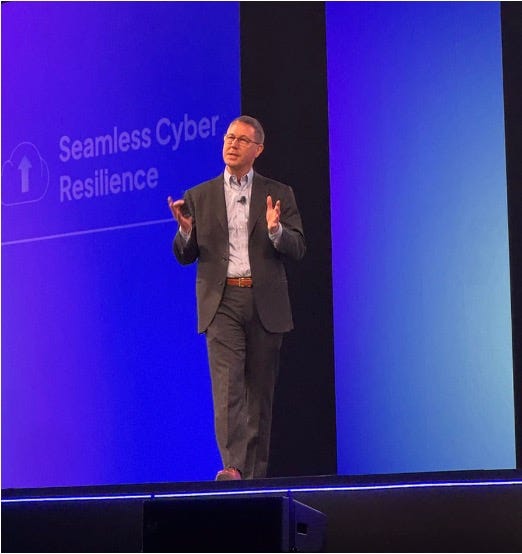
“As part of our Kaseya platform strategy, we’ve built a fabric that connects every Kaseya product, allowing us to weave all of our solutions together,” said Dave Baggett (pictured), formerly CEO of INKY, the email security vendor Kaseya bought last October, and now the SVP in charge of Kaseya’s security suite, during a product keynote appearance last week. “This means that from now on each security component will share real-time event data with other components, connecting the dots in a transformative way.”
Look for that transformative power to be Succar’s next strategic move now that the launch of Kaseya Intelligence is behind her.
“We’ll increasingly become a security player,” she told me last week. “We’re leaning heavily towards cyber resilience and cybersecurity, and that will be our edge over time, and that also will create that valuation as we go forward.”
4. MCP and AI-as-a-service still to come? Two topics that came up during my first conversation with Succar last August failed to come up during Connect last week. One (much to the disappointment of this MSP, who I ran into at Connect) is the MCP support we discussed. I didn’t get a chance to ask her about it this time around, but given that she’s into APIs and data gravity, one assumes letting people interface with Kaseya data via their favorite chatbot remains on the roadmap.
The other topic is Kaseya’s eventual role in helping MSPs move from deploying AI internally to selling AI solutions to their customers. This one I did bring up, and yes, it’s still in the cards.
MSPs want to provide AI services to end users, she said. “They’re experimenting, but they’ve yet to have significant breakthrough success. They need help with that. It’s our ambition to help them.”
But only after the company completes two higher priorities. “Right now, our number one focus is to get to autonomous IT and security,” Succar says.
As long as we’re talking about AI and security…
One of the nice things about going to conferences is that they give you a chance to speak face-to-face with other conference-goers. My co-host and I took advantage of one such chance at Kaseya Connect last week by interviewing David Primor, CEO of vCISO software maker Cynomi, on MSP Chat, our podcast. If, like me, you’re curious about how autonomous vCISO services will eventually get with help from AI, the interview in our latest episode is a great place to start.

We need a service desk automation benchmark, people
If you’re an MSP eager to capitalize on the productivity-boosting power of AI automation (and if you’re not, you might want to get eager to avoid falling way behind your peers), there have never been more options for realizing that goal. Which is a blessing, of course, but also a curse, because the people responsible for those options at companies ranging from Kaseya and ConnectWise to Pia and Thread and way, way beyond all say their AI automation is the best.
And they can’t all be right, so how do you make a choice? Build a lab and test them all out in an endless series of in-house bake-offs? Flip a coin and hope for the best? This is something that’s been on my mind for months, and the launch of Kaseya Intelligence is as good a reason as any to bring it up here.
I think we need a benchmark.
Now, I say this knowing that AI benchmarks are flawed. They can be gamed for one thing, they create perverse incentives to “write to the test” rather than build what people need, and they’re not always easy for laypeople to understand fully.
On the other hand, assuming it’s designed and maintained by a neutral third party, a benchmark is objective, and it gives MSPs otherwise stuck with hunches and guesswork something to go by when evaluating solutions. Having one specifically for service desk automation would, I think, be helpful.
It’s also something I truly, deeply don’t know how to create. So I’m just putting this out there in the hopes that someone who agrees that a service desk AI benchmark would do more good than harm will build one.
I promise to write all about it here in Channelholic if you do. Writing I mostly know how to do.
Over on the Business of Tech
Host Dave Sobel does the math on the AI spending black hole I wrote about recently:
Imagine you’ve got a 120-user client at $150 per user. That’s $18,000 a month. Now the client rolls out agents and automation and they “need fewer seats.” They drop to 85 users. Your seat-based revenue just fell to $12,750 — same environment, fewer licenses.
But your AI costs don’t shrink with seat count. They move with activity. So now you’ve got usage fees, API calls, agent runs, and premium tiers that can easily turn into $1,500, $3,000, $5,000 a month in consumption — and it spikes when projects spike.
That’s the squeeze: the old revenue proxy shrinks, while the new cost line becomes variable and harder to predict.
Also worth noting
Remember the 40% quarter-over-quarter increases in paid monthly active users that Google’s Gemini Enterprise has been enjoying, per my last post? The streak continues.
Cynet has enhanced its CyAI engine to continuously improve detection and response capabilities via self-learning.
89% of SMBs employ at least one victim of credential compromise at any given time, according to Guardz.
Breach Secure Now’s new AI Risk to Adoption program aims to help MSPs guide SMB customers from unmanaged AI use toward secure, scalable adoption.
The newest version of MSP360 Backup features extended backup immutability support across major cloud storage providers.
Agentic email security vendor Sublime Security has launched a new channel partner program for MSPs and resellers.
JumpCloud’s new Agentic IAM solution is designed to extend identity and access management controls to AI agents, models, and workflows.
Joining OpenAI’s Trusted Access for Cyber TAC initiative has given Cato Networks access to advanced models like GPT‑5.4‑Cyber.
Keeper Security has introduced Verify Mode and new browser controls to protect users from phishing and credential misuse.
Keeper Security has also released Agent Kit to secure AI coding workflows by protecting secrets and credentials used by AI agents.
A new connector has extended real-time scam detection and threat intelligence from Malwarebytes to Claude AI conversations.
Bishop Fox has launched AIMap, a platform designed to help organizations identify and manage AI-related security risks.
GMO GlobalSign has launched TLS Connect, a solution designed to automate certificate lifecycle management for SMBs.
Pax8 has partnered globally with NinjaOne to expand unified IT operations and cybersecurity offerings for MSPs.
LogicMonitor says its latest release turns its AIOps platform into an “AI-first platform for Autonomous IT”.
95% of MSPs agree automation is no longer optional, according to new research from Rewst. Only 4% consider themselves fully mature at it.
AvePoint has added new agentic AI and multicloud resilience capabilities to its Confidence Platform in a bid to enhance security, governance, and operational continuity.
It takes a gutsy company to launch a brand new managed services tool suite right now, especially in the middle of a Kaseya conference. I had a chance to meet one such company, called IgnitHQ, at the show and will be writing more soon.
10ZiG and Nerdio have expanded their partnership to reduce total cost of ownership and simplify deployment of Azure Virtual Desktop and Windows 365 environments. Bound to come up at NerdioCon, the conference I’m flying to right now as I write this.
GTIA says channel partners are hedging bets amid uncertain Q1 economic conditions, balancing cautious spending with growth investments.
MSP-as-a-Service, a new venture from Summit Holdings you read about here recently, now has a strategic go-to-market alliance with Kaseya.
Kamiwaza AI has launched Kamiwaza 1.0, a secure AI orchestration platform tailored for regulated industries.