



MSPs like automation.
A lot. So much, in fact, that 97% of the ones Rewst surveyed not long ago said they plan to do more of it this year, and 71% called it essential to their strategy. Not hard to understand why, either, given that 86% of respondents to the RPA vendor’s study say automation has increased operational efficiency, 75% say it’s improved consistency and standardization, and 46% say it’s reduced ticket volumes.
Such figures help explain why MSPs like Durham, N.C.-based Net Friends have run over 19.5 billion tasks on Rewst’s platform in the last year, nearly 2.4x the prior year’s volume.
“We were probably trending around 300, 400 hours saved [a month] on about 80 automations,” says Net Friends CEO John Snyder, until the company’s growing automation skills quickly grew those savings to more like 700 hours.
Embedded in Snyder’s story, however, is a clue to why Rewst’s undeniable success (the company’s attracted some 1,500 partners and $124 million in seed and venture capital since its founding in 2021) hasn’t been even greater: Though its software is capable of delivering serious ROI in the right hands, such hands are in short supply.
Indeed, there are something like 80,000 to 90,000 MSPs in the world and collectively, Rewst guesstimates, they might employ 1,000 qualified automation engineers (or “builders” as the company often refers to them). Net Friends is racking up big RPA productivity gains because it has three such engineers on its payroll.
“Rewst is fantastic if you’ve got builders like we have,” Snyder says. “They’re really hard to find.”
All of which suggests Rewst and its MSP users have been sitting on a huge unrealized unlock for some time. “It’s not a technical problem anymore,” said Rewst CEO Aharon Chernin (pictured) of RPA adoption at the vendor’s FLOW event in Nashville last week. “We have a product that can automate anything. It’s a people problem.” Make the system easier to use and a lot more people will use it.

Which is exactly what Rewst hopes will start happening as soon as this coming week when early access opens to a new version of its software designed to democratize access to RPA’s power. And when I say that release is new, I mean all new from the ground up and so infused with generative and agentic AI that when I asked Chernin about the product’s AI roadmap he said there isn’t one.
“The entire app is now controlled by AI,” Chernin explained. “There’s nothing left for me to add AI to that doesn’t have AI already.”
The result is a heavily automated solution capable of building new automations on the fly based on natural language instructions. “As long as you know how to prompt—and we have classes to teach you if you don’t know—you can get it to do anything,” says Charlie Tomeo, Rewst’s chief revenue officer.
And “you,” theoretically, is no longer limited to engineers, automation or otherwise. With a little training, bookkeepers, salespeople, and administrative assistants will be able to automate their workflows with minimal or no assistance.
Importantly, Chernin notes, the same goes for customer-facing employees. Rewst has been encouraging partners to provide “automation-as-a-service” to clients using its software since 2024, but only about 17% of them do at present, mostly because account managers and process optimization analysts don’t know how to build automations. Now, the company says, they don’t need to.
“They can go in, interview a client, get the details, type them into the agent, and have a draft done in minutes,” Chernin says. “It’s going to be a dramatic shift.”
With potentially dramatic implications for Rewst too. I wrote about the impact automation as a service had on the vendor’s total addressable market many months ago. How much more of that TAM will Rewst and its partners capture now that you don’t have to be a builder to build?
Hear it straight from Rewst
Tomeo discusses everything I just did and more on the latest episode of MSP Chat, the podcast I co-host. Tune in here to listen, or click here to view all our recent interviews with the likes of ThreatLocker CEO Danny Jenkins, Cynomi CEO David Primor, and ScalePad CEO Chris Day among many others.

Data gravity meets action gravity
I’ve written in the recent past about data gravity, the inexorable attraction that large masses of data exert on vendors, IT providers, and end users who need data to make AI work. Rewst, interestingly, is cultivating something different but arguably every bit as valuable, at least for MSPs. Let’s call it action gravity.
Part of what partners like about Rewst’s software is that it integrates with roughly 100 widely used managed services tools. Except that the product’s true integration count is actually a great deal bigger than that, according to Chernin, now that it has the ability to build integrations on demand for users in response to natural language prompts.
“If the agent can make an integration on the fly, why would we even go to market that Rewst has 100 integrations, because it really has an infinite number of integrations,” Chernin says.
That matters a lot for MSPs and the vendors who serve them for reasons related to the difference between RPA and AI, a difference that BetterTracker Chief Business Development Officer Matt Solomon summed up neatly during a general session presentation at FLOW: “AI thinks. Automation acts.”
Which is to say that while AI is increasingly good at figuring out how to do something an MSP needs done, it’s generally not responsible for most of the actual doing.
“AI is directing tools to go do that,” Chernin says.
And MSPs have a lot of tools, 96 of them on average, according to BetterTracker’s data, up from 88 just nine months ago. Say I’m an MSP with a mere 30, however.
“If you connect your agent to 30 different tools, that context from all the tool data is sent on every request,” Chernin says. “That’s probably bringing you, I don’t know, hundreds of thousands of tokens.” Use Rewst instead, he continues, and you get access to all 30 tools at once through a single, far more efficient connection with an infinite supply of integrations.
But not just integrations. Automations in Rewst reflect an individual user’s standardized workflows and they execute those workflows exactly the same way every time an agent triggers one. Left to their own devices, as headlines regularly reveal, agents are a tad less predictable.
One connection to one tool that’s integrated with all of an MSP’s other tools and executes a nearly limitless set of actions based on the MSP’s best practices with lock-step consistency. That, I’d argue, is action gravity and it should make Rewst and other RPA solutions with similarly expansive integrations very popular with systems of action and their agent coworkers.
B2A (business-to-agent) marketing
Being popular with systems of action is something vendors like Rewst need to start thinking about too, Chernin argues. As agents gradually spend more time in their products than humans, they also gradually become the users whose opinion matters, especially for sales and marketing teams.
“We need the agent to recommend our products,” Chernin says, “and the only way to do that is to make an agent’s life easier.”
He’s seen that play out in real life too. During his keynote presentation, Chernin ran side-by-side demos he created showing Claude Code execute a task about 50% faster with Rewst than without it. What he didn’t tell his audience was how difficult getting Claude to run the task without Rewst was.
“It was dying,” Chernin says. “It wanted to use the Rewst connection so much.” To the point of repeatedly making him confirm that he absolutely, positively wanted to complete the task the harder, more expensive way.
“I was fighting with it so much that I eventually had to disable the Rewst MCP,” Chernin says.
And if you think that marketing to agents is something only software makers have to think about, he adds, it’s not.
“MSPs are going to have to start to market to agents too because your prospects are now in agents all night planning their family’s healthcare, and you need to figure out how to get the agents to recommend your products and services,” Chernin says. “We’re in the same boat.”
Over on The Business of Tech
Host Dave Sobel plans to hit me with some interesting topics during my latest appearance on the weekly live episode of his show, and he’s made them no secret:
– Pax8’s “managed intelligence provider” gap, the Agent Gateway, and why trust may be the MSP’s last real moat
– ConnectWise’s bet on becoming a “system of action,” not just a system of record — and who actually owns the data
– The pricing collision: why seat-plus-consumption billing may be devastating to the MSP model, and whether MSPs will do the AI work while vendors capture the upside
– What an MSP with a flat-rate client should change Monday before AI eats their margin
Wish me luck on that last one. I’m not sure anyone has a good answer right now.
N-able sheds light on AI’s shadows
Lately, it feels like a lot of what I’ve been writing about reflects a widely shared sense that there’s no time to lose with AI.
Anthropic’s feeling it, certainly, which is why it’s building AI solutions for SMBs directly before OpenAI or Google has a chance to do the same.
Pax8’s feeling it too. The marketplace recently rolled out an enablement program designed to help managed service providers become managed intelligence providers, plus a set of outsourced professional services they can sell while they’re making the transition. And just in case anyone at the marketplace operator’s recent Beyond conference failed to appreciate that completing the MSP-to-MIP journey quickly matters as much as completing it at all, CEO Scott Chasin walked onstage for his keynote to the sound of a ticking clock.
Last but not least, business leaders are feeling it. As a couple of my posts have noted in passing lately, SMBs aren’t so much receptive to AI proposals from IT providers as pleading for them, and often charging ahead on their own at damn-the-torpedoes velocity.
“They’re signing up for every AI platform they get an Instagram ad for,” says Robert Johnston, N-able’s chief innovation officer.
And then promptly losing track of them. Fully two-thirds of businesses surveyed by researchers from The Economist don’t really know how many agents they have and what they’re all doing. It’s just like shadow IT except worse, notes N-able CEO and president John Pagliuca (pictured).
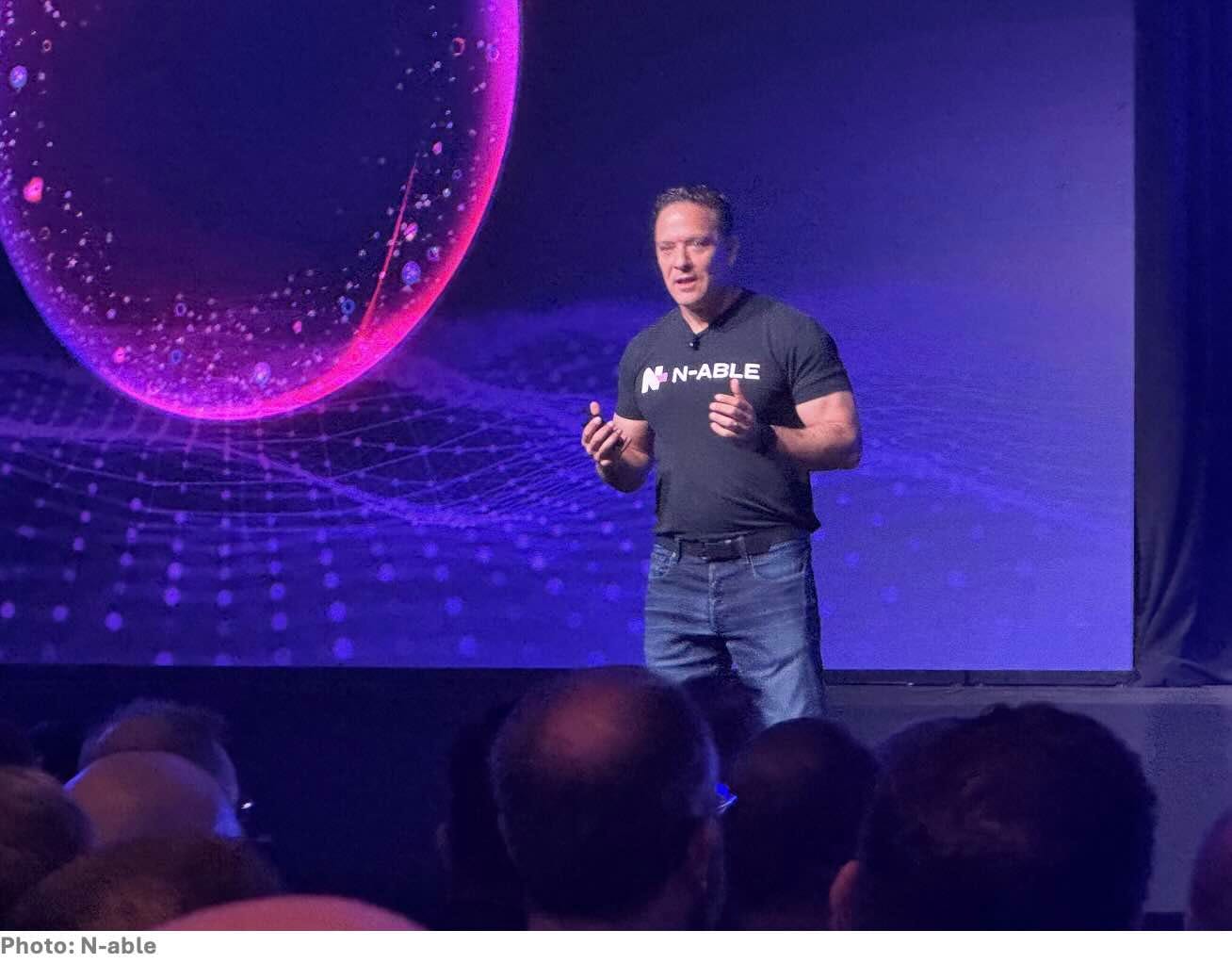
“The potential outcome is even more devastating with shadow AI as opposed to shadow IT because of what the agents could potentially do,” he says. Like delete a company’s entire production database or leak customer PII.
Protecting clients from that fate is both an opening for MSPs feeling time pressure to add AI services, according to Pagliuca, and the function performed by the Shadow AI Visibility solution N-able quietly unveiled last week.
“We’ll show an MSP what the end customer is installing and what’s being used from an AI perspective within that environment,” Johnston says. Securing it all is both an immediate source of one-time project revenue and a long-term source of recurring monitoring and management fees.
“It’s a perfect tool in the MSP’s toolkit: discover it, build a project around it, launch it, and then wrap a service around it,” Pagliuca says.
Perfect, perhaps, but not unique. Kipling Secure, ShadowLock, and Nudge, among others all make similar products. According to Johnston, however, using one requires MSPs to add another item to an already sprawling tool stack.
“I don’t think they want yet another tool,” Johnston says, noting that N-able partners get the same functionality through the RMM and/or MDR solution they already use at no extra cost.
Both/and versus either/or
The logic of that last thought applies more broadly to how market-leading MSP software makers are thinking about AI.
Like all businesses, managed service providers rely on systems of record for comprehensive, trustworthy data. Large numbers of them now rely on AI-powered systems of action as well to boost profits and accelerate growth. There’s strategic power for vendors in playing either role, but as ConnectWise CEO Manny Rivelo recently said here and as his counterpart at Kaseya would undoubtedly say too, the true sweet spot for software makers is to be both a system of record with massive data gravity and a system of action with autonomous AI functionality.
N-able concurs.
“We believe that putting an AI-infused system of action on top of a system of record is the right formula,” Pagliuca says. Partners are completely welcome to use N-able solely as a source of data, as its recent MCP server launch makes clear. Those looking for more value with fewer interfaces, tighter integration, and less spending, Pagliuca predicts, will get their AI from N-able too.
“We believe that provides the best path and the best experience,” he says.
At present, N-zo, the AI assistant N-able introduced in April, is the closest thing the company has to system of action functionality. That’s set to change in the future, however.
“We’re in the process of building coworkers right now,” Pagliuca says. As in agents capable of performing tasks like patching and vulnerability management mostly or entirely on their own.
“When we look at the top, call it, 10 or 15 tasks that MSPs and technicians do, our plan is to automate that leveraging AI so we can take the burden off some of the L1 technicians,” Pagliuca says. “We’re expecting to put that in preview later this year.”
BetterTracker greets Betty and Bob
N-able likes the sound of combining data gravity with AI automation in one platform, as do ConnectWise, Kaseya, and many others. Would it surprise you to learn BetterTracker is headed there as well?
Before I explain where the company’s going, though, let’s review where it’s been. BetterTracker’s solution has its roots in a system called NaviStack that helped MSPs inventory all of the software they use or sell. Over time through integrations with a subscriber’s Microsoft tenants, banks, and credit cards the system also began revealing what they were paying for all that software. Later still, BetterTracker let MSPs monitor all of their spending using those same integrations.
Providing that service involved accumulating a lot of information from what’s now approaching 7,000 MSPs. BetterTracker’s latest feature, Betty AI, is how the company begins converting that data from a helpful data store into a real-time intelligence resource too.
Currently in beta testing with selected partners and due to reach everyone else late next month, Betty lets users get AI-powered answers to spend-related questions via natural language prompting. For example, notes CEO Kevin Lancaster (pictured), MSPs have long yearned to know not just what they’re paying for tools but what they should be paying.

“Now we have a big enough volume of transactional data where we can tell you that pretty straight up,” he says. “We can give you ranges on what you should be paying for certain products in certain categories based on your size and endpoints and revenue and what have you.”
By end of year, MSPs who use BetterTracker’s customer-facing functionality to enhance strategic relevance will be able to ask similar questions about end users.
“What should I be selling them next? Where are they overleveraged? How can I help them optimize their technology stack?” Lancaster says.
In time, though, he continues, the system will move past answering questions about spending to calling out issues like unused subscriptions, overlapping tools, contract anomalies, and approaching renewal dates unprompted.
“Betty will basically be your business adviser,” Lancaster says. “It will turn into a very proactive, ongoing, business optimization platform.”
Useful stuff for a system of record, according to Lancaster, but not a complete realization of Betty’s potential.
“The holy grail in all of this is how do you turn it into a system of action,” he says.
And the answer is by going a step beyond identifying money-saving suggestions to actually implementing them automatically. “If you can do that and create some predictability to it, you can start squeezing out two, three, four, five, ten points of margin,” Lancaster says.
BetterTracker has similar functionality coming for vendors. The system already helps them use partner reviews and spending data to benchmark themselves against competitors, Lancaster notes. Betty’s forthcoming companion Bob will add AI-powered analysis to those insights.
“We’ll help vendors understand, based on anonymized aggregate data, how they should be pricing and what their true ICP looks like,” Lancaster says. Crucially, he adds, and in a departure from how most vendors handle pricing and targeting today, Bob’s suggestions won’t be speculative.
“Everybody’s making assumptions and we can show them real, factual, real-time data,” Lancaster says. “It’s pretty eye-opening.”
Also worth noting
Sophos has joined OpenAI’s Daybreak Cyber Partner Program to combine its agentic SOC and prevention architecture with OpenAI’s cyber capabilities.
Proofpoint has joined too.
Cynomi has added vulnerability management integrations, automation, and AI-powered capabilities in what it calls the largest expansion of its platform to date.
SuperOps and Guardz have introduced a bundled offering designed to give MSPs a unified, AI-ready operations and security stack.
Bitdefender has launched RealCheck, a deepfake detection solution for iOS and Android that analyzes videos for manipulation and malicious intent.
The new Wasabi Impact Circle is a sustainability program designed to help customers and partners measure and address cloud storage emissions through curated carbon credit portfolios.
Keeper Security’s new Keeper Teams App brings privileged access request, approval, and management workflows directly into Microsoft Teams.
Netwrix has added visibility, continuous monitoring, identity risk assessment, and other AI governance features for hybrid Microsoft environments to its 1Secure solution.
Xurrent has launched a built-in iPaaS platform designed to simplify enterprise integrations and automation.
Parallels has added a new hypervisor-agnostic integration platform to Parallels RAS.