


Lemhi may not be thinking much about agentic AI yet, per a recent post, but D&H sure is.
“This is what’s emerging for us,” Colin Blair, the distributor’s vice president of cybersecurity and emerging technologies, says. “62% of organizations are experimenting with AI agents. There’s a lot of work to be done here.”
It’s going to be a while before most businesses and IT providers are ready to do it though. “Three-quarters of enterprise leaders tell us they’re adopting agentic AI. Only a small minority have it running in meaningful production beyond ‘agentish’ chatbots, and true scaled multiagent systems are rarer still,” writes Forrester in a recent blog post, mostly because the technical sophistication and organizational readiness necessary to implement them are equally rare.
“The technology is a runaway train,” the post says. “The enterprise is the heavy load it has to pull.”
Fortunately, D&H has plenty of room to make money in big, fast-growing markets like cloud computing and security in the meantime. Indeed, the whole point of NEXT+ was to get partners excited about joining the distributor’s effort to expand beyond its traditional focus on PCs and conference room gear into advanced solutions as well.
“When you look at D&H for the last 15, 20, 30 years, we’ve really focused on selling to VARs and system integrators,” says Adam Crockett (pictured), senior director of services in the company’s Advanced Solutions+ business unit. “We’re kind of known as the end user compute distributor.”

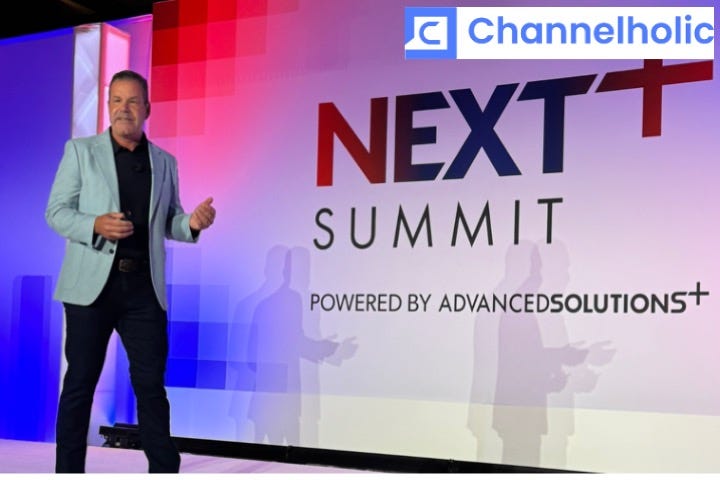
It’s been a great role to play in the channel too. “We’ve grown the company over the last 10 years from a little over $3 billion to over $7 billion, which is 3x the growth of North American distribution,” said Jason Bystrack (pictured at top of post), D&H’s SVP of cloud and Advanced Solutions+, during a keynote presentation, noting that the company grew $260 million more just in May, the first month of its new fiscal year. D&H wants to extend that momentum now from the front office to the back office.
“When it comes to distribution and total available market, we’ve had a very large share of the desktop, laptop, and end user compute space, but we’ve had a small market share when it comes to advanced solution technology manufacturers,” Crockett says. “All of our growth over the next 10 to 15 years is going to come from advanced technology vendors, because that’s where we’re so under indexed.”
Several of those vendors, including AMD, Extreme Networks, Fortinet, and HPE, made general session presentations at NEXT+. D&H itself made a point of underscoring its ability to wrap assessment, implementation, and management support around the products those companies sell for partners new to them.
“The mid-market partners we’ve grown up with and helped mature along the way may not have a deep bench of technical resources in a specific product line,” Crockett notes. “We just want to help them be able to deliver on the associated services that would go along with an advanced solutions purchase.” The idea, he continues, is to help partners add profitable new revenue streams faster and with fewer upfront investments by embracing a “borrow, not build” model.
“The professional services growth that we’ve had in the last couple of years has been based on that,” Crockett says. “Borrow our facility, we’ll do the pre-deployment work. Borrow our technical resources, we’ll do the onsite installation.”
Helping partners enter unfamiliar markets rapidly is a priority for D&H in areas beyond services too.
“We need to be able to provide them vendor-agnostic consultative pre-sales enablement, technical resources, people who know the OEM programs, how to apply for the best economics, how to make sure they take advantage of all their backend programs and post-sales service and support,” Crockett says, “all the things they need to learn about manufacturers that are new to them.”
Remember that whole managed services thing?
Interesting fact about those end user compute partners at NEXT+: A lot of the same ones intrigued enough about advanced solutions to make the trip to Austin are also intrigued about managed services. Blair said as much during his keynote while citing data showing that 75% of IT spending is now on operational versus capital expenses.
“If I would have shown you the OpEx to CapEx ratio a couple of years ago, this would have been swapped. So it would have been 40% OpEx and 60% CapEx,” he said. As a result, he added, “many of you that were in the traditional VAR/resell model are becoming MSP-like. It’s because you’re paying attention to how your customer is buying.”
And still learning how to accommodate that demand, he could have added, which is why D&H recently launched its Success Path to MSP Toolkit, a series of live and on-demand webinars offering detailed guidance on the nuances of launching a managed services practice.
“You don’t want to build out a service desk and a NOC or a SOC without understanding how you need to thoughtfully consider changing compensation models for your sales organization to drive that behavior” for example, Crockett says. “You’ve got to be a little more methodical, a little more coordinated about making that leap.”
The kit includes additional information about automating and scaling managed service offerings, adding managed security capabilities, zero trust, cloud security, and more.
“We found that many of our partners who are somewhere on that journey of transitioning from more of a VAR or a system integrator into becoming a managed service provider need a kit that brings all these fragmented tool sets and processes and different software options out there into some sort of coordinated discussion,” Crockett says.
The toolkit’s useful in a further, less intentional way as well for those of us who’ve been covering the shift from VAR-based business models to managed services for over two decades now. Cycles like the AI one just getting underway take a very long time to play out, it shows. There will probably be partners gratefully consuming Success Path to AI Toolkits many years from now.