


Pax8 wasn’t the only company to break news during its Beyond event last week. ConnectWise made an announcement too that I finally have time to discuss.
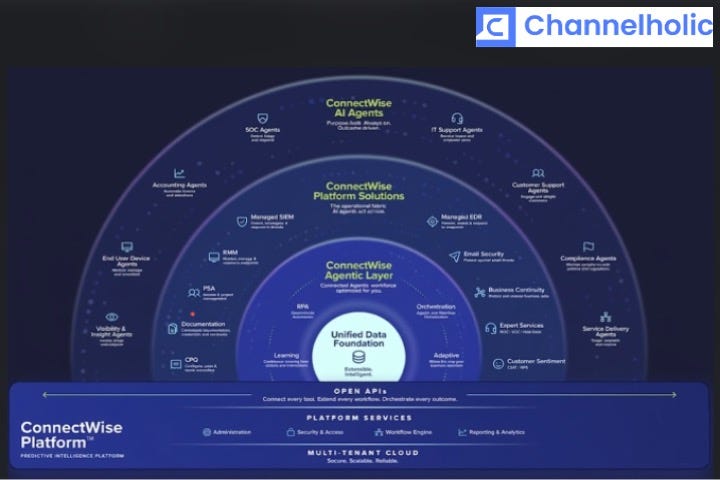
It was kind of a big deal, too, concerning the launch of what the company calls “the industry’s first predictive intelligence platform” for managed service providers, a sensible thing for it to be launching given that competitors both large and much smaller already sell AI-enabled MSP stacks and a surprising development only in that it follows the company’s acquisition of AI-powered service desk automation startup zofiQ by a mere five months.
Indeed, the only thing odd about the launch of what’s officially called the ConnectWise Platform is that the company responsible for it already had a platform, called Asio, which it’s been expanding and integrating since 2021 and which it only just recently finished porting its PSA solution onto. Is Asio, after all that time, effort, and money, dead?
Yes and no.
“This is Asio modified,” says ConnectWise CEO Manny Rivelo (pictured). “It’s version 2.0, if you will. Next-gen Asio.”

Which is to say that while huge parts of the ConnectWise Platform are brand new, substantial parts aren’t. “A lot of it is new code, but not all of it,” Rivelo says. “They rewrote dozens and dozens of modules inside the platform.”
“They” being ConnectWise chief product and technology officer David Raissipour and his team, who’ve been hard at work on that project since Raissipour stepped into the job a year and a half ago. Their mission wasn’t so much to discard and replace Asio as to accelerate its completion, increase its scalability, deepen its data lake, and equip it with a layer of agentic services it previously lacked. The result is a largely new platform with an entirely new AI-native core composed mostly of code acquired along with zofiQ in January.
“We didn’t want to bolt it on,” says Rivelo of that core. “We thought bolting it on was going to be restrictive with MCP servers and APIs and all that kind of stuff. We want access right into the control plane or the data plane of the product.”
Having that access is delivering measurable results for the hundreds of MSPs ConnectWise says are already using the new platform, including an 86% reduction in L1-to-L2 ticket escalations and a 30% or more improvement in technician productivity.
“If you’re an organization and you have 10 technicians, that’s three people. It’s material,” Rivelo says. “If you’re an organization and have 100, 200 technicians, it’s very material.”
There are even better returns to come, he continues, as the platform grows increasingly automated over time. Predictive intelligence isn’t so much what the ConnectWise Platform delivers today as the eventual destination of an ongoing five-phase genAI journey. Phase one, in which AI automates specific, generally routine tasks, began late in 2023 when ConnectWise released its SideKick copilot feature. In phase two, where ConnectWise says it is today, AI accelerates workflows with human-in-the-loop participation. The next phase is approaching fast, according to Rivelo.
“It’s where most of the work is being done by AI, but the humans are supervising it,” he says. “We believe we will be at phase three by the end of the year, not for every problem that can be fixed, but for many of them.”
Phase four, in which AI becomes fully autonomous and recursively self-improving, will take longer to reach, as will the longest-term goal, phase five, in which predictive intelligence anticipates and remediates issues before they have a chance to happen.
“Uptime, we believe, will be almost five nines,” Rivelo says.
In the meantime, the phase two version of the ConnectWise Platform remains a work in progress. Most of the agents available today automate ticketing-related workflows like triage, dispatch, and summarization but equivalents for RMM workflows are due in the next few months, according to Rivelo, who says that ConnectWise plans to port its CPQ and ScreenConnect products onto the new platform over the next several quarters as well.
“At that point in time, the full kit and caboodle will be in the product,” he says.
By the way, if the name “ConnectWise Platform” seems a touch generic…
That’s because it is, though not entirely by design. ConnectWise wanted Asio 2.0 to bear a name other than Asio to make clear how different it is from the 1.0 version, but finding something good not already in use proved difficult.
“We came up with every name that we felt was creative, and there was always somebody else out there that had claimed it or was using it,” Rivelo says. The easiest way to name the ConnectWise platform without encountering trademark disputes turned out to be naming it the ConnectWise Platform.
System of action, system of record
Needless to say, shipping the ConnectWise Platform, even if it is still a work in progress, is an important milestone for a company previously at risk of disintermediation by an emerging crop of AI-native automation startups theoretically capable of converting ConnectWise PSA in particular from the most critical application in a user’s stack to an out-of-sight-out-of-mind supplier of data to far more strategic applications. That’s a fate Rivelo refuses to suffer.
“We want to be a system of action,” he says. The ConnectWise Platform and its increasingly autonomous functionality position Rivelo’s company to be one, like Thread and Pia, and to be a system of record like Lexful as well.
Remember Lexful? The other headline you could easily have missed last week amidst all the news from Pax8 and ConnectWise is that the AI-native documentation vendor has landed $7 million of fresh seed funding in a round led by Top Down Ventures and York IE. That’s a flash in the pan compared to the $400 million secondary raise NinjaOne disclosed the next day, which increased its valuation from $1.9 billion early in 2024 to an astonishing $12.3 billion now, but a big deal nonetheless for a company just four months out of stealth mode trying to build the definitive data repository for managed services AI.
Rivelo believes the system of action functionality ConnectWise has just introduced gives it an edge over companies like Lexful (which he didn’t explicitly name) building chiefly around data gravity, just as the data gravity ConnectWise already has gives it an edge over system-of-action vendors dependent on someone else’s system of record.
“We have a native advantage in that the data is right there,” he says. “It’s embedded. The system itself can help you understand how to optimize your business.”
Chris Day (pictured), chairman of Top Down and CEO of Top Down portfolio holding ScalePad, wonders how big an advantage ConnectWise really enjoys as a system of record, however. Something like half the knowledge you need to run an MSP resides in applications like ConnectWise PSA, he says, but the rest is in the Microsoft cloud, HubSpot, Docusign, QuickBooks, and apps from MSP favorites like Huntress.

“None of us is going to have all the first-party data,” says Day, and that includes ScalePad. “You might have the service data, you might have the RMM data, but MSPs are not necessarily going all one vendor.” Lexful’s early momentum merited more seed capital in part because it’s attempting to build a superset of first-party data and make it accessible to agents, he continues, which could put it in an enviable position as the agentic AI “arms race” among heavyweights like ConnectWise and newcomers like GenticFlow unfolds.
“The more integrations and the more data overlay you can do will be where the best systems of action will happen,” he says.
More on the ConnectWise Platform coming soon to MSP Chat
The next episode of the podcast I co-host will feature further discussion of this story. Enjoy our episode from Pax8 Beyond in the meantime!
