


It takes conviction, I’d argue, to launch a service desk automation application right now, like the company you’ll read about later in this post, given how many other vendors are doing the same thing.
It takes something altogether different, however, to fund the creation of an entire managed services suite out of your own pocket and then launch it into a market full of brand-name incumbents with broad, deeply entrenched user bases and heaps of private capital to draw on.
Courage? Craziness? Perhaps, but I’m going to go with audacity.
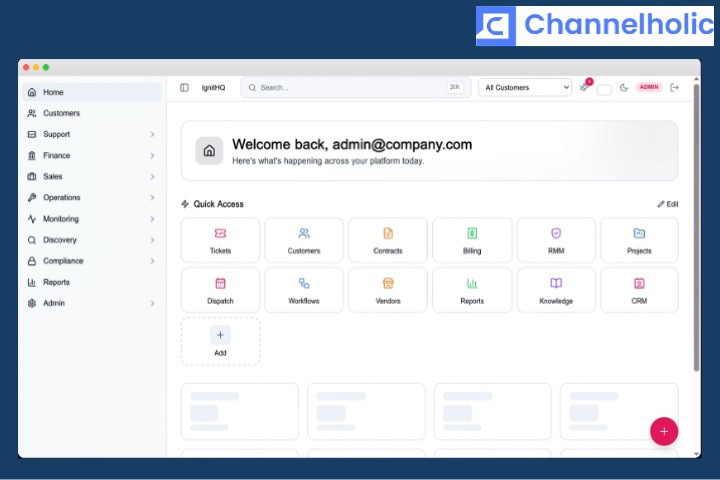
Meet IgnitHQ, an upstart MSP platform maker with audacious ambitions to beat the likes of ConnectWise and Kaseya at their own game by offering the kind of solution it contends both vendors would be selling if they were starting from scratch instead of burdened by legacy code.
“The incumbents are describing where they want to go,” says IgnitHQ founder and CEO Yaron Baitch (pictured). “We are already there.”

Where that is more specifically is a solution generally available for a few weeks now with five core attributes:
1. It’s expansive. Surprisingly so, in fact, given its youth. Developed over the last two years, the solution includes more than 80 modules spanning from RMM, PSA, compliance, and documentation to quoting, billing, and beyond.
“No additional functionality outside of our platform is required aside from endpoint protection and backup,” Baitch says. “We’re not going to touch those two things because very clearly there are unbelievable products out there that are really good.”
2. It’s built atop a single, unified database. According to Baitch, this is one of the product’s most critical design principles.
“We have one database that everything lives out of,” he says. “We want to make sure everything is managed with a single source of truth.” That’s something market leaders often claim to provide but don’t, Baitch contends, mostly because they built much of their platforms through acquisitions.
“They have a core system and then they bring another component on and then throw an API on it and a logo, and that’s called integration,” he says. “That’s not integration. In essence, that’s still a separate, disparate database.”
3. It’s AI-native. Unlike ConnectWise and Kaseya, which are both in different ways adding autonomous AI to existing platforms, IgnitHQ built AI into its solution from the start.
“Built-in beats bolted-on every time,” Baitch says, mostly because it provides visibility and control that solutions with layered-on AI and fragmented data can’t mimic.
“Our AI engine is called Duke, and Duke is basically completely cross-corpus aware of the whole platform,” Baitch says. “No matter where you are, Duke knows and it’s able to reference data from the other parts.”
4. It’s affordably priced. According to Baitch, this too is a core design principle, and one that gives IgnitHQ an edge over legacy alternatives.
“Their cost is so expensive and changing is so expensive and their long-term contracts are so expensive,” he says. “We wanted to level the playing field.”
Pricing for IgnitHQ starts at a flat $499 a month for a Starter plan with support for up to 10 technicians and 500 managed endpoints. The more feature-rich Professional plan with unlimited managed clients and techs sells for $999 a month.
5. It’s scalable. One of the system’s early adopters, in fact, brought roughly 897,000 tickets along with them, and the company has tested the solution in the lab against as many as 5 million.
“We still had sub-60ms response time,” Baitch says.
That makes the solution appropriate for large as well as small MSPs, he adds, noting that a private equity-backed rollup with an MSP portfolio “in the high double digits” is about to begin piloting it.
Baitch is well aware, of course, that convincing people to take a chance on an untested newcomer won’t be easy despite all of that. To de-risk the process, IgnitHQ features a “dual-write bridge” that saves data simultaneously to its own database and an MSP’s current tool stack.
“It allows you to use your existing platform and IgnitHQ at the same time” and then pick whichever you prefer without losing anything added during the evaluation process, Baitch says.
Whether that will be enough to drive serious adoption is anyone’s guess. A bootstrapped company with essentially no brand equity at present, IgnitHQ can’t afford giant marketing campaigns. Though who knows, Baitch notes. Maybe that will change some day.
“We’re being very selective about what type of conversations we want to have,” he says, “but there are basically people knocking on our door to help us fund this.”
GenticFlow says trust in us for help desk automation
I rolled the dice last November and predicted that trust will be the word of the year in technology for 2026. It’s looking like a safer and safer bet all the time.
The particular technology I had in mind at the time, of course, was AI, and for obvious reasons. As more and more of what software does happens autonomously, out of view, and very, very rapidly, questioning the safety and efficacy of that software’s output is all but inevitable. And sure enough, study after study after study published in the months since my prediction has revealed the gap between the spending AI is inspiring on the one hand and the uneasiness it’s creating on the other. The gap’s so big, in fact, that Veeam is betting its future around closing it.
So to a great extent is GenticFlow, an AI-powered help desk automation startup that’s as serious about earning the trust of its users as it is about enabling better, faster resolution of technical issues.
“The number one issue that we have to address head-on is trust,” says Marius Mihalec, the company’s founder and CEO. “You break the trust, you break everything.”
The lengths to which GenticFlow goes to avoid that fate are apparent throughout the product. Like solutions you’ve read about here before and others you haven’t yet, the system automatically diagnoses end user help desk requests. Unlike at least some such systems, however, it addresses those requests without human oversight only in limited cases authorized ahead of time, generally in response to the simplest of issues, like password resets and printer restarts.
“Every workflow has an approval policy you assign where one or multiple team members get to approve before certain steps that carry risk can be executed,” Mihalec says. “I don’t think it’s very responsible for anyone to say autonomous anything.”
Approvals are based on detailed diagnostic information collected directly from the endpoint by a lightweight, RMM-like agent and inserted automatically in the ticket, Mihalec adds.
“What makes that useful, and different from tools that manage the ticket, answer the user, summarize the thread, or route the request, is that it is connected to real-time device investigation and action,” he says.
To further build trust, Mihalec notes, GenticFlow carefully documents every action it takes in formats MSPs can both inspect easily themselves and share easily with compliance auditors and cyber insurers.
“Everything is fully logged,” he says, creating a “proof layer” that work done quickly and invisibly was also completed responsibly and effectively.
Not to mention affordably. At a time when only 8% of organizations are extremely confident they understand what running AI services costs them and unpredictable usage-based AI billing is rapidly becoming the norm, GenticFlow makes a point of providing thorough reporting and forecasting data on token consumption.
“We’re very transparent about that,” Mihalec says.
It’s reflected in the system’s pricing too. Each of the product’s two base plans comes with a monthly allowance of tokens sufficient to process several hundred tickets.
“If you’re a light to medium user, that’s enough,” Mihalec notes, adding that heavier users can either pay GenticFlow $1 for every additional million tokens they consume or buy and bring their own tokens from the third-party LLM of their choice.
GenticFlow, which currently has about 30 users, is the second solution Mihalec has sold to MSPs. The first, called Pulseway and fully owned by Kaseya as of a year ago after years of partnering, had already established a foothold as a cloud-first, mobile-first alternative to legacy RMM/PSA platforms when I first wrote about it nearly a decade ago. The new solution aims to offer a similar alternative not only to old school management tools but to fully autonomous ones as well.
“GenticFlow is AI-first, but not AI-only,” Mihalec says.
Over on the Business of Tech
Host Dave Sobel spoke last week about Veeam’s big new data and AI play, equally big channel plays from Anthropic and OpenAI, and why MSPs aren’t providing the AI governance help SMBs so badly need with … me. Listen in here.
Learning from the AI collective
It’s best to avoid generalizations as a rule, but I’d say it’s generally true nonetheless that taking on a challenge all by yourself is a bad idea for entrepreneurs, and the harder the challenge, the truer that is.
That’s worth keeping in mind if you provide IT services to SMBs, because according to Jerry Koutavas, CEO of MSP community The ASCII Group, the challenges you face at present adjusting to the rise of AI may be your toughest ever.
“It’s a significant pivot, something that’s more difficult than the transition from break-fix to being an MSP,” said Koutavas on the sidelines of last week’s ASCII Edge event near Seattle. Think about it, he continued.
“When people moved from break-fix to becoming an MSP, it was in their economic interest to drive their customers to that model,” Koutavas (pictured above) notes. “It was a means for them to grow, smooth out cash flow, and service customers in a unique way.”
This transition is different. Your clients will profit from the AI services you provide them if you do your job right, but you might not.
“Everything is individualized,” Koutavas observes. “If I go into a particular client and they have interest in AI, it’s unique to them, it’s unique to their business, unique to their problems.” How’s an MSP supposed to scale an answer to something like that, especially given that any answer they arrive at this month could be obsolete next month. There was a time when prompt engineering services looked like a good money maker, for example.
“That’s dead in the water today,” Koutavas says. “The technology is shifting and changing so fast that it’s hard to stabilize on a strategy.”
And therefore hard to blame people who successfully made the change from break-fix to managed services and then from on-prem to SaaS for bowing out now rather than reinvent themselves yet again.
“There’s conversations taking place behind closed doors that we’re going to lose 20 to 30 percent of the MSPs that aren’t going to pivot, and it’s sort of startling to hear that from people that are in the industry as long as I have been and it’s a reality check,” said Koutavas during a keynote presentation.
A worrying one too, obviously. The more Koutavas thinks about it, however, the less worried he becomes.
“Sure, there’s going to be some MSPs that have reached a certain point in their business that they’re going to say, ‘OK, I’m going to retire and that’s all.’ But what’s great about this industry is that we learn from each other,” he says.
Great and defining. For as long as managed services as we know them have existed, which is to say over two decades now, MSPs have been freely sharing knowledge with actual or potential competitors. That’s easy to take for granted if you’ve spent as much time in the industry as I have, but it absolutely floored Manny Rivelo when he became CEO of ConnectWise.
“This is a unique community,” Rivelo said during a conference in London last year. “This is a community that helps each other drive success. You tell each other your best secrets and how to increase your profitability, how you drive your revenue.”
Good luck finding that in any other service industry. “MSPs can say, ‘I have a client that’s experiencing this. I’m thinking about that solution or this solution. What have you guys heard and what have you tried?’ You’ll get a dozen answers inside of ten minutes,” says Brad Gross, an attorney who serves MSPs, during an episode of the podcast I co-host. “That doesn’t exist for doctors. It doesn’t exist for lawyers or accountants.”
And it’s why Koutavas believes the MSP community will weather this latest, hardest transition successfully. “Members are going to teach members what they’ve done and how it impacted their business, and that’s going to be the catalyst to help our community move ahead,” he says.
It’s happening already, in fact. “The collaboration that’s taking place is a lot stronger than I’ve ever seen from a community perspective,” Koutavas says. “We just had a member meeting here, and we had a couple members talk about what they’re building internally for the organization and I’m absolutely blown away.”
The ASCII Group’s trying to facilitate more such exchanges through its AI Collective program.
“It’s a peer initiative,” Koutavas says. “We’re basically gathering members that have built specific tools around AI and allowing them to teach other members about those particular services.” The result, he adds, is classic community.
“Everyone moves forward.”
Cracking the Level 3 training conundrum
My previous post, which discussed the mystery of where tomorrow’s Level 3 technicians will come from once AI’s doing all the Level 1 and 2 work, mentions a thought on the matter by Joshua Skeens, CEO of mega MSP Logically. Hiring people with high potential but no experience and then training them for a year, he said last July, might be the only solution to the puzzle.
Well, Skeens has had more time to ponder the topic since then, and he dropped me a line in email to share his current view, which is that the same AI making L1 and L2 jobs a thing of the past can theoretically prepare people for L3 positions in way less than a year.
“With AI’s current abilities, I believe that if you find the right individuals, you can actually ramp employees quicker from an L1 to L2 to L3 model than has ever been possible before,” Skeens writes. Building a repeatable process for that will take effort, he continues, but he’s done similar things in the past.
“Before AI, we took entry-level employees, who would normally not be providing actual customer support for 100 to 180 days, and had them on the phone in under 2 weeks and very operational in 30 days,” Skeens says. “This was a very structured training we put them through, but it worked extremely well and actually made the employees have greater job satisfaction because they felt more like contributing members of the team almost immediately. Leveraging AI, I believe you can do the same, but not only ramping employees but jumping them levels faster.”
It’ll help, he adds, that tomorrow’s Level 3s, unlike today’s, will be thoroughly familiar with AI.
“A 10yr old by the time they enter the workforce would have spent their entire life using technology and over half of it using AI,” Skeens writes, noting that vocational programs tailored specifically to the needs of MSPs and MSSPs could give future L3s a head start too.
“I can see a world where we hire an L1 candidate, and they work ½ days and then bootcamp for ½ days with very specific training and testing for the first 30 days. At the end of day 30, you likely have an L2 employee moving towards an L3 with more training.”
But enough about AI. Let’s talk security.
I’m not the only one who thinks LLMs like Anthropic’s Mythos make left-of-boom prevention more important than before relative to right-of-boom detection and response. ThreatLocker CEO Danny Jenkins does too, and he explains why in the latest episode of MSP Chat, the podcast I co-host. Tune in here.

Also worth noting
Food for thought, MSPs: You don’t have to be as big as ePlus to launch a private AI infrastructure managed service.
Sherweb and HaloPSA have a new integration designed to automate cloud billing workflows.
Proofpoint’s new Active Exploits Protection is designed to detect and block attacks exploiting vulnerabilities before patches are available or applied.
Proofpoint’s new 365 Total Protection platform, meanwhile, aims to help MSPs deliver integrated Microsoft 365 security services.
CrowdStrike’s newly expanded Project Quiltwork employs alliances with leading cyber insurers to mitigate financial and security risks associated with frontier AI technologies.
Check Point’s new Agentic Exposure Validation offering is designed to help defenders spot the kind of vulnerabilities advanced AI models can now uncover before attackers do.
Jonathan Berger is the new SVP of global channels and alliances at SonicWall.
HYCU’s new AI Resilience (aiR) solution aims to turn backup data from dozens of applications into a live, actionable intelligence resource for security, compliance, and IT teams.
Reinvent Telecom’s new MyCloud Managed Security service lets MSPs and resellers deliver 24/7 threat monitoring, vulnerability management, and managed XDR.
APX Net is partnering with AVANT to give the latter’s partners access to the former’s carrier-agnostic fiber and dedicated internet solutions through a single-source procurement, billing, and support model.