



Spend even a little time with data center spending figures right now and you find yourself encountering very big numbers very quickly. Like, numbers so big they make anything involving mere billions look puny.
Such as the $2.9 trillion Morgan Stanley expects to be spent on data center projects through 2028, or the $1.6 trillion the firm says will be spent specifically on data center infrastructure through 2030.
A lot of that latter sum will flow directly to NVIDIA if Jensen Huang’s forecast a few months ago proves correct. Another hunk will wind up with memory manufacturers, according to TrendForce, which foresees DRAM contract prices rising 13-18% in Q3. Not year over year, mind you, but quarter over quarter, which is actually a dip from the 58-63% quarter-over-quarter spike it projected in Q2. You can safely look forward to similar price hikes for many quarters to come too, according to SK Hynix CEO Kwak Noh-jung, an admittedly biased source who says customer demand for memory will exceed supply beyond 2030.
Remember what happens when demand exceeds supply? Of course you do.
“We’ve all taken economics,” observed Cheryl Rang (pictured), vice president of technology solutions at Ingram Micro, during a keynote presentation at the distributor’s Trust X Alliance Unplugged event in Buffalo, N.Y., last week. “The price is to the highest bidder.”
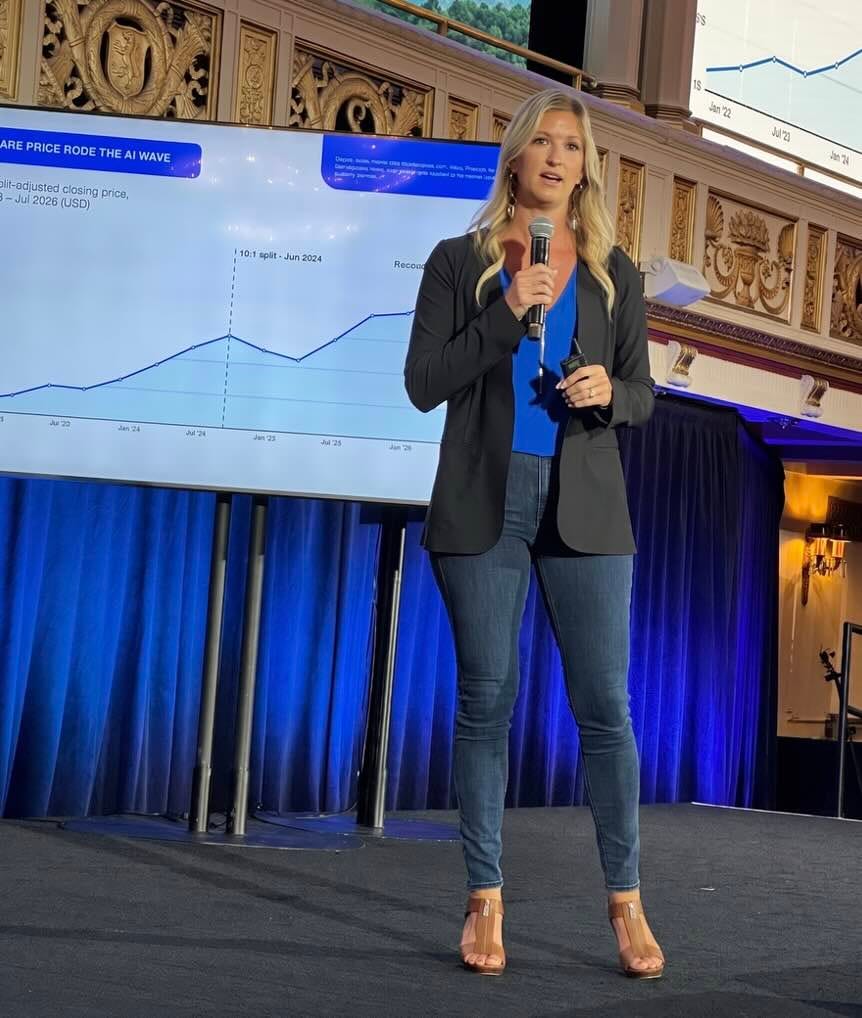
And who is that? “The hyperscalers, the neocloud providers, the Fortune 100 enterprises,” Rang said, “because they have no care in the world. They’re not dealing with budgets the same way that we are.”
And by “we,” of course, she meant the channel partners in her audience and their sub-Fortune 100 clients.
“We are in a capacity locked environment,” Rang said, and we’re going to be there a while. “You can talk to any manufacturer. They will tell you this isn’t a 2026 problem.”
It is instead the decidedly uneven playing field on which companies with voracious infrastructure appetites and stratospheric valuations collide with 50-person companies overdue for a laptop refresh, not to mention their IT providers.
“So many of those chips and the hardware and RAM and the storage are going to the new AI data centers,” says Trust X Alliance member Zach Esmond, director of strategic partnerships at Houston-based MRE Consulting. “Most of the manufacturers are producing as quickly as they can, but they’re doing it obviously for whoever’s buying the most.”
And the giant sucking sound from all their buying is producing supply constraints big enough to affect even major hardware makers. One of MRE’s clients in the oil and gas industry uses high-end custom workstations from Dell formerly priced at $12,000 each. “We just did a proposal for them to add a few staff members, and our cost on those right now is $18K.”
That’s an only slightly above average example of an industry-wide phenomenon. Year-over-year price hikes across comparable product lines rose 20-40% in Q2, according to Omdia, increases steep enough to have driven global shipments of desktops, notebooks, and workstations down 3.6%.
“Everyone’s starting to feel it,” says Josiah Philipsen, owner of Newberg, Ore.-based NextTech Consultants, including the customer who recently learned that the new laptops he needed would cost $2,000 versus the maybe $1,500 he was expecting.
“That conversation, that frustration, is hard to navigate,” Philipsen says.
Sticker-shocked businesses are hanging onto aging devices longer than they normally would, he adds. Omdia’s seeing the same thing:
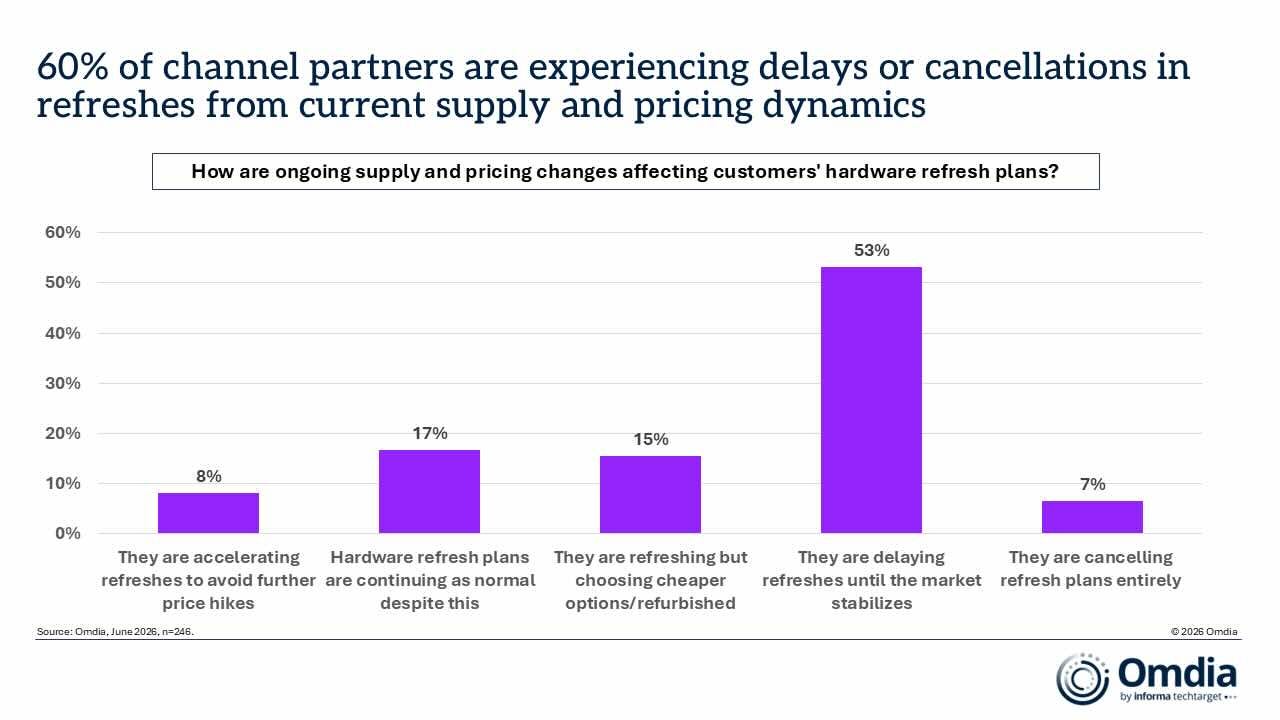
It could wind up backfiring, though, when delaying any further stops being an option. “I know in six months the price is going up,” Philipsen says. “Lenovo’s told us that. Dell’s told us that. The vendors aren’t being discreet about it because they’re trying to be transparent and they know this is a problem we’re all facing.”
That problem might actually be easier to deal with if prices were only moving in one direction, but they’re not. MRE recently sent a $66,000 quote to a client on a server that would have cost more like $40,000 a year ago, and didn’t hear back right away.
“Quotes have been expiring in two weeks instead of 30 days on the price commit lately because of the fluctuations, so we had to reprice it,” Esmond says. “My cost went down to $46,000.”
Some buyers have had enough. “They’re migrating up to the cloud I’d say at substantially faster rates than they have in the past,” Esmond says. “Generally, we’re actually coming in a little better [than physical servers] on the five-year total cost of ownership.”
Which is good news, I suppose, for the same hyperscalers driving hardware prices through the roof, but still leaves most IT providers in a tough spot.
“We know that AI is in demand. We know the hyperscalers aren’t stopping their purchasing. We know that inventory is going to continue to be constrained. We know that there’s going to be more and more pricing pressure put on every single one of you. And we know that the impact to the partners and to the customers that sit in this room is going to be at the absolute highest because you don’t have infinite budgets,” Rang said.
Distributors like Ingram with purchasing power can help offset those costs, she continued, provided they have an ongoing feel for what to buy and in what quantities.
“We need you to tell us what you need, what you’re seeing, and how we can bring that in faster to make sure that you don’t lose your place in line and that you’re not stuck seeing and dealing with all these price increases one at a time after time.”
AI is our baby
Distributors and channel partners sharing supply chain intel. It takes a village to navigate a hardware crunch, doesn’t it?
It also takes a village, famously, to raise a child, as Rang experienced personally the first time she flew cross-country with a newborn. You don’t get a VP title at a company the size of Ingram without some pretty serious organizational skills, and Rang had every last logistical detail planned in advance. It all went like clockwork too on the outbound leg of the trip, and for the first two hours of the return trip as well. And then…
“He woke up very fussy and you start getting the smell and I’m like, all right, it’s time to go change a diaper,” Rang said during her keynote. “So I’m getting all my stuff together and I grab him and I stand him up and he looks at me and he looks at the guy next to me and just projectile vomits all over this guy.”
Who was exceptionally patient about the whole thing. That and a sympathetic flight attendant got Rang through the ordeal. Which is more than just the basis of a memorable story, she added. It’s a metaphor.
“The baby is AI,” Rang said.
As in lovable, unpredictable, and disruptive at the worst times in ways impossible to plan for.
And they grow up so fast! “What I’m hearing a lot is how do we keep up with the rate of change, because it’s moving at a speed most companies haven’t been familiar with,” says Bill Brandel (pictured), Ingram’s EVP and president, North America, during an interview on MSP Chat, the podcast I co-host. Just as it took a village to help Rang with her baby, moreover, so too will it take one to help the rest of us raise our baby.

“We’ve got to get back to that community where we work together to figure this stuff out,” said Brandel during a keynote.
Which is precisely what Trust X Alliance members are doing these days wherever they gather, according to Holly Niedzielski, director of partner communities at Ingram. “The leaders have to figure out their strategies and their companies, and this is what these owners are talking about,” she says, in part because there’s nowhere else to do it. “They can’t have those conversations with their staff back at home.”
Indeed, coping with anxious employees is one of the biggest AI-related discussion topics among Trust X Alliance members at the moment. “AI is transforming everything, and it scares the crap out of a lot of people,” Brandel observed during his keynote. And understandably so, he added.
“If you’re not involved with those decisions and people are making decisions for you, trust me, that’s a scary place to be, because they might be making decisions that are good for them and not necessarily good for you,” Brandel said. The remedy, he adds during his podcast appearance, is communication.
“It’s making sure that you are communicating to your team openly and transparently,” he says. “The more transparent you can be about where you want to go and how you’re going to leverage the technology to get there, I think that solves a lot of the issues of people being afraid and of you getting any resistance to the adoption.”
Philipsen agrees. “I’ve been very transparent with my employees,” he says. “Being transparent is how you gain trust.” And what he’s telling them is that NextTech’s AI transition won’t cost anyone their job, if they commit to being part of the change coming.
“In five years when support changes, your position will change with it as long as you’re willing to be flexible and adapt,” Philipsen tells his team. “I think that’s the key concept with your employees. Make sure they can be flexible and adapt because if they don’t and your company doesn’t, you’re going to fail miserably.”
MRE is proving to employees that they have a future with the company if they’re willing to adapt by making training programs and certifications available to them. “As long as we have them on a path where they’re always learning something new, I don’t think it’s going to be a humongous problem,” says Esmond of workforce displacement. Reminding employees that IT providers will need people no matter how good AI gets is helpful too, he adds.
“The human element, the human connection, the trust factor—you’re not going to get that from AI,” Esmond says. Or at least not yet.
“We’ll see what the future holds.”
Want to hear the rest of what Brandel had to say about AI last week?
Tune into the latest episode of MSP Chat to hear my complete conversation with him on AI, community, and more. Then go here to explore the many other stimulating conversations we have with industry thought leaders on that show every week.

Thread’s next magic act is for techs
My conversation with Esmond occurred five days after a separate one with Mark Alayev, founder and Chief of Magic at service desk automation vendor Thread. I didn’t bring the topic up, but MRE turns out to be a recent and happy Thread partner.
“It basically responds in a manner that actually sounds better than a traditional Tier-1 tech just responding to [tickets],” Esmond says. “It’s going to take away a lot of the busy work, just the mundane tasks that don’t truly add value to our end customers or honestly that much to us.”
I’m guessing he’s not Thread’s only success story given how many people privy to its financials are investing in it. Thread completed an $18 million round last December and raised an additional $8 million in March. The company’s first major feature, a ticket triaging tool called Magic Agent, is responsible for much of that investor enthusiasm.
“We are hitting 66% successful triage from an AI to a human,” Alayev (pictured) says, plus a 36% reduction in time to close.

The people who like Magic Agent most though, he continues, are the end users getting quick, accurate IT help over the phone, in email, and from inside tools they live in all day like Teams and Slack. “Our superpower is the communication layer,” Alayev says. “We, from our very first day, focused on realizing that the PSA is not where people communicate.”
Thread’s second major feature, shipped earlier this month, is designed to add another superpower, this time less for an MSP’s clients than for its employees.
“We’re finally launching an agentic solution for the technicians,” Alayev says. Using everything Thread has learned about customers from past interactions, the system diagnoses tickets, devises a resolution, and then executes it as soon as a tech approves the plan.
“It’s not a product, it’s a platform,” Alayev says. “You can delegate your work to it, not a task.”
That includes work done by MSP owners and account managers rather than the help desk. “At the launch, we were able to build a whole QBR deck just by talking to Super Magic,” Alayev says. So far, he continues, techs and their employers both like the system.
“For every two people that try out Super Magic, one person uses it every day of the week,” Alayev says.
The Super Magic launch was the first of what will be a weekly series of updates and additions Thread’s calling the “Summer of Magic.”
“We’re just harnessing all of the power of our engineering team using AI and delivering the things that our partners have wanted from us,” Alayev says.
Which apparently includes functionality inspired by the same AI coding technology Thread uses in house. The company’s next big feature will be an AI-powered scripting tool called Auto Magic.
“I’m not going to say too much about it, apart from the fact that it’s less like an RPA and more like a Claude Code or Lovable,” Alayev says.
And it’s coming soon. “It’s not vaporware,” Alayev insists. “We already have a customer on the platform.”
Over on The Business of Tech
Host Dave Sobel discusses the connection between the infrastructure and workforce change issues Ingram and its partners spoke about in Buffalo last week and IBM’s horrific Tuesday:
“A software giant losing seventy billion dollars in a day. PC refreshes stalling. The heaviest AI spenders hiring more people, not fewer. IT unemployment falling through the floor. If you read any one of those alone, you’d get the story wrong. Because these aren’t four stories. They’re one — and it’s about where the money for all of this is coming from … AI spending isn’t arriving as new money added on top of existing budgets — it’s being funded by raiding the line items that were already there.”
Also worth noting
The ConnectWise Platform, which you read about here recently, is now generally available.
Russell Rosa is the new CRO at N-able.
MSP360 has introduced MSP360 Tickets, a built-in ticketing system that integrates with its management platform to give MSPs a unified way to track, manage, and resolve support requests.
Devolutions and Telegraph Ventures have made a strategic minority investment in Mizo, a service desk automation startup you’ve read about here before.
Workflows, from JumpCloud, is a no-code automation capability that enables IT teams to securely streamline routine identity, device, and access management tasks.
According to its founders, the MSP Business Growth Marketplace is the first free, vendor-neutral expert consulting marketplace for MSPs.
Sophos calls its new Fusion platform the industry’s first AI-native cybersecurity defense system. More to come in next week’s post.
Fortinet has added new AI governance, data security, risk visibility, and AI-assisted operations capabilities to its FortiEndpoint platform.
Blumira and DNSFilter have shipped an integration that combines DNS-layer threat protection with security detection and response capabilities.
Keeper Security has introduced Keeper Privileged Cloud, a cloud-native privileged access management solution.
NINJIO has acquired SafeStack to add secure coding education and developer-focused training to its human risk management platform.
Cato Networks has proved in lab testing that AI can complete an end-to-end attack chain unassisted in as little as 40 minutes.
Small businesses using AI are significantly more confident and growth-oriented than non-users, though roughly one-third remain stuck in the experimentation phase, according to new data from Pax8.
AI is saving nearly half of small businesses at least four hours per week while improving productivity and operational efficiency, according to small business bank Bluevine.
Exclusive Networks has inked a global distribution agreement with Fortinet.
Coalition is now selling cyber insurance directly to U.S. enterprises.
Delinea’s new global partner program features updated incentives, enablement resources, and engagement models.