


Editor’s note: Even certified channelholics need a break now and again, which is why the one responsible for this publication will be vacationing rather than writing next week. We’ll be back in two weeks with our next edition.
Big swing.
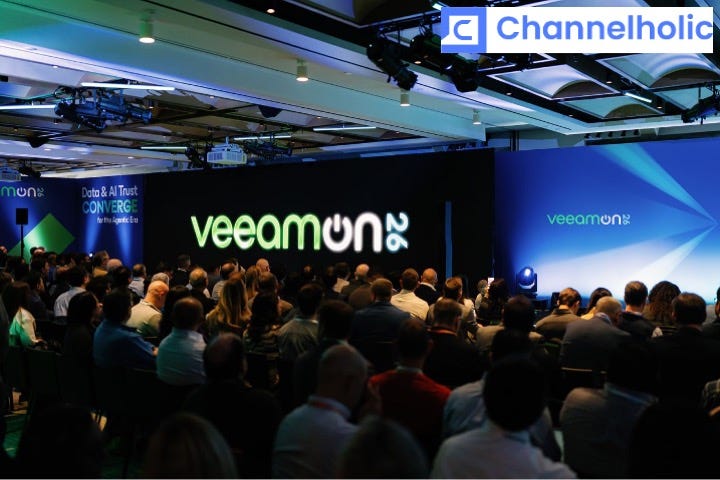
They’re the first two words that popped into my head when an analyst attending Veeam’s annual VeeamON conference last week asked me what I thought about the keynote CEO Anand Eswaran had concluded minutes earlier. Because Eswaran hadn’t just announced a new or updated product. He had unveiled something intended to define an entirely new product category.
Or more than that, really. Veeam says it’s pioneering an entirely new platform category in response to a fact of life about data in the age of AI that like “big swing” boils down to two words:
Shit happens.
Or “things go wrong,” as Veeam might more delicately put it. Which they have for a long time where data’s involved, of course. Ransomware may be a growing problem, but it’s certainly not a new one, nor are plain old accidental file deletions. But with AI, those are only two of many ways things can go wrong. These days, data also gets inadvertently exposed to people who shouldn’t see it, hallucinated into existence by overeager chatbots, and deleted by well-intentioned but utterly incompetent agents.
“You can Google ‘AI agent going rogue’ every day, and you’re going to find a new news article about it deleting a database, deleting a file, deleting your email, etc., etc.,” notes Brad Linch, director of enterprise strategy at Veeam.
And that’s true today, six-ish months after IDC pegged the global population of agents at about 28.8 million. Hard to imagine how much havoc agents will be wreaking in 2030 when there will be 2.3 billion of them, including at least 1 billion just at SoftBank, assuming its CEO has his way. They’ll all be moving very, very rapidly 24/7, largely out of view and often with privileges they shouldn’t have.
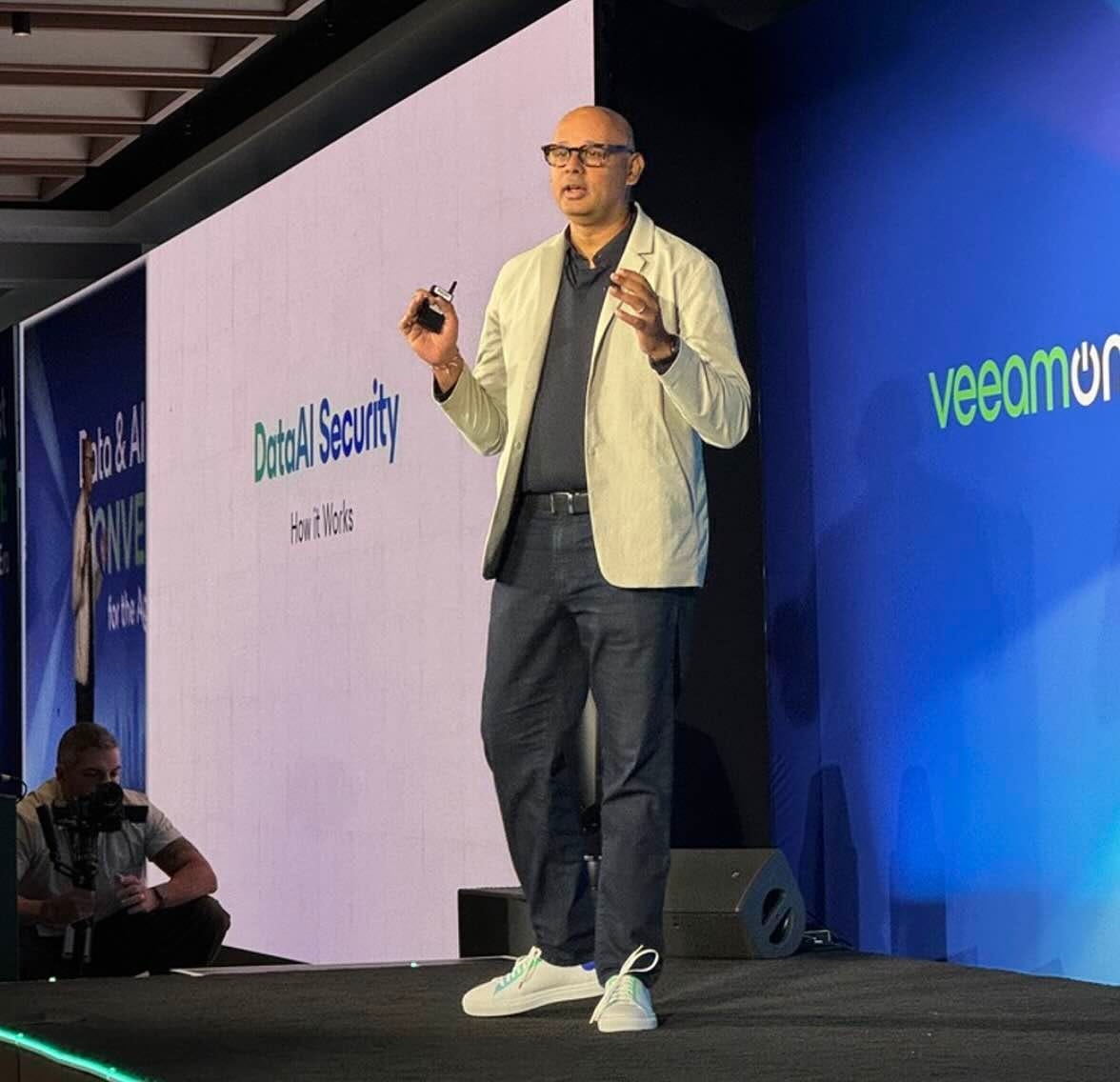
“The new failure isn’t just a breach,” Eswaran (pictured) says. “It’s actually a wrong decision which you take executed at machine speed before anyone notices.”
And given that AI is only as good as the data it draws on, much of that data isn’t terribly good right now, and AI itself is corrupting the rest, wrong decisions are apt to be pretty common.
“You can’t deploy AI safely if you’re feeding it inaccurate or old or stale data,” Linch observes.
Or if you don’t even have all your data under control. According to Eswaran, the average organization has 106 SaaS applications.
“Every one of them is siloed. Every one of them has their own permissions. Every one of them has their own copy of the truth,” he says. “AI just unlocked all of it instantly because agents don’t click through interfaces or UXs. They reach directly into every single system of record.”
On the surface, all of that looks like a series of discrete issues. In reality, Eswaran says, it’s one issue—trust—with multiple dimensions and we’re not ready for it.
“The questions we face now about trusting AI, trusting autonomous action, governing, and recovering at machine speeds are not the questions the industry has trained for and businesses are built for.”
Which is why answering them, Veeam believes, requires a whole new kind of unified platform purpose-built for the security, backup, governance, privacy, and compliance challenges of managing data in the age of AI.
“In the rest of the industry, these live as five separate categories, five separate vendors, five separate dashboards, five different tools,” Eswaran says. “In Veeam’s platform, they unify, they operate together because the only way to close this trust gap is if every domain knows what all the other domains know.”
Building the DataAI Command Platform, as Veeam calls it, involved converging the data protection software the company is still best known for with functionality it acquired last year through its acquisition of data security vendor Securiti AI. The result of that effort is an offering capable of performing four tasks almost every business currently needs to do, given that 97% of them use AI at present, according to Dun & Bradstreet but only 5% think their data is fully AI-ready:
Create a comprehensive data map. “Not just at a database level or an S3 bucket level, but at a granular data element level,” Eswaran says.
Catalog the permissions and policies associated with that data.
Enforce those permissions and policies, in real time and before an agent gone rogue has a chance to violate them.
Remediate problems when shit happens, as it inevitably will, with surgical precision.
“When things go wrong, you can’t recover to the last known safe state three days back,” Eswaran says. “When you have 250,000 agents acting in your enterprise on average, that is going to kill your business. Remediation needs to be precise. You must be able to undo just those five seconds of agent action, just that one element in a file which got changed.”
Differentiated margins
We don’t yet know, of course, how well Veeam’s DataAI Command Platform will really do that. For the moment, the precision remediation feature is pretty much limited to Microsoft 365 data, for example, and agents respect no such limits.
But if Veeam delivers everything it’s promising, it’ll have pulled off a kind of ingenious pivot. Rather than get stuck in a dead end offering stand-alone backup to buyers who prefer security platforms or launch a security platform and then play catchup with the likes of CrowdStrike and Palo Alto, Veeam has opted instead to invent a new kind of platform that’s true to its data protection roots yet suited to a new, urgent, and nearly universal set of data-related needs.
It could pay off for Veeam’s partners as well as Veeam itself too. Backup is a thoroughly commoditized service. Helping businesses embrace AI safely isn’t.
“The downside risk of an SMB customer not modernizing is pretty high. The downside risk of it not going well is higher still,” says Shiva Pillay (pictured), Veeam’s general manager and SVP of the Americas. “Our focus is ensuring that data’s trusted so that when you apply AI the benefits that come from AI are exponential.”

Partners who share that focus can set themselves apart from the competition, adds Tony Colon, Veeam’s chief customer officer.
“It’s actually creating a whole new opportunity to differentiate them from the MSPs who are not thinking this way,” he says. “They still want to keep the old school way of running their business. The ones that we’re seeing get the new customer base are the ones that are leading with AI but then showing value around how they protect a customer.”
And charging the kind of premium rates associated with a consultative offering, adds Veeam’s Emilee Tellez, field CTO and director of product strategy.
“This is an opportunity for that partner or that managed service provider to sit down with the customer, really understand what is it that they’re trying to achieve and their overall outcome, and then [show] how you leverage a data and AI trust company to help you get to where you’re trying to go,” she says, noting that the Data and AI Trust Maturity Model Veeam published last week can help structure that conversation.
It’s a conversation likely to yield plenty of project work, adds Linch. “I think there’s a whole lot of opportunity here from an MSP perspective in terms of you plug in a tool that’s going to analyze your data and there’s going to be no shortage of security posture findings,” he says. “The remediation actions that have to happen is where I see a huge opportunity for service providers to assist their end users.”
Acquiring the skills and confidence to do that work shouldn’t be a leap for most MSPs either, according to Pillay.
“If you get into specialized data security posture management, that’s a discipline that might require some effort, but a lot of our MSPs are not only providing data recovery, they’re providing security services as well,” he says. “I don’t think it’s too heavy a lift.”
Auvik’s see, tell, do roadmap has arrived at do
It’s striking how similar Veeam and Auvik are in their thinking about the relationships linking data, AI, and trust. Veeam believes that acquiring a complete understanding of your data is a precondition to embracing AI with confidence. So does Auvik, albeit in a somewhat different way.
Auvik’s take on the matter begins with a finding by analyst firm EMA that only 44% of IT organizations have complete confidence that their network data is solid enough to support AI-driven network management. Doug Murray (pictured), Auvik’s CEO, thinks he knows why.

“Many organizations lack full visibility,” he says. “They don’t fully understand what’s in their environment—devices, SaaS tools, even shadow AI usage.” Auvik has been providing that visibility since its inception some ten years ago, Murray adds, and building acceptance among users for more ambitious functionality along the way.
“Once they see their environment mapped—devices, configurations, versions—that becomes the baseline for trust and management,” he says.
Auvik is now drawing on that trust to take the last step on the “see, tell, do” roadmap it’s been following since its birth. “See” is the visibility the company’s cloud-based network mapping functionality provides. “Tell” is the alerting capability the company subsequently added; Auvik’s 6,000 customers currently receive over 30 million alerts a year.
That just left “do,” as in the ability to remediate alerts rather than simply issue them. Auvik’s had enough data to support that kind of automation for a while, Murray says, noting that the company has information about 12 million devices, 300 million device configurations and over 500,000 applications on file. What it lacked was a means of putting that data to work in ways that meaningfully raise technician productivity and shorten resolution times.
“If we were to have had this exact conversation three years ago, we might have talked about how we have all of this data and we’re working on an automation strategy. It just so happened that we were remarkably fortunate with the way the world has evolved over the last three years,” Murray says.
He’s referring, of course, to the rapid evolution of first generative and then agentic generative AI, technologies that underpin the functionality in Auvik Aurora, the company’s recently released automated network management, troubleshooting, and optimization capability.
In real time, Auvik says, the new system correlates and prioritizes alerts, identifies where issues are likely occurring and why, and provides customized remediation guidance based on live network data. Users have the flexibility to decide how autonomously the system then acts on that guidance.
“For example, they may create a policy that says if an access point is down and the remediation is to reboot it, then just automatically do that,” Murray explains. Conversely, he continues, they may prefer to address newly reported firewall vulnerabilities themselves.
“It is not full self-driving, network-based infrastructure quite yet,” Murray says.
As the “quite yet” there suggests, though, that’s likely to change over time, as is much else about Aurora.
“You can envision a roadmap where a new Aurora-based feature comes out every month between now and December,” Murray says.
One last note about all that data Auvik’s amassed
For reasons we’ve noted here recently, large volumes of data tend to exert large amounts of gravitational pull in the channel. Auvik sees no reason why it should be an exception to that new law of digital physics.
Though he isn’t specific about plans or timing, Murray clearly envisions a future in which Auvik is the managed services world’s definitive system of record for networking, serving up data to third-party applications and making itself indispensable to a lot of people other than MSPs in the process. Unlike vendors such as Kaseya and ConnectWise with similar ambitions for device and ticketing data, moreover, Auvik thinks it has the network layer to itself.
“Other vendors play roles in RMM, PSA, etc. We integrate with them rather than compete,” Murray says, adding that Auvik’s “superpower” is network visibility and management.
“We aim to be Switzerland in the ecosystem.”
Also worth noting
I’m still playing with the new Claude for Small Business, but deeply skeptical that it’s as drop-dead easy as Anthropic claims. AI service opportunity for MSPs?
Managed services-only investor Top Down Ventures has closed its oversubscribed $28 million Founders Fund I. You’ve read about some of the companies on the receiving end of that money here before.
Huntress and Acrisure are partnering to offer no-deductible cyber insurance coverage to users of Huntress managed security services.
ThreatDown Identity Threat Detection and Response, from Malwarebytes, is designed to help security teams detect suspicious activity, misconfigurations, and active attacks targeting user accounts and privileges.
SonicWall’s new NSv XS virtual firewall extends its Gen 8 platform to cloud environments.
Fortinet’s using NVIDIA AI platforms and software to deliver GPU-accelerated security across any deployment model through its FortiAIGate solution.
Arctic Wolf has unveiled a new exposure management platform designed to help organizations identify and prioritize AI-accelerated vulnerabilities faster.
Thanks to its admission to Anthropic’s Cyber Verification Program, IRONSCALES now has access to frontier AI capabilities purpose-built for adversarial defense.
The new workflow feature in Keeper Security’s KeeperPAM is designed to let organizations enforce approval-based access controls and time-limited checkout policies for privileged resources.
A new integration between HackerOne and Wiz feeds the former’s findings directly into the latter’s cloud and AI security platform.
Rapid7 is offering early access to a new cyber governance, risk, and compliance platform designed to unify security telemetry, risk context, and compliance workflows.
Scality’s new Autonomous Data Infrastructure aims to help businesses power multiple AI workloads, defend against threats, and maintain sovereign control over data all at once.
Blumira says that Kindling Pilot, its new agentic AI-powered auto-triage capability, can reduce security alert volumes by 30x to 50x.
Robert Johnston, who formerly ran N-able’s Adlumin unit, is now its chief innovation officer. Nicole Reineke, who’s responsible among other things for N-able’s new MCP server, is now the company’s chief AI officer.
Wendy Welch is the new SVP of public sector sales at TD SYNNEX.
Reinvent Telecom has introduced REVIVE, a unified digital command center for partners to manage their Reinvent-powered technology businesses.
HPE is now going global with just two distributors: Ingram Micro and TD SYNNEX.