



I cast myself as the Grinch in a recent post, but you can make the argument that the real Grinch this holiday season is AI.
I mean, I’m not the one driving electricity prices so high that the only Griswold holiday house most Americans can afford these days fits on a countertop. Nor am I responsible for driving up the price of everyone’s favorite holiday gifts by commandeering a huge hunk of global DRAM output.
Those (semi-)facetious complaints aren’t the biggest ones on people’s minds, either. A lot of folks blame AI for things like the higher unemployment recent college graduates are experiencing relative to workers overall, and there’s at least some evidence they’re right: Employment’s down 16% for “early-career” workers in “AI-exposed” fields like software development and customer service relative to more experienced peers in the same roles, according to researchers at Stanford.
Is it any wonder, then, that next to the much-feared AI bubble, the AI backlash might just be the biggest AI-related story of 2025? Indeed, research by CNBC last summer found that 68% of Americans are “uncomfortable with AI,” while a Pew Research Center study published two months ago suggested the U.S. is a global leader in being more concerned than excited about the technology.
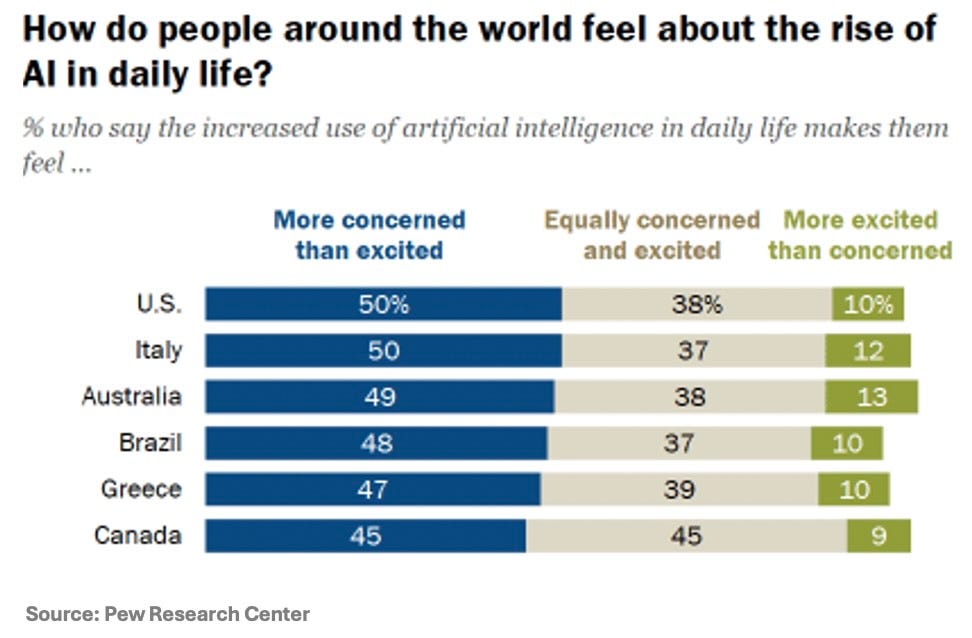
The thing of it is, though, some Americans are if not excited about AI then at least optimistic about it. Roughly 93% of corporate leaders and 80% of investors believe AI will have a net positive impact on society, according to non-profit Just Capital, while 68% of CEOs plan to increase AI spending next year, according to advisory firm Teneo.
Which raises an interesting question: What happens when MSPs, following advice from me and many others, start talking clients into deploying AI business solutions that yield disappointing results because AI-wary employees resist using them?
It’s not a theoretical question, either. I asked three of the most AI-savvy MSPs I know if they’re seeing this kind of thing, and all three said yes.
Sometimes, anyway. “I notice it most when people are trying to come up with a problem to solve to implement the technology, instead of implementing the technology to solve a problem,” says Jake Van Buschbach, CEO and president of Burnaby, B.C.-based Umbrella I.T. Services. “I have experienced almost no pushback at all when it is being used to deliver reports, automate mundane tasks, create resources, and other back-end tasks.”
Plenty of people are using AI at work in the shadows, moreover. Indeed, 81% of workers and an astonishing 88% of security professionals use unauthorized AI tools on the job at present, according to cyber risk management vendor UpGuard. So the real issue probably isn’t resentment of AI generally among rank-and-file employees so much as wariness of unfamiliar AI solutions forced upon them by management.
Which points the way to the techniques for overcoming resistance that my trio of contacts are having success with so far, all of which hinge on cultivating trust.
“The key to overcoming resistance is deliberate adoption pacing. Start small, celebrate quick wins, and build confidence,” says Brian Weiss (pictured), CEO and chief AI officer of San Luis Obispo, Calif.-based ITECH Solutions. Weiss typically introduces users to AI via productivity-boosting capabilities baked into Microsoft 365, like intelligent meeting recaps and Copilot Chat, rather than big, disruptive workflow overhauls.

“These deliver immediate wins without massive complexity,” he says.
Dave Blake, general manager of the Seattle regional office at Convergence Networks, says that letting employees see AI produce results without being part of it has a similar effect.
“We find it’s best to focus an organization’s first steps into AI adoption on projects that don’t require employee involvement, such as automating a workflow or billing process,” he says. “Once some wins happen independent of adoption, there is something to point back to and it’s a bit easier to get buy-in on more employee-centric AI implementations going forward.”
Above all, Weiss urges, don’t oversell the technology. “We’re upfront about today’s limitations: AI still needs human oversight, and it won’t solve everything,” he says. “When we frame it this way, employees usually shift from skeptical to curious pretty fast.”