


It’s best to avoid generalizations as a rule, but I’d say it’s generally true nonetheless that taking on a challenge all by yourself is a bad idea for entrepreneurs, and the harder the challenge, the truer that is.
That’s worth keeping in mind if you provide IT services to SMBs, because according to Jerry Koutavas, CEO of MSP community The ASCII Group, the challenges you face at present adjusting to the rise of AI may be your toughest ever.
“It’s a significant pivot, something that’s more difficult than the transition from break-fix to being an MSP,” said Koutavas on the sidelines of last week’s ASCII Edge event near Seattle. Think about it, he continued.
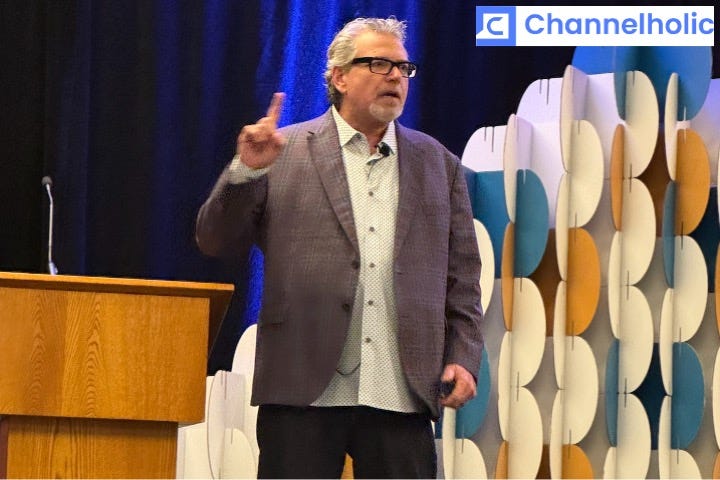
“When people moved from break-fix to becoming an MSP, it was in their economic interest to drive their customers to that model,” Koutavas (pictured above) notes. “It was a means for them to grow, smooth out cash flow, and service customers in a unique way.”
This transition is different. Your clients will profit from the AI services you provide them if you do your job right, but you might not.
“Everything is individualized,” Koutavas observes. “If I go into a particular client and they have interest in AI, it’s unique to them, it’s unique to their business, unique to their problems.” How’s an MSP supposed to scale an answer to something like that, especially given that any answer they arrive at this month could be obsolete next month. There was a time when prompt engineering services looked like a good money maker, for example.
“That’s dead in the water today,” Koutavas says. “The technology is shifting and changing so fast that it’s hard to stabilize on a strategy.”
And therefore hard to blame people who successfully made the change from break-fix to managed services and then from on-prem to SaaS for bowing out now rather than reinvent themselves yet again.
“There’s conversations taking place behind closed doors that we’re going to lose 20 to 30 percent of the MSPs that aren’t going to pivot, and it’s sort of startling to hear that from people that are in the industry as long as I have been and it’s a reality check,” said Koutavas during a keynote presentation.
A worrying one too, obviously. The more Koutavas thinks about it, however, the less worried he becomes.
“Sure, there’s going to be some MSPs that have reached a certain point in their business that they’re going to say, ‘OK, I’m going to retire and that’s all.’ But what’s great about this industry is that we learn from each other,” he says.
Great and defining. For as long as managed services as we know them have existed, which is to say over two decades now, MSPs have been freely sharing knowledge with actual or potential competitors. That’s easy to take for granted if you’ve spent as much time in the industry as I have, but it absolutely floored Manny Rivelo when he became CEO of ConnectWise.
“This is a unique community,” Rivelo said during a conference in London last year. “This is a community that helps each other drive success. You tell each other your best secrets and how to increase your profitability, how you drive your revenue.”
Good luck finding that in any other service industry. “MSPs can say, ‘I have a client that’s experiencing this. I’m thinking about that solution or this solution. What have you guys heard and what have you tried?’ You’ll get a dozen answers inside of ten minutes,” says Brad Gross, an attorney who serves MSPs, during an episode of the podcast I co-host. “That doesn’t exist for doctors. It doesn’t exist for lawyers or accountants.”
And it’s why Koutavas believes the MSP community will weather this latest, hardest transition successfully. “Members are going to teach members what they’ve done and how it impacted their business, and that’s going to be the catalyst to help our community move ahead,” he says.
It’s happening already, in fact. “The collaboration that’s taking place is a lot stronger than I’ve ever seen from a community perspective,” Koutavas says. “We just had a member meeting here, and we had a couple members talk about what they’re building internally for the organization and I’m absolutely blown away.”
The ASCII Group’s trying to facilitate more such exchanges through its AI Collective program.
“It’s a peer initiative,” Koutavas says. “We’re basically gathering members that have built specific tools around AI and allowing them to teach other members about those particular services.” The result, he adds, is classic community.
“Everyone moves forward.”