


Businesses are pretty excited about AI. So much so that their AI spending has doubled in the last year, according to Boston Consulting Group.
And it’s not just big businesses. Small and midsize ones appear to be excited about AI too, enough so that 71% of them worldwide are using AI at present, according to Pax8’s latest SMB AI Report.
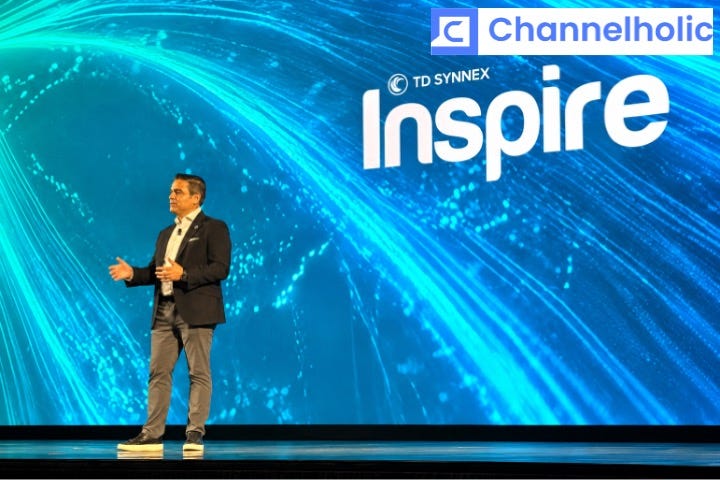
Indeed, pretty much everyone in the business world is excited about AI, as they always are initially for new technologies, observes Francisco Criado (pictured), TD SYNNEX’s SVP of security, cloud, and AI.
“Then they start getting the bills,” he says.
Which can be painful. Fully 57% of the U.S.-based SMBs Pax8 surveyed, in fact, have received an unexpectedly high AI bill in the past year, and 25% have received more than one. It’s a familiar problem, and not just to regular Channelholic readers. Veterans of the cloud explosion that preceded the current AI explosion know this nightmare all too well.
“AI has become the new unmanaged cloud spend, and I think we’ve all seen that movie before,” said Criado during an Inspire keynote. “Costs sprawled, nobody owned the bill, and we had to invent a whole new discipline to bring it under control. AI is doing that again, only faster.”
And in two separate places: the off-prem data centers that host frontier lab LLMs and the on-prem servers and even laptops that businesses increasingly use to host closed and open-source models locally. Businesses, it seems, no longer have a cloud FinOps problem or an AI FinOps problem. They have a FinOps problem, period, and need an answer to it everywhere they encounter usage-based pricing.
It’s a realization Criado and his team came to in May during partner meetings at TD SYNNEX’s High-Growth Conference that led just five months later during Inspire to the release of FinOps Fusion, a new service offering centralized visibility into cloud, AI, and local consumption spending.
“You get one view, one console where you get that entire estate,” Criado says.
Even if you bought the components of that estate from someone other than TD SYNNEX. “We can go into any environment and we can look at wherever that sits on premise or in the cloud,” Criado says. “There are no limits to it.”
At present, Fusion identifies rather than remediates overspending, but users get detailed recommendations on cost-cutting next steps like downsizing over-provisioned infrastructures, leveraging reserved instances, and replacing always-on environments with usage-based architectures.
Partners that neither can nor wish to manage that for clients themselves, moreover, can outsource the job to TD SYNNEX. According to Criado, they’ll reap customer retention and satisfaction rewards either way. AI spending is largely tied to token usage, he noted during his keynote.
“Whoever helps customers see, understand, and govern that usage helps them save money, unlock value, and scale AI responsibly. That opportunity belongs to you.”
It’s a revenue as well as stickiness opportunity, moreover. Users of TD SYNNEX’s pre-Fusion cloud FinOps service typically cut spending 15-30%, and Criado expects AI FinOps savings to be even higher. Converting some of that bounty into FinOps-as-a-service fees, he notes, is a good deal for everyone involved.
“That’s usually a pretty easy value proposition and most customers are going to say yes, because they’re going to save money regardless,” Criado says, adding that it can drive AI solution sales too.
“If you’re a line of business owner and you’re trying to convince your CFO and everybody to do an AI project, knowing that you have visibility and you’re not going to get surprises gives you a much better probability of getting your projects approved,” Criado says. It also helps you quantify what your customers are getting for all those tokens they’re consuming, he adds, which is the question everyone in IT needs to have answers for.
“Everybody likes the shiny new object and everybody gets really excited, but eventually we’re going to have to be able to show, as an industry, the ROI.”