


So, what’s new since my last post?
Well, for one thing, we learned there’s a “Frontier Suite” version of Microsoft 365 coming that features a “control plane for agents,” something you’ll almost certainly want just as soon as you figure out what it does. Perplexity, meanwhile, has unveiled an OpenClaw-esque agentic “digital proxy” that will happily run—or wreck, time will tell—large parts of your life for you. And a new study reveals that the average end user spends three hours and 50 minutes a week validating AI outputs that save them three hours and 38 minutes of labor.
Oh, and cyber warfare has knocked a medical device maker offline.
“It’s a complex time,” says Dan Wensley, CEO of the Global Technology Industry Association, aka GTIA.
And to be clear, that’s not necessarily a bad thing.
“The word complexity usually conjures something negative to people,” observes Carolyn April, GTIA’s vice president of research and market intelligence, during an episode of the podcast I co-host. Yes, she observes, complexity is hard.
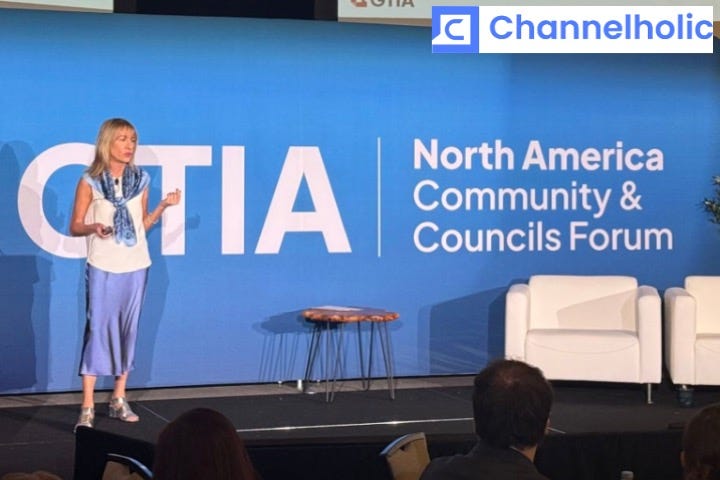
“But for those of us in any industry, really, where you are the experts, complexity can be your friend,” April (pictured above) says. “It generates demand for your expertise.”
Based on new data she presented during a keynote at GTIA’s annual Community & Councils Forum in Chicago last week, IT providers know it. Half of them pointed to increased demand for IT services in response to complexity when asked to identify factors contributing to channel health.
As it happens, the number two contributor on the list, cited by a far lower 37% of surveyed partners, turns out to be the number one source of complexity for those partners themselves.
“We’re in a period of time where the channel is trying to absorb a new pivot to AI,” April says. “During transitions like this, you often will be in a period where you are in between your old way of doing things, the new way of doing things, and figuring out how you’re going to bridge from one side to the other. And that’s the period of time that we’re in right now.”
It’s an interesting period too. As we’ll see momentarily, April’s biggest recommendation for navigating it is by her own admission decidedly not interesting. There’s reason to believe it’s wise advice just the same.
Plenty of evidence in April’s research makes clear that the AI pivot is far from over. Close to three and a half years into the genAI era, fully 98% of partners are using AI in some capacity at this point. Only 20%, however, are using it strategically in conjunction with rigorous policies, programmatic enablement, and a defined set of internal and customer-facing usage plans.
“Lots of us are experimenting and using AI in organizations. Very few of us have a formalized plan around it,” April says. As a result, while 71% of partners expect AI to be a growing source of revenue in the next two years, only 28% expect that growth to be significant.
In the next two years. This transition is going to take a little while, as transitions this profound usually do.
“Workforce level disruption is going to happen, competitive level disruption is going to happen, how you interact with the vendors and the other people in your ecosystem is going to be disrupted,” April notes. And don’t forget the constantly evolving tools and techniques you have to master to bring the power of AI to your customers.
“Technologists don’t just learn by osmosis,” April observes.
Which brings us to her wise, if uninteresting, piece of advice for everyone coping with all that change. “In this disruptive environment, operational soundness, as boring as that does sound, is really what’s going to matter most here,” April says.
None of what she has in mind is terribly sophisticated either. “We’re talking about being good at basic operational ways to run a business: finance, accounting, forecasting, understanding KPIs, good fundamental sales and marketing processes,” April notes. “It pays off.”
Specifically with respect to AI, moreover, and you can see it in the data. Let’s take it as a given that the most operationally sound businesses not only have concrete business goals for the year but are outperforming them thanks to disciplined execution. 24% of the partners in April’s survey fit that profile, and of those, 51% expect greater than 15% AI revenue growth through 2027. Just 18% of partners trailing their goals have the same expectation.
“People who are ahead of their business plan, who are working their operational models effectively, who’ve got their employees working too in a productive manner, those are the companies that are tending to do best right now with AI revenue,” April says.
And I’ve got to say, at this moment of continual disruption, it’s nice to know that you don’t have to reinvent, revolutionize, or digitally transform anything whatsoever to set yourself up today for AI success tomorrow. You just need to buy every Peter Drucker book you can get your hands on, read them cover to cover, and live by what you learn, because management matters most if you want to be a winner in the next new thing. Thus it is now, according to April, and thus it has always been.
“The companies that have good operational foundational practices tend to be the ones that are on that leading edge,” she says. “I see it over and over and over again.”
The AI alignment problem no one talks about involves partner programs
Here’s something else worth noting in GTIA’s data: Partners are less happy with their vendors than they used to be.
We’re talking relatively less, mind you. Happiness overall is pretty high. But the number of partners who describe themselves as satisfied with vendors dropped from 88% last year to 74% this year, and the portion who call themselves very satisfied plunged all the way from 39% to 18%.
Hard to know why, but April’s pretty sure it has less to do with anything vendors are doing wrong than it does with things they’re still relearning to do right.
“It’s about alignment and the changes that are going on in the marketplace today with AI,” she says. “The types of priorities that are important to [IT solution providers] and the things they want to see in a partner program, for instance, they’re different now.”
Before AI, she explains, partners valued margin points, volume discounts, and access to MDF. Now, just as they increasingly price services based on outcomes, they want to be rewarded based on outcomes too.
“Vendors are struggling a little bit to figure out what the best partner program looks like for the most partners that they’re able to reach,” April says. “It’s not as easy as saying, ‘we’re going to pay you X percent on the number of desktops you sell.’”
To be fair, part of why vendors are struggling with that challenge is because their partners are struggling to define new AI business models. “That’s going to change the interactions that they have with vendors and what the programs are going to look like to reward AI-based types of partners,” April says.
So moving targets on both sides of the relationship, which brings us back to where we began a short time ago.
“It’s just complex,” April observes. “This is an example of perhaps not so fun complexity for the channel.”
Over on The Business of Tech
Host Dave Sobel has some thoughts of his own about partner program alignment issues in the age of AI:
“The structural reality is this: partner programs are now the control plane for who gets margin, who gets leads, and who gets pulled into the ongoing operations annuity. The MSPs who treat ecosystem alignment as a procurement decision rather than a strategic positioning decision will find themselves doing the labor while someone else owns the customer relationship. That’s not a future risk. That’s already the mechanism in motion.”
GTIA brings the power of community to complex times
In addition to attending an industry association meeting last week, I also researched an MSP mental wellness program and the $70 million funding round announced by a very young BCDR vendor. Somewhat astonishingly, I hope to prove in the remainder of this post, all three activities are connected by the word community.
Which is just another word for most people, but a nearly sacred concept for MSPs. Just ask ConnectWise CEO Manny Rivelo, who was in London at the company’s IT Nation Connect Europe conference last week, and who marveled at the power of the MSP community during last year’s edition of the same event.
“This is a unique community,” he said. “This is a community that helps each other drive success. You tell each other your best secrets and how to increase your profitability, how you drive your revenue.”
MSPs need that secret-sharing now more than ever, according to Sean Lardo, ConnectWise’s vice president of IT Nation communities. “It’s always been important,” he says. “It’s extremely important now.”
Wensley (pictured) agrees.
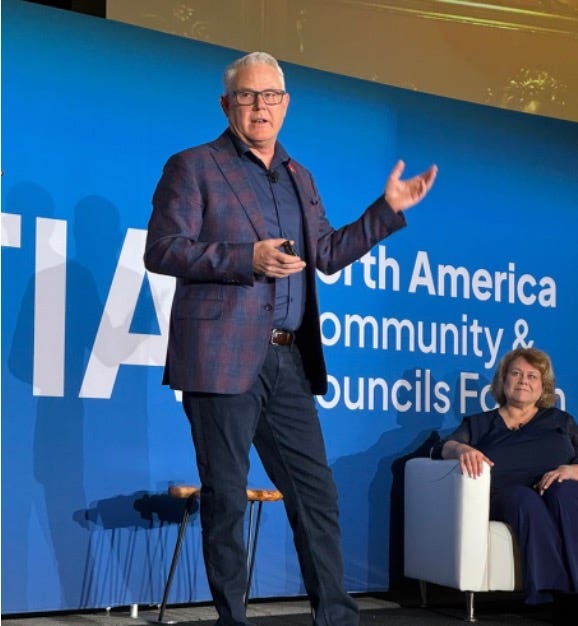
“With the evolution of AI, the pace of change is so incredibly enhanced and accelerated that having these conversations quickly is really a requirement,” he says. “There is no more important time to come together as a community and share best practices and share ideas.”
And no more important time to do that in a truly impartial way, he continues. Communities run by companies like ConnectWise have for-profit objectives, as they should and must. What MSPs are starving for right now, however, are the kind of non-partisan insights provided by GTIA.
“We’re in a unique situation where we’re just bringing everybody together to have these conversations and aren’t beholden to any particular software or advancement where the market is,” Wensley says.
Slide’s liftoff is as much about culture as tech
The thing about communities like GTIA is that the members have a pretty good idea of who’s there to give and who’s there mostly to take. The same goes for the MSP community more broadly in relation to vendors. People can tell who means it when they say they’re committed to partner success and who says it because it sounds good. They reward vendors in the former camp with their business and loyalty.
The latest evidence came our way last week courtesy of Slide, the BCDR startup founded by Datto veterans Austin McChord and Michael Fass, which you’ve read about here a few times since its first product reached market last February. The company made headlines last week in conjunction with a $70 million Series B funding round and the revelation that its nearly 1,000 MSP partners have sold roughly 4,000 devices in about 13 months.
Slide’s leadership is very proud of those devices, but they’re also quick to describe them as part of a larger, culture-level commitment to MSPs at the company.
“We spent almost two years in the lab building the tech that is delivered through Slide,” Fass (pictured) says. “That’s not because we were curious. It’s because we’re passionate. It’s because we care about MSPs, we are MSP focused, and we bring every ounce of passion that we can to the project.”

There’s no way to know for sure, of course, but I’d wager heavily that the degree to which MSPs feel that passion, in and beyond Slide’s products, has a lot to do with how Slide attracted 1,000 partners—a milestone that MSP favorite NinjaOne needed 18 months to reach—in a touch over a year.
Fass points to several ways MSPs can see Slide’s “deeply empathetic” approach to MSPs in action, including its month-to-month pricing (something MSPs love and few vendors offer) and its refusal to sell direct to end users, even when (as actually happened not long ago) one of them tries to place a 250-appliance order.
“Regardless of the deal size, what was important to us was holding to that core value,” says Carlson Choi, Slide’s COO. “Even if we lost the bid, right? It’s the right thing to do for the channel.”
Interestingly enough, VC fund General Catalyst, which led Slide’s Series B, specifically called out the company’s commitment to doing right by the channel as a reason for its willingness to invest in the company.
“Michael, Austin and the team understand the MSP community at a foundational level and are rebuilding a critical category with modern architecture and long-term conviction,” said General Catalyst partner Mark Crane in the press release announcing the funding round.
Fass calls the scale of that round a sign that despite turmoil, trouble, and uncertainty in various corners of private capital, investors remain bullish on managed services.
“The investor community is seeing that there is a massive untapped market for great technology delivered by MSPs through MSPs to tens of thousands of small to medium-sized businesses across the globe,” he says. “We are, in some ways, a good proxy for that.”
Wait, what about platformization?
Humility is an admirable trait in my opinion, so let me display a little here. I’ve made the case before that MSPs prefer platforms to point solutions, so much so that it’s a rough time right now to be a maker of stand-alone anything, and especially stand-alone data protection.
Unless, apparently, you’re Slide, which is and intends to remain 100% focused on backup.
“Our commitment is to build an MSP technology company focused on backup solutions,” Fass says.
Though not exactly stand-alone backup. “Our mandate is to backup data wherever it lives,” Fass says. “We’ve got a big horizon of solutions that we’ll be coming down the pike with over time.”
Sounds like a data protection platform along the lines of what Veeam’s building. Is it? If so, then maybe Slide will turn out to be less the exception that proves the platformization rule than simply yet another example of the platformization rule in action.
MSP Well offers a helping hand out of the IT pressure cooker
The examples of community we’ve discussed to this point have basically been B2B. I’ll close this week by discussing an arguably even better manifestation of the MSP channel’s spirit of community that’s P2P, as in person-to-person.
I’m referring to a recently launched non-profit community called MSP Well dedicated to connecting MSPs and others in the managed services ecosystem to mental health resources.
And really, could there be an ecosystem more in need of something like this? Running a managed services practice is a relentlessly-paced pressure cooker of a job held by people who spend their days, nights, and weekends taking care of clients, employees, spouses, and children—everyone, in fact, but themselves.
“If you don’t take care of yourself, how are you going to take care of others?” asks Larry Meador (pictured), channel chief at data security posture management/attack surface management vendor Cavelo, who now moonlights as MSP Well’s executive advisor for strategy and communities. It’s a seemingly obvious question that MSPs, like many others, try hard to avoid.

“Talking about mental health and admitting that you yourself perhaps have a challenge is one of those things that especially men don’t want to admit,” Meador says. “Traditionally it’s seen as a sign of weakness, so people don’t want to talk about it.”
Until recently, those people included Cavelo CEO James Mignacca, who was trying as so many of us do to muscle his way through stress and depression all alone.
“He just happened to open up to me one day at a conference, and I just sat there and listened,” Meador says. “A few weeks later, he was like, ‘You know what? That was the best thing that could have ever happened. I just needed someone to listen to me and just tell me I’m not crazy.’”
A few months after that he broached the possibility of helping others in the industry experience the same relief. “I said, ‘I think it’d be a fantastic thing,’” Meador recalls.
So did Joe Ussia, CEO of Canadian MSP Infinite IT, who quickly signed on to co-found MSP Well alongside Mignacca. An extensive set of advisors soon volunteered to help as well. Their mission is to connect members in need to information, advice, and peers.
“Every single one of us has something going on,” Meador says. “All we want to do is facilitate a place for them to go and get the help that they perhaps haven’t sought out before.”
It does that free of charge, he adds, noting that the organization is self-funded by its founders and advisors for now. Mignacca and Ussia hope to get financial support from vendors and other sponsors in the future, and Meador’s optimistic they’ll succeed given the enthusiasm the initiative has inspired since its launch week before last.
“We knew that this would have legs out of the gate. We didn’t realize it would go sprinting out of the gate,” he says. “It’s gone viral.”
Which shouldn’t actually surprise anyone familiar with that strange, wonderful spirit of community I referred to before, and which animates MSPs and their vendors in ways that people in other professions would have trouble recognizing.
“We always talk about how unique this channel is, but I don’t think people really understand just how truly unique this channel is,” Meador says. “We’re all one big, happy, dysfunctional family.”
You’ve heard my take. What does Carolyn April think about GTIA’s latest research?
Find out on the new episode of MSP Chat, the podcast I co-host, which also features further thoughts from yours truly about the power of community, Slide’s Series B, and MSP Well. Tune in to that and earlier episodes right here.

Also worth noting
One last note from GTIA CCF: The association named the winners of its North America Spotlight Award there.
Clio—remember them from this recent story?—has launched Clio Operate to give large and midsize law firms a unified system for managing complex legal workflows.
New features in Robin, the artist formerly known as Atera Autopilot, include the ability to build custom AI workflows with playbooks and the ability to instruct Robin to resolve tickets independently or escalate them based on configurable confidence levels.
AvePoint’s new AgentPulse Command Center is designed to provide governance, visibility, and security controls for AI agents across multicloud environments.
Salesforce’s new Agentforce for Contact Center is designed to assist service teams and automate customer support workflows agentically.
Like many others, OpenAI’s concerned about agentic security, enough in fact to have bought agentic security vendor Promptfoo.
The latest enhancements to Fortinet’s Security Operations platform include a unified SOC experience, agentic AI capabilities, and expanded endpoint protection.
Also from Fortinet, the newest version of FortiOS adds secure AI controls, AI-agent integration within its security fabric, and expanded SASE and SD-WAN capabilities.
Also also from Fortinet, the new version of its Engage Partner Program is designed to reward partners at the point of value rather than the point of sale alone. Smart.
Huntress has expanded its global partner program to encompass resellers as well as MSPs.
Businesses are scaling up usage of AI solutions way faster than security testing of AI solutions, according to HackerOne.
ESET’s new eCrime Reports are designed to give organizations strategic intelligence on cybercriminal groups and emerging attack trends.
In a move beyond password management, LastPass has introduced an IAM solution for SMBs named Secure Access Essentials.
Hackers are getting very interested in AI very quickly: Discussions of AI-related cybercrime on the dark web rose 1,500% between November and December of last year alone, according to Flashpoint.
According to HP, 57% of IT decision makers call print security a low priority even though 56% of SMBs experienced at least one print-related data loss in the past year.
It remains a challenging time to be a woman in security: 21% of them surveyed by ISC2 say their team is just 10% women or fewer, and 14% say there are no women on the team at all. Good reason to attend ISC2’s virtual Global 50x50 Women’s Summit conference on March 18th.
Also worth attending: Registration for The Channel Marketing Association’s 2026 Marketing Summit is now open.
The Q4 numbers that Ingram Micro reported a few weeks back are one way the company’s investment in its Xvantage platform is paying off. The two patents Xvantage won more recently are another.
TeamViewer’s new regional restricted access for U.S. customers allows organizations to limit remote connections to specific geographic regions for enhanced security.
ControlUp’s new Tap-to-App provides end-to-end visibility into login and application-launch experiences in healthcare environments via hardware running IGEL OS.
Action1’s vulnerability and patch management solution now integrates with Rapid7, Tenable, CrowdStrike, and Microsoft Defender.